AI Inventory
As organizations adopt AI across more business functions, maintaining visibility into AI systems becomes increasingly important. An AI inventory helps organizations track, manage, and govern their AI assets by providing a centralized view of the models, applications, and tools used throughout the business.
Maintaining an inventory reduces operational risk, speeds audits, and makes it possible to link technical signals to business impact. For leaders, it clarifies ownership and compliance exposure. For engineers, it shortens incident response and enables safer rollouts.
An AI inventory supports transparency, compliance, risk management, and effective AI governance.
What Is an AI Inventory?
An AI inventory is a centralized, searchable catalog of the AI systems and assets an organization uses, develops, or deploys. It records what AI assets exist, who owns them, where they are used, and the key information needed to assess risk, compliance, cost, and operational performance. As a result, the inventory serves as a single source of truth for AI governance, audits, incident response, and lifecycle management.
An AI inventory typically captures:
- What AI assets exist
- Who owns them
- Where they are deployed
- How they are used
- Which governance requirements apply
By maintaining an AI inventory, organizations gain the visibility needed to govern AI systems effectively throughout their lifecycle.
Why Is It Important to Maintain an AI Inventory?
You cannot govern what you cannot see. When an organization runs dozens or hundreds of AI systems across different teams, vendors, and products, not having a single, reliable record of them becomes a serious liability. AI inventory solves this by giving the business one place to answer the most basic governance questions: What AI do we have? Where is it running? Who owns it? And what risk does it carry?
Without that visibility, AI accumulates in the shadows. Teams adopt third-party tools, embed large language models into workflows, and spin up internal models faster than any central function can track. An AI inventory turns this sprawl into a managed asset base, and in doing so it underpins nearly every other AI governance activity an organization performs.
The value of an AI inventory becomes clearest when you consider what depends on it. Risk classification, regulatory reporting, incident response, and model oversight all rely on an accurate picture of which systems exist and how they connect. When that record is missing or out of date, every downstream control inherits the same blind spots.
A well-maintained inventory directly supports several core functions:
- Risk prioritization: Classifying systems by impact and sensitivity lets teams focus oversight where exposure is highest, rather than treating all models the same.
- Shadow AI reduction: Continuous discovery surfaces unsanctioned tools and undocumented integrations before they become a source of risk.
- Clear ownership: Assigning an accountable owner to each system closes the gaps that appear when responsibility is diffuse or undefined.
- Regulatory compliance: Frameworks such as the EU AI Act, ISO 42001, and the NIST AI Risk Management Framework all assume the organization can identify and document every system in scope.
Core Components of an AI Inventory
An effective AI inventory serves as a comprehensive governance framework that provides visibility into an organization’s entire AI ecosystem. To support governance, compliance, and day-to-day oversight, it has to capture enough structured detail about each system to answer who, what, where, and how risky.
In practice, a complete inventory is built from the following core components:
AI Systems Registry
The foundation of any AI inventory is a centralized registry of AI systems and applications. This component documents all AI assets used throughout the organization, including internally developed models, third-party AI tools, Generative AI applications, and Agentic AI systems. Each entry typically includes information about the system’s purpose, functionality, business owner, and deployment status.
Ownership and Accountability
Every system in the inventory should map to a named owner and a responsible team. This component closes the gaps that appear when responsibility is diffuse, ensuring there is always someone answerable for a model’s behavior, documentation, and lifecycle decisions. It is the practical foundation of AI accountability across the organization.
Risk Classification and Impact Assessment
Not every system carries the same level of risk. This component assigns each entry a risk tier based on its impact, the sensitivity of the data it handles, and its regulatory exposure. Clear classification lets teams concentrate oversight where it matters most and aligns the inventory with risk-based frameworks like the EU AI Act and the NIST AI Risk Management Framework.
Data Lineage and Dependencies
AI systems do not operate in isolation. This component tracks the datasets a model was trained on, the data sources it draws from in production, and the upstream and downstream systems it connects to. Capturing these dependencies is what makes root-cause analysis, impact assessment, and bias investigation possible when something goes wrong.
Lifecycle Status
Models are not static; they move through development, validation, production, and eventual retirement. Recording each system’s lifecycle stage keeps the inventory current and prevents deprecated or shadow models from lingering unmanaged. It also supports timely intervention when performance degrades through model drift.
Compliance and Governance Documentation
Finally, the inventory links each system to its supporting records: technical documentation, risk assessments, evaluation results, and audit logs. Keeping these artifacts attached to the inventory entry turns it into a ready-made audit trail and satisfies the record-keeping expectations of regulations and standards such as the EU AI Act and ISO 42001.
What Information Should an AI Inventory Capture?
An effective AI inventory should capture both technical and governance-related information about each AI system. While the specific fields may vary based on regulatory requirements and organizational needs, most inventories include information about system ownership, risk, data usage, lifecycle status, and compliance obligations.
| Inventory Element | Description | Example |
| System Name | Unique identifier for the AI system | Customer Risk Scoring Model |
| Business Purpose | Intended use of the system | Loan Approval Support |
| Owner | Responsible individual or team | Data Science Team |
| Model Type | AI technique or architecture used | LLM, ML Model, Agent |
| Risk Classification | Governance risk category | High Risk |
| Data Sources | Datasets used by the system | CRM and Transaction Data |
| Vendor Information | Third-party provider details | OpenAI |
| Deployment Status | Current lifecycle stage | Production |
| Compliance Requirements | Applicable regulations and policies | EU AI Act |
| Last Review Date | Most recent governance review | June 2026 |
Together, these fields give the organization a single, structured view of each AI system. The more consistently they are captured, the more the inventory can support downstream activities like risk prioritization, compliance reporting, and incident response.
Why Is an AI Inventory Important for Governance and Compliance?
An AI inventory is what makes governance enforceable and compliance provable. Regulations and standards assume an organization can identify, classify, and document every system it operates, and the inventory is the record that makes that possible. Without it, governance stays aspirational, and compliance can’t be demonstrated.
In practice, the inventory supports compliance by:
- Mapping systems to regulatory requirements — risk classification and documentation duties under frameworks like the EU AI Act, ISO 42001, and the NIST AI Risk Management Framework.
- Producing audit-ready evidence — linking each system to its documentation, risk assessments, and evaluation results for AI audits and reviews.
- Assigning clear accountability — tying every system to a named owner so oversight responsibilities are unambiguous.
- Sustaining continuous compliance — surfacing new and modified systems as they appear, so nothing falls out of scope.
Building and Maintaining an AI Inventory
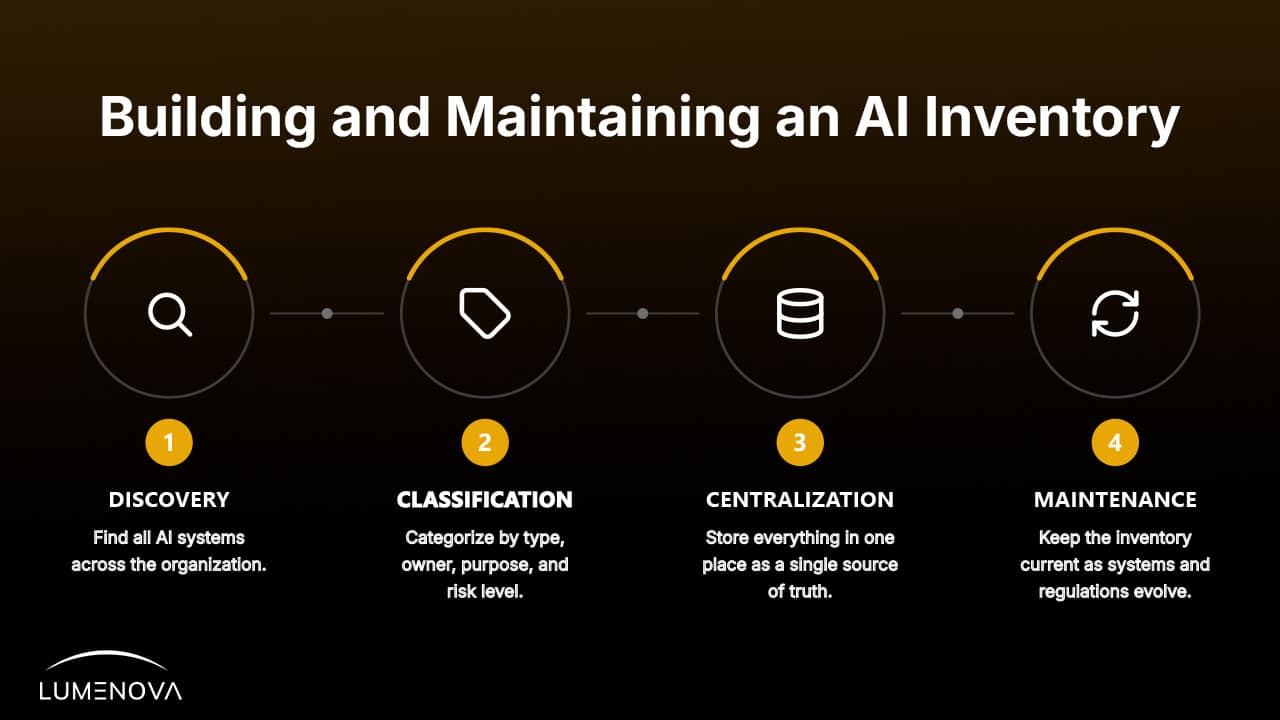
Building an AI inventory is not a one-time exercise. It is less about buying a tool and more about establishing a repeatable process. The goal is a single, trusted record that stays accurate as the organization’s use of AI grows and changes. In practice, most organizations follow four stages.
1. Discovery: Locating Every AI System
The first step is finding every AI system already in use. This means looking beyond the models the central team knows about and actively searching for shadow AI: unsanctioned tools, embedded vendor features, and forgotten legacy models. Discovery often combines automated scanning with input from teams across the business, since AI rarely lives in one place.
2. Classification: Categorizing by Type, Owner, and Risk
Once systems are found, each one needs to be described and categorized. Teams tag every entry with its type, owner, purpose, and risk level, turning a raw list into structured, usable records. Clear classification is what lets the organization later filter for high-risk systems, assign oversight, and report on its AI footprint with confidence.
3. Centralization: Building a Single Source of Truth
Next, all of this information has to live in one place. A single source of truth prevents the fragmentation that happens when different teams keep their own spreadsheets or tracking tools. Centralizing the inventory gives everyone, from engineers to compliance officers, the same accurate view and makes the record far easier to govern.
4. Continuous Maintenance: Keeping the Inventory Current
An inventory is only useful if it stays current. New models get deployed, existing ones are updated or retired, and regulations evolve, so the inventory must be kept in step with all of it. The most effective approach embeds updates into existing workflows, so that registering or changing a system becomes a routine part of how AI is built and deployed rather than a separate chore.
Challenges of Maintaining an AI Inventory
While establishing an AI inventory is an important step toward effective AI governance, maintaining it can be challenging as AI adoption expands across an organization. AI moves quickly, ownership is often unclear, and much of an organization’s AI now lives outside its direct control. Understanding these challenges is the first step to designing an inventory process that can withstand them.
1. Shadow AI and Sprawl
The biggest challenge is that AI is adopted faster than any central function can track it. Individual teams sign up for new tools, build quick proof-of-concept models, and integrate AI into their workflows without notifying governance or IT. Each of these decisions is reasonable on its own, but together they create a constant stream of unregistered systems that the inventory has to keep finding and absorbing.
2. Limited Visibility Into Third-Party and Embedded AI
A growing share of an organization’s AI is not built in-house at all. It arrives embedded inside vendor software, bundled into platforms teams already use, or accessed through external APIs. These systems are difficult to inventory because the organization often cannot see how they work, what data they use, or when they change, yet it remains accountable for the outcomes they produce.
3. Keeping Pace With Constant Change
An AI inventory describes a moving target. Models are retrained, fine-tuned, version-updated, and retired on an ongoing basis, and each change can alter a system’s behavior or risk profile. Without a way to capture these updates as they happen, even a thorough inventory drifts out of date quickly, leaving the organization to govern systems as they used to be rather than as they actually are.
4. Ownership and Accountability Gaps
Many systems end up with unclear or contested ownership, particularly after reorganizations or staff turnover. When the original creator of a model leaves, responsibility for it can quietly disappear, leaving an entry in the inventory that no one is actively managing. These orphaned systems are some of the riskiest, because no one is watching them for degradation, drift, or compliance issues.
5. The Pace of Generative AI Adoption
The rapid spread of generative AI has intensified every challenge above. Teams can now stand up LLM-powered assistants, agents, and integrations in days, often using a mix of internal and third-party components. This speed, combined with the complexity of these systems, makes them especially hard to capture completely and keep current within the inventory.
Despite these challenges, a well-maintained AI inventory remains one of the most effective tools for supporting AI governance, risk management, and regulatory compliance. Organizations that establish clear ownership, standardized processes, and automated inventory management practices are better positioned to maintain visibility and control over their growing AI ecosystems.
AI Inventory vs. Model Registry vs. Agent Registry
Because all three keep track of AI assets, an AI inventory, a model registry, and an agent registry are often confused, but they serve different purposes and audiences. A model registry is an engineering tool that manages the versions, artifacts, and deployment status of the machine learning models a team builds. An agent registry plays a similar operational role for agentic AI, cataloging the autonomous agents an organization deploys, along with their roles, capabilities, tool access, and status. An AI inventory is a governance record that captures every AI system the organization uses, including models, agents, and third-party or embedded AI, along with the ownership, risk, and compliance information needed to oversee them. In practice, the inventory sits above both registries, drawing on them as sources of record while adding the governance layer they lack. The table below breaks down the key differences.
| Feature | AI Inventory | Model Registry | Agent Registry |
| Primary Purpose | Provides a centralized record of AI systems, their risks, ownership, and governance information. | Manages machine learning models throughout development, testing, deployment, and versioning. | Catalogs the AI agents an organization deploys, including their roles, capabilities, and operational status. |
| Scope | Covers the entire AI ecosystem, including models, applications, datasets, vendors, and governance artifacts. | Focuses specifically on machine learning models and their lifecycle. | Focuses on autonomous and multi-agent systems, including the tools and permissions they rely on. |
| Primary Users | AI Governance Teams, Risk Managers, Compliance Officers, AI Product Managers, and Business Leaders. | Data Scientists, Machine Learning Engineers, and MLOps Teams. | Agent Developers, MLOps Teams, and AI Platform Engineers. |
| Governance Focus | High. Supports accountability, compliance, oversight, and risk management. | Limited. Primarily focused on model development and operational management. | Moderate. Supports oversight of agent behavior and autonomy but is not a complete governance record. |
| Ownership Tracking | Tracks business owners, technical owners, and accountable stakeholders. | Usually tracks model creators and maintainers. | Tracks the agent owners responsible for each agent’s operation and registry records. |
| Risk Classification | Includes risk assessments, impact evaluations, and regulatory classifications. | Typically does not include formal risk management information. | May flag autonomy levels and decision impact, but does not provide formal risk assessments. |
| Compliance Support | Stores documentation, approvals, audit records, and regulatory requirements. | May contain technical documentation but is not designed for compliance management. | Documents agent configurations and approvals but is not designed for compliance management. |
| Data Visibility | Documents data sources, lineage, dependencies, and usage. | Focuses on datasets used during model training and validation. | Focuses on the tools, data sources, and systems each agent can access and act on. |
| Lifecycle Coverage | Tracks AI systems from development through deployment, monitoring, and retirement. | Tracks model versions and deployment status throughout the ML lifecycle. | Tracks agents from registration through active operation to decommissioning. |
| Third-Party AI Tracking | Includes vendor-provided AI systems, foundation models, and external dependencies. | Typically limited to models managed within the organization’s ML environment (either built or bought). | Typically limited to agents deployed within the organization’s own environment (either built or bought). |
| Typical Questions Answered | What AI systems do we use, who owns them, and what risks do they present? | Which model version is deployed, and how has it performed over time? | Which agents are running, what can they do and access, and who owns them? |
Manage Your AI Inventory With Lumenova AI
A complete, continuously updated AI inventory is the foundation of responsible AI, and it’s where effective governance, risk management, and compliance begin. Lumenova AI helps organizations discover every system they operate, classify it by risk, and keep a single source of truth that stays audit-ready as their use of AI grows.
See how Lumenova can give you full visibility into your AI footprint. Book a demo with Lumenova AI today!
Frequently Asked Questions
Yes. Effective AI inventories are designed to connect with the tools an organization already uses, rather than acting as a standalone list. They commonly integrate with model registries, agent registries, and MLOps platforms, cloud environments, data catalogs, and procurement or ticketing systems, pulling in system details automatically and keeping the record current as those sources change. This integration is what allows the inventory to stay accurate without relying on manual updates.
Regulations like the EU AI Act require organizations to classify, document, and oversee their AI systems, none of which is possible without a complete record of what they operate. Standards such as ISO 42001 and the NIST AI Risk Management Framework take the same approach. So while few laws mandate an “AI inventory” explicitly, the obligations they impose effectively require one.
An AI inventory should be updated continuously as new AI systems are deployed, modified, or retired. Organizations should also conduct periodic reviews—typically quarterly or annually—to verify that inventory records remain accurate, complete, and aligned with governance and compliance requirements.
Responsibility for maintaining an AI inventory is typically shared across multiple stakeholders. AI governance teams often oversee the inventory, while system owners, data scientists, MLOps teams, compliance officers, and business leaders are responsible for keeping records accurate and up to date. Clear ownership and accountability are essential to ensure the inventory remains complete, current, and effective for governance and compliance purposes.
Yes. An AI inventory gives governance teams the complete, accurate picture they need to assign oversight, classify risk, enforce policy, and demonstrate accountability across every system. Without it, governance has no reliable record to act on. In practice, the inventory is the system of record that makes effective AI governance possible.
It makes risk visible and actionable. By classifying every system by impact, data sensitivity, and regulatory exposure, the inventory lets teams focus oversight where risk is highest instead of treating all systems alike. It also surfaces unmanaged or orphaned systems before they become incidents, and its lineage and dependency detail speeds up risk assessment when something goes wrong.