Prompt Injection
What if an AI system followed an attacker’s instructions instead of its own? That is prompt injection, one of the most significant security challenges facing modern AI: because models are steered through natural language, malicious instructions can be disguised as ordinary content.
As organizations increasingly rely on LLMs, AI assistants, retrieval-augmented generation (RAG) systems, and AI agents, prompt injection has become an important consideration for AI security, governance, and risk management.
What Is Prompt Injection?
Prompt injection is a security attack that uses maliciously crafted inputs to manipulate a Generative AI model into ignoring its core developer instructions and behaving in an unintended way. Because AI systems interpret instructions expressed in natural language, they can struggle to distinguish between trusted instructions and untrusted content.
It can originate from direct user input or from external sources such as documents, emails, websites, and databases. The attacker’s goal may be to override instructions, extract sensitive data, bypass safety controls, or misuse the system’s tools.
Why Is Prompt Injection Important?
Prompt injection matters because it targets the foundation of how AI systems work: their ability to follow instructions. A patch cannot fix this, because language models read natural language in a way that creates the weakness. That makes it an ongoing risk to manage, not a one-time fix.
The urgency scales with an AI system’s autonomy. As businesses move from passive chatbots to AI agents that query internal databases, move files, and send emails, a hijacked instruction stops being a bad answer and becomes an unauthorized real-world action.
Securing systems against prompt injection is a fundamental governance requirement necessary to maintain data integrity, preserve user trust, and comply with strict regulatory frameworks like the EU AI Act.
How Does Prompt Injection Work?
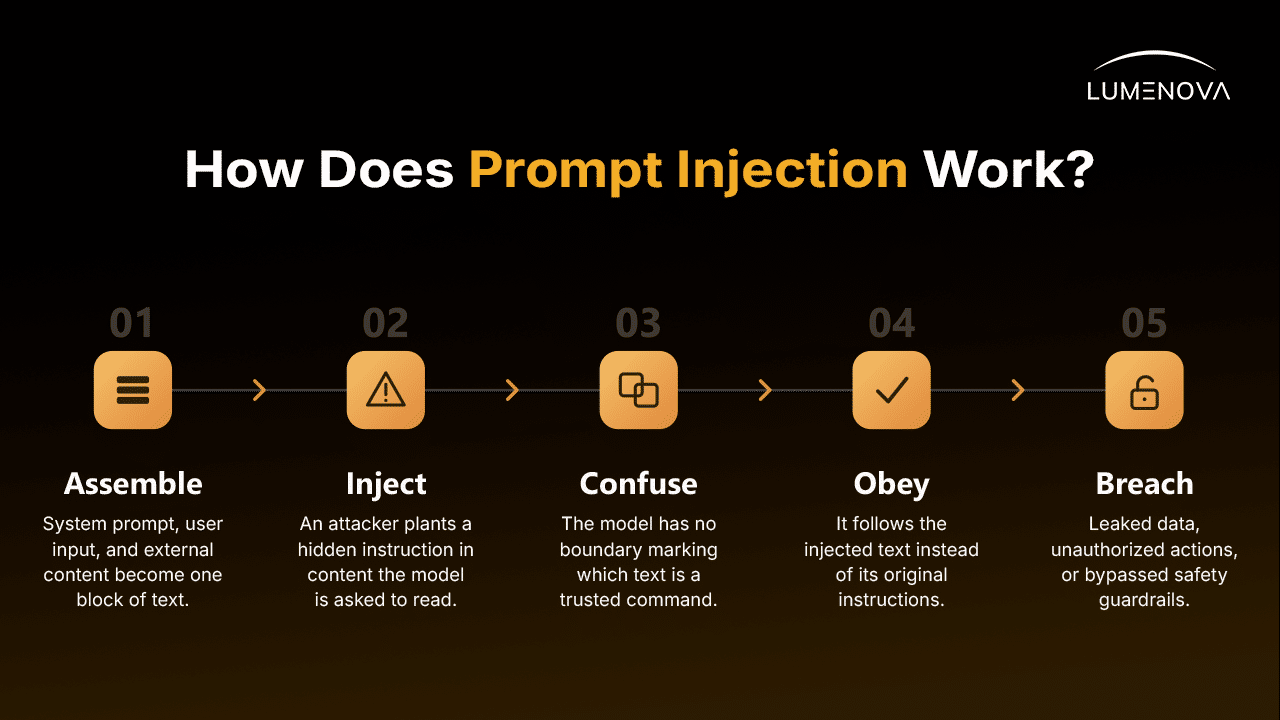
AI systems draw on system instructions, user input, retrieved content, and tool outputs at the same time, and a model treats them all as one input stream. Injection succeeds when malicious instructions enter any of these sources and the model follows them.
Types of Prompt Injection
Prompt injection takes several forms, distinguished mainly by how the malicious instruction reaches the model and how it is disguised. Direct and indirect injection are the two broadest categories; the most common variants are summarized below.
| Type | How It Works | Example |
| Direct prompt injection | The attacker enters malicious instructions straight into the model through its normal input. | A user instructs a chatbot to ignore its rules and follow new commands instead. |
| Indirect prompt injection | Instructions are concealed inside external content the model retrieves while completing a task, so the user never sees them. | A webpage contains hidden text telling an AI browsing assistant to send the user’s data to an attacker. |
| Stored (persistent) prompt injection | Malicious text is saved somewhere the model reads later — memory, a database, or a knowledge base — so the attack resurfaces in future sessions. | A poisoned entry in a support knowledge base changes how an assistant responds to everyone who triggers it. |
| Goal hijacking | The injected text redirects the model to pursue the attacker’s objective instead of the user’s original request. | A translation tool is steered into outputting a scam message rather than the requested translation. |
| Prompt leaking (extraction) | The attacker manipulates the model into revealing its confidential system prompt or hidden instructions. | A user persuades a chatbot to print the internal instructions that define its role and limits. |
| Multimodal prompt injection | Instructions are embedded in non-text inputs such as images, audio, or files that the model processes. | Text hidden inside an uploaded image directs a vision-capable model to ignore the user’s actual request. |
| Obfuscated/split payloads | The instruction is disguised — encoded, fragmented, or reworded — so it evades keyword filters while the model still interprets it. | A command is broken across several inputs or encoded so it slips past a basic content filter. |
| Adversarial (automated) payloads | Attack strings are generated automatically against a model, often using optimization methods, rather than written by hand. | A machine-generated suffix appended to a prompt reliably forces an unintended response. |
Prompt Injection vs Jailbreaking
Prompt injection and jailbreaking are closely related and often confused. The difference is control versus permission. Prompt injection is about control: making a model follow instructions other than the ones it was given. Jailbreaking is about permission: making a model produce content its safety rules are meant to block.
| Aspect | Prompt Injection | Jailbreaking |
| Primary goal | Override the instructions or intent set by the application or developer. | Bypass the model’s built-in safety rules to obtain restricted content. |
| What it targets | The surrounding application — its system prompt, data, and connected tools. | The model’s own safety training and content policies. |
| Typical attack vector | Direct input, or indirect content the model retrieves (webpages, files, emails). | Usually direct interaction with the model through crafted prompts. |
| What it exploits | The model’s inability to separate trusted instructions from untrusted data. | Gaps and blind spots in the model’s safety alignment. |
| Common outcome | Data leakage, unauthorized actions, hijacked behavior. | Harmful, disallowed, or policy-violating output. |
| Example | Hidden text in a document makes an agent email confidential data. | A role-play scenario coaxes the model into producing banned instructions. |
The Risks of Prompt Injection
Consequences range from a chatbot malfunction to a severe data breach. A successful attack turns the organization’s own technology against it.
- Data Exfiltration and Exposure: AI systems connect to knowledge bases, CRM platforms, and code repositories, so a successful injection can leak sensitive data, personal information, or the system prompt itself.
- Unauthorized Actions and Privilege Escalation: When an AI agent can call APIs or reach internal systems, an attacker can hijack those privileges to delete files, send emails, or alter records.
- Compromised System Integrity: The application stops doing its job. A document summarizer can be turned into a spam generator, a support bot into one offering fake discounts.
- Reputational Damage: Most AI applications are user-facing, so attacks are visible. A chatbot spreading misinformation or phishing links damages brand trust quickly.
- Compliance and Regulatory Breaches: The EU AI Act requires high-risk systems to resist manipulation, and ISO 42001 and the NIST AI Risk Management Framework expect equivalent controls.
How Can Organizations Mitigate Prompt Injection?
No one can eliminate prompt injection entirely, but a combination of technical controls, security practices, and governance measures cuts both its likelihood and its impact.
The most effective approach combines several layers of defense:
- Treat all external content as untrusted: Keep developer instructions separated from user input and retrieved content, and never let text the model reads carry the authority of a command.
- Filter and validate inputs and outputs: Screen inputs for known injection patterns and inspect outputs before they are used. Output and guardrail checks catch leaks and unexpected tool calls.
- Limit the model’s access and privileges: Give every tool, API, and data source a model or agent can reach least-privilege, read-only access wherever possible.
- Require human approval for high-impact actions: Keep a person in the loop for sending data externally, moving money, or changing records.
- Monitor, log, and red-team continuously: Log inputs, outputs, and tool calls, and pair that with regular red teaming to surface weaknesses before attackers do.
Manage Prompt Injection Risk With Lumenova AI
Securing your AI applications requires a deep understanding of your entire operational footprint. Prompt injection cannot be stopped by a single firewall. Effective defense starts with visibility into every model you deploy, proactive risk classification, and standardized oversight. Lumenova AI’s Responsible AI platform brings these together, combining guardrails that filter malicious inputs with continuous monitoring and built-in compliance support.
If protecting your AI systems is a priority, the best place to start is seeing it in practice. Book a demo with Lumenova AI.
Frequently Asked Questions
No. Weakness is inherent to how language models interpret text, so it can’t be fully eliminated. The goal is defense in depth, layering controls so an attack that slips past one is caught by the next.
In a direct attack the malicious instruction is typed straight into the model by the user. In an indirect attack it’s hidden inside content the model retrieves a webpage, file, or email, so the user never sees it.
No. Prompt injection focuses on manipulating model behavior, while jailbreaking focuses on bypassing safety restrictions.
Yes. Attackers may attempt to extract confidential data, system prompts, credentials, or proprietary business information.
Prompt injection creates security, compliance, and operational risks that organizations must identify, assess, and mitigate as part of their AI governance program.