September 1, 2026
A Strategic Guide to the Agentic AI Audit
Contents
Key Takeaways
- Traditional software compliance assumes fixed behavior. Agents change behavior without any code change.
- Manual review fails at scale, becoming either a bottleneck or a rubber stamp. Both look identical in the audit record.
- An agentic AI audit examines the agent’s decisions, tools, and permissions, not just the model.
- Six areas define the audit scope: inventory, permissions, decision records, escalation, testing, and change management.
- Automated governance captures evidence while agents work, so one record serves the EU AI Act, the NIST AI RMF, and ISO/IEC 42001.
At present, agentic AI is not a virtuality anymore: in fact, it’s already running in production at banks and insurers. Agents triage claims, screen transactions, pull records from internal systems, and take actions that used to require a person to sign off. The compliance question arrives after deployment, usually when an auditor asks why an agent did something, and nobody can produce the answer.
Auditing an agent is a different job from auditing the software these organizations have certified for years. Traditional systems behave the same way on Tuesday as they did on Monday. An agent picks its own steps, calls tools in an unspecified order, and shifts behavior when an upstream model changes. The audit trail that satisfies a software review covers none of that.
Most teams cover the gap with manual review. A person checks the agent’s decisions, signs off, and moves on. That works at ten decisions a day. At ten thousand, it fails quietly, because the reviews keep getting signed.
What Is an AI Audit?
- An AI audit is a structured examination of an AI system’s design, behavior, and controls against a defined standard. For agentic systems, it extends beyond the model to the decisions the agent makes, the tools it can reach, and the evidence showing that each action stays within its authorized scope.
That last part separates an agentic audit from a model audit. Auditing artificial intelligence has traditionally meant auditing a model. For a credit scoring system, that means examining the training data, testing outputs against a fixed set of inputs, and documenting how the score is produced. One system, one job, one output to verify.
An agent works differently. Handling a single insurance claim, it might read the submission, query the policy database, request a missing document, and route the file for approval. Every step is a decision that depends on the step before. The same claim a week later can take a different path, because a database returned different data or the model was updated.
An audit that only examines the model misses that sequence. The model can behave exactly as validated while the agent produces an outcome no one authorized, because the failure sits in what the agent did with the output rather than in the output itself.
Why Traditional Software Compliance Doesn’t Transfer to Agentic Systems
Software compliance in the traditional sense assumes the system you certify is the system that runs. Code is fixed at release, so you test it against a defined set of cases, document the results, and the certification holds until the next release. Configuration drift and dependency updates complicate this, which is why change control exists, but the assumption holds.
Agentic systems break it. The code is still fixed, but the behavior it produces is not. An agent decides its own sequence of steps while it runs. It calls tools that return different data on different days. Its outputs can change without a line of code changing, just because, for instance, a vendor updated the model underneath it on a schedule the deploying organization does not control.
For a bank running agents in transaction monitoring or client onboarding, a passed test tells you what the system did once, not what it will do on the next run. The same gap is reshaping model risk management for agentic systems.
| Traditional software | Agentic AI system | |
| Behavior across runs | The same inputs produce the same outputs, every time | The same inputs can produce different paths and different outcomes |
| Scope of action | Fixed at release and defined in code | Determined at runtime by which tools the agent selects and what permissions it holds |
| What changes behavior | A new release, managed under change control | A model update, a different tool response, or a revised prompt |
| Audit evidence | Test results and documentation produced at release | Decision-level records captured while the agent runs |
The difference is what the evidence has to describe. Traditional compliance documents how the system was built. An agentic audit has to document a specific decision: what the agent saw, what it chose, and what it was permitted to do at that moment. That record only exists if something captured it while the decision was happening. Nothing reconstructs it afterward.
Why Human-in-the-Loop Oversight Breaks Down at Scale
Human review is the first control most organizations put on an agent, and for good reason. It is quick to implement, straightforward to explain to a regulator, and required outright for high-risk systems under Article 14 of the EU AI Act. A person sits between the agent and the outcome, checks the decision, and approves or rejects it.
The design works at pilot scale: one agent, a few dozen decisions a day, a reviewer with time to read each one. Then the deployment succeeds. Agents move into several workflows, decisions arrive in the thousands running concurrently, and the reviewer’s queue stops being something a person can work through. From there, the control fails in one of two directions.
- It becomes a bottleneck. Review is the slowest step in the process, so agent output waits for human capacity. The productivity case for deploying agents disappears, and teams start asking which decisions really need a reviewer, usually without a documented basis for the answer.
- It becomes a rubber stamp, which is more dangerous because it is invisible from outside. Approvals continue at a rate that makes real examination impossible, and the control still shows as operating. The evidence looks identical either way: a reviewer name, a timestamp, an approval.
Rejection pushes reviewers toward approval. A reviewer who rejects a decision cannot fix the agent at the point of review. Correcting it means changing prompts, permissions, or decision logic, which sends the work back to engineering and through testing again. One rejection can pause a workflow for days, and reviewers learn this quickly. The result is oversight that satisfies the requirement on paper and delivers less assurance as the deployment grows.
The Cost of Fragmented, Manual Processes
Fragmentation is rarely a decision anyone makes. It accumulates. One team logs agent activity in an observability tool, another keeps approvals in a ticketing system, a third documents risk assessments in a shared drive. Each record is reasonable on its own. What does not exist is the link between them: nothing connects a specific agent decision to the review that covered it or the risk assessment that authorized it.
The consequences show up in three places:
- Auditors find gaps in the record. Evidence exists, but it cannot be assembled into a coherent account of how a system was controlled. Teams spend weeks gathering documentation that should have been a query, and the gaps that remain become findings.
- Nobody can reconstruct why an agent acted. When someone challenges an agent’s decision months later, the organization has to show what the agent saw, which tools it called, and what it was authorized to do. If nobody captured that at the time, the team can only reconstruct an answer, and a reconstruction is not evidence.
- Regulatory review exposes the difference. A supervisor asking about an AI system will ask for the control framework and then test it against specific cases. Fragmented documentation survives the first question and fails the second.
Fragmentation is invisible while everything works. It becomes visible during an audit, an incident, or a supervisory examination, when the organization has the least time to fix it.
What an Agentic AI Audit Actually Examines – A Short Guide
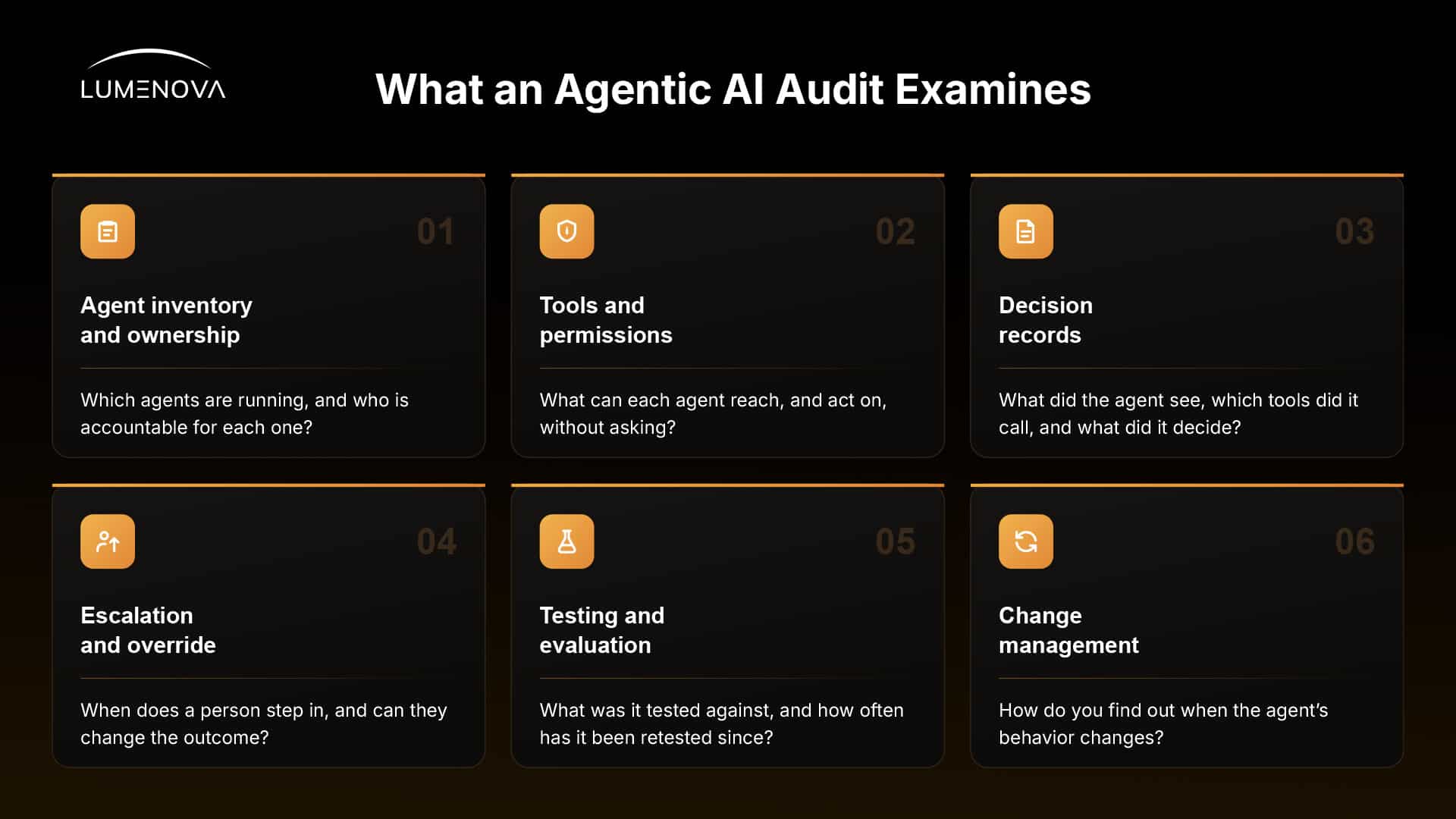
The scope of an agentic audit is wider than most teams expect, and knowing it is what makes the tooling decision straightforward. Six areas account for most of it.
Agent inventory and ownership
Which agents are running, what each one does, and who is accountable for it. Most organizations cannot answer this fully, because agents get deployed inside existing workflows without a separate approval step. When a team adds an agent to a claims process, they log it as an update to that process. It never gets recorded as a system in its own right, so it never enters the inventory.
Tools and permissions
What each agent can reach: which systems, which data, and which actions it can take without asking. It also changes quietly, because adding a tool to an existing agent rarely triggers the same review as deploying a new one.
Decision records
For any given action, what the agent saw, which tools it called, in what order, and what it decided. This is the evidence that answers the auditor’s question. It only exists if something captured it while the agent was working.
Escalation and override
An audit asks two questions here. What makes the agent stop and hand a decision to a person? And when that happens, can the reviewer actually change the outcome? If rejecting a decision means sending the agent back to engineering for a fix, the override exists on paper but is rarely used, and the audit record shows it.
Testing and evaluation
The audit asks what the agent was tested against before it went live, how often it gets retested, and what happens when it fails a test. A single test at release says little about behavior six months later, once the workflow around the agent has changed.
Change management
How the organization finds out when an agent’s behavior changes. This is the hardest one, because the change often comes from outside. A vendor updates the model, a tool starts returning different data, and nothing in the deployment triggers a review.
Fragmented processes fail across all six. Evidence for each one exists somewhere, but assembling it is manual work that has to be repeated every time someone asks.
Automated AI Governance
Automated AI governance captures the audit record while the agent works, instead of assembling it after someone asks for it. AI audit tools built for this, including Lumenova AI, provide pre-configured compliance modules: control frameworks, evidence requirements, and reporting formats already mapped to the standards an organization has to meet. Teams configure their agents against an existing structure instead of designing an audit approach from scratch. Three capabilities matter most.
- Automated governance workflows. Approvals, risk assessments, and sign-offs run through one system rather than across email, tickets, and shared drives. Each step is recorded as it happens, with the reviewer, the timestamp, and what was approved held against the agent it applies to. This addresses the inventory and ownership problem directly, because registering an agent becomes part of deploying it.
- Decision-level tracking. The platform records what the agent saw, which tools it called, and what it decided, at the time of the decision. When a decision is challenged months later, the answer is a query rather than an investigation. This is the capability the fragmented model cannot replicate, no matter how well individual teams document their work.
- Continuous behavior monitoring. Agent behavior is compared against expected patterns while the system runs, so drift surfaces as it develops rather than at the next scheduled review. This covers the change management gap: when a vendor updates a model or a tool starts returning different data, the shift in behavior is detected even though nothing in the deployment changed.
Together, these change what human reviewers spend their time on. Rather than checking every decision, reviewers handle the cases the system flags: decisions outside expected patterns, actions near the edge of an agent’s permissions, and escalations the agent raised itself. Oversight stays in place, as Article 14 requires, but applies to a volume a person can actually examine.
That last point is what makes the model work at scale, and it is worth stating plainly: automation does not remove the human from the loop. It decides which decisions reach them.
Mapping Your Agentic AI Audit to Global Standards
Most organizations are not preparing for one framework. A European insurer with US operations works against the EU AI Act, the NIST AI Risk Management Framework, and its own internal audit requirements at once. The controls overlap heavily, but the evidence formats do not, so teams produce the same record three times in three shapes.
EU AI Act – for high-risk systems, the Act requires risk management across the lifecycle, technical documentation, automatic logging of events, and human oversight. The logging requirement is the one agentic deployments most often fail, because it assumes a record exists of what the system did and when. An agent that produces no decision-level trace cannot satisfy it, regardless of how well the deployment is documented elsewhere.
NIST AI RMF – the framework is voluntary and organized around four functions: govern, map, measure, and manage. Its value for agentic systems is in measure and manage, which cover ongoing evaluation and response rather than one-time assessment. Organizations using it as their internal structure need continuous evidence, not a point-in-time review.
ISO/IEC 42001 – the certification path for an AI management system. Certification requires demonstrating that governance processes operate consistently, which auditors test by sampling specific cases. Organizations pursuing it need retrievable records rather than assembled ones.
For financial entities in the EU, Digital Operational Resilience Act (DORA) adds requirements around ICT risk and third-party dependencies that apply to agents relying on external model providers.
Platforms like Lumenova AI map controls to these frameworks directly, so a single captured record satisfies multiple reporting requirements. Evidence is collected once and formatted per framework, instead of each obligation running as a separate exercise. An AI governance assessment is a practical way to see which of these frameworks your current controls already cover.
From Ad-Hoc to Centralized: The Workflow Shift
The clearest test is what happens when someone asks for evidence. In a fragmented setup, that request starts a project: collect logs from one system, approvals from another, risk documentation from a shared drive, then work out how they connect. In a centralized workflow, it is a query.
Governance also moves earlier. Ad-hoc review puts the compliance check at the end, after the agent is built. Centralized workflow moves registration and risk assessment into deployment, so an agent cannot reach production without an owner, a risk tier, and a defined oversight level.
Ownership becomes explicit, which is often the hardest part. A centralized workflow requires a named owner for each agent before it deploys. That is a simple field to fill in and a difficult conversation to have, because it makes visible what was previously assumed.
Where to Start With Agentic AI Governance
Most organizations discover the gap in the wrong order. Agents go into production, they scale, and the audit question arrives once reconstructing the deployment’s history is no longer practical.
The work to avoid that is not complicated, but it has to happen before the volume builds. Know which agents are running and who owns them. Capture decision records as agents work. Set oversight by risk tier, so reviewers see the cases that need judgment. Map evidence to the frameworks you already report against, so one record serves several obligations.
Organizations that put this in place early are the ones that scale agent deployments without pausing for compliance. The rest scale first and pay for it during the next examination.
If you want to see where your current agent deployments stand, Lumenova AI’s risk assessments map your systems against the controls an agentic audit will test.
Frequently Asked Questions
A model audit validates fixed inputs and outputs. An agent selects its own steps, calls tools in an order nobody specified, and can change behavior when an upstream model updates. The audit has to cover the sequence of decisions, not just the model’s output.
No. Human oversight is required under Article 14 of the EU AI Act, but manual review of every decision fails at scale, becoming either a bottleneck or a rubber stamp. Automated governance captures the evidence and routes only the cases that need human judgment to a reviewer.
Auditing an AI system means examining its design, behavior, and controls against a defined standard. For agentic systems, that covers six areas: agent inventory and ownership, tools and permissions, decision records, escalation and override, testing and evaluation, and change management.
AI audit tools capture governance evidence automatically as AI systems operate. They register agents and owners, record decision-level activity at the time each decision is made, monitor behavior for drift, and map the resulting records to frameworks such as the EU AI Act, the NIST AI RMF, and ISO/IEC 42001.