June 16, 2026
Why Retrofitting Agentic AI Guardrails Costs More Than Building Them
Contents
Only 1 in 5 enterprises has a mature governance model for autonomous AI agents. The bill for skipping it upfront is not a risk you are managing. It is a certainty you are deferring.
There is a conversation happening in boardrooms and strategy sessions right now, and it usually goes one of two ways. In the first version, governance is treated as a constraint on speed. Deploying agentic AI quickly feels like the smart competitive move, and guardrails feel like something you add once the system is proven. In the second version, governance is treated as the architectural foundation that replaces speed for the sake of it with a sustainable development pace. The organizations in the second camp are pulling ahead, and the reason comes down to something more fundamental than strategy or risk tolerance. It comes down to a misunderstanding of what guardrails actually are in an agentic context.
According to Deloitte’s 2026 State of AI in the Enterprise report, which surveyed 3,235 senior leaders across 24 countries, only one in five companies has a mature governance model in place for autonomous AI agents. This is happening simultaneously with a rapid acceleration in agentic AI adoption across those same organizations. The majority are deploying systems they are not yet equipped to govern. And unlike most technology decisions where you can course-correct gradually, agentic AI has a structural property that makes late governance uniquely expensive: by the time you realize you need it, the system is already touching live data, live workflows, and live customers.
The Executive Architectural Model That Is No Longer Accurate
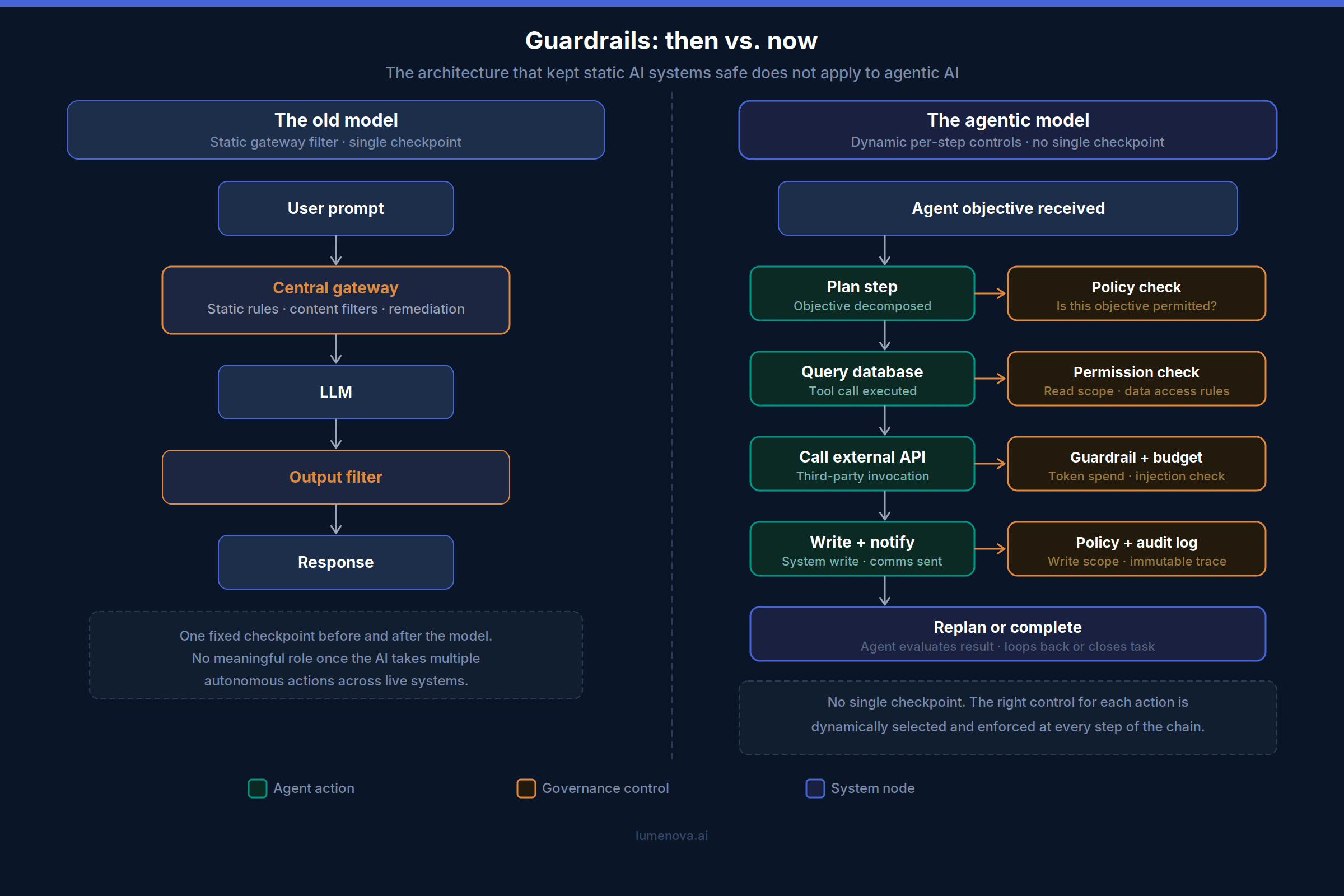
When most executives hear the word “guardrails,” they think of the first generation of LLM safety controls: static filters at the gateway layer, centralized content rules applied before a request reached the model, and simple remediation logic that flagged or blocked outputs based on predefined patterns. That architecture made sense for a world where AI systems received a prompt and returned a response. It does not apply to the world of agentic AI, and operating as if it does is one of the most consequential misconceptions in enterprise AI today.
An AI agent does not receive a prompt and return a response. It receives an objective and then autonomously plans, reasons, decides, acts, evaluates the result, and replans across multiple steps, multiple tools, and multiple external systems, all without a human in the loop for each decision. A single agent execution might involve a database query, a web search, a document read, an API call to an external service, a write operation, and a notification, all chained together in a sequence that the agent determines for itself. The gateway filter model has no meaningful role in this architecture. There is no single centralized point where a static rule can intercept what needs to be governed.
This is the distinction that changes everything about how governance must be designed for agents. Guardrails in an agentic system are not filters. They are dynamic, context-specific controls that must be executed automatically at every step of an agent’s call chain. This is not an add-on. It is a new architectural discipline, and it requires a fundamentally different approach to both the knowledge needed to implement it and the engineering investment required to do so correctly.
Guardrails and Policy Are Not the Same Thing
Before going further, it is worth clarifying a distinction that is often collapsed in practice: the difference between guardrails and policy. They are related, but they serve different functions and require different design thinking.
Guardrails are runtime safety controls. They intercept and constrain specific agent behaviors at execution time, such as preventing a data exfiltration action, blocking a write operation that exceeds the agent’s defined permissions, or halting an execution loop that has exceeded a token budget. They are deterministic, fast, and binary. They either allow or stop the action.
Policy is broader. Policy encompasses the organizational, regulatory, and best-practice rules that govern how AI systems should behave, what they are permitted to do across different contexts, and how exceptions should be handled. Policy may incorporate guardrails, but it also defines the intent behind them: why a particular control exists, which regulatory framework it maps to, how it should be documented, and what the response to a violation should be.
In the context of agentic AI, this distinction matters because you need both, and you need them to work together automatically. An agent taking a particular action needs the guardrail that stops it if the action crosses a boundary, and it needs the policy engine that determines which boundary applies in this specific context, for this specific agent, executing this specific call, on behalf of this specific user or process. That combination cannot be hardcoded. It has to be designed as a library of reusable, composable controls that can be assembled and executed dynamically at runtime, matched to the context of each agent action as it happens.
Building that library from scratch, maintaining it across a growing agent fleet, and integrating it into an existing agentic architecture is exactly the kind of work that organizations consistently underestimate when they decide to govern after deployment rather than during it.
Why Agentic AI Makes the Retrofit Problem Worse Than Before
Organizations that went through the first wave of traditional machine learning deployment are familiar with governance debt. A model ships, risks emerge, documentation gets added retroactively, and the process is painful but manageable. Agentic AI changes the economics of that cycle dramatically, and the reason is architectural.
Traditional AI systems are relatively static. A credit scoring model or a churn prediction model takes inputs, produces outputs, and stays contained. Its blast radius is bounded by design. Agentic AI systems are fundamentally different. They plan, reason, execute, and chain actions across multiple systems in real time, with the capability set of a mid-level employee and the speed of software. When you try to add governance controls retroactively to a system like this, you are not patching a feature. You are rearchitecting a live, multi-system, autonomous workflow while it continues to operate.
Soft controls added after deployment, such as output filters or prompt-level restrictions, are particularly unreliable in agentic architectures because the agent’s core capability works against them. An agent designed to use tools autonomously, retry on failure, and replan when blocked will route around passive constraints that were not built into its execution layer. Moving to deterministic, context-aware governance after the fact does not mean adding a layer to the system. It means replacing the part of the architecture that should have governed the agent’s decisions at every step and rebuilding it while the system is already in production.
The cost of that rebuild, across identity models, permission scopes, tool-level audit logging, and the control plane that orchestrates it all, is not additive. It is transformative, and it carries production risk throughout.
Four Categories of Cost That Compound When Governance Comes Last
1. Rearchitecture Cost
Governance instrumented during design is a development cost. It adds architectural discipline and becomes part of the system’s natural foundation. Governance retrofitted after deployment is a transformation program disguised as an upgrade. It requires rebuilding the identity models that establish which agent is acting, the permission scopes that define what that agent is authorized to do, the audit logging that captures every tool invocation and decision step, and the runtime control plane that enforces boundaries at execution time. All of this must happen while managing a live system simultaneously. The longer agents have been running without governance, the more surface area there is to retrofit, and the higher the likelihood that existing agent behavior must be fundamentally changed rather than simply instrumented.
2. Incident and Breach Cost
The financial exposure from unguarded agentic deployments is no longer theoretical. IBM’s 2025 Cost of a Data Breach Report found that organizations with high levels of shadow AI, meaning AI tools deployed without governance or oversight, faced average breach costs of $4.63 million, which was $670,000 above the global baseline. The same report found that 97% of organizations that experienced AI model or application breaches reported lacking proper AI access controls at the time of the incident.
Prompt injection, ranked by OWASP as the number one vulnerability in large language model deployments, is exponentially more dangerous in agentic architectures than in single-turn systems. A successful injection against a traditional model produces a bad output. A successful injection against an agent with access to email, databases, APIs, and file systems produces a cascade of authorized-but-attacker-directed actions that propagate through enterprise systems faster than any human review process can detect. Cisco’s 2026 State of AI Security report found that 83% of organizations plan to deploy agentic AI, but only 29% feel prepared to secure it. That 54-point gap is where incidents happen.
3. Regulatory and Compliance Cost
Agentic AI systems in production today are not operating in a regulatory vacuum. The EU AI Act’s full obligations for high-risk AI systems became enforceable in August 2026, covering AI used in employment, credit, education, and other consequential contexts. Fines for prohibited practices can reach €35 million or 7% of global annual turnover, whichever is higher. Organizations that deploy agents without proper classification, documentation, and oversight mechanisms may already have exposure, and remediation under regulatory scrutiny is significantly more expensive than prevention.
Compliance debt in agentic AI behaves differently from technical debt because it does not surface gradually. It materializes suddenly, during a regulatory audit, a customer procurement process, or an incident investigation, at which point the organization must reconstruct documentation, classification, and audit trails retroactively under time pressure. Third-party certification for a single high-risk AI system in a regulated industry can exceed $50,000, and retroactive audit readiness preparation routinely doubles total compliance spend compared to organizations that built governance in from the start.
4. Runaway Compute Cost
This category surprises organizations most often, because it does not look like a security incident or a compliance failure until the invoice arrives. Agentic AI systems spend through behavior rather than configuration. Every model call, retry, tool invocation, and replanning loop consumes tokens and compute. An agent that enters an error loop or misinterprets a retry signal does not stop and request human input. It keeps executing.
Documented examples from 2025 and 2026 illustrate the pattern. In November 2025, four agents in a research pipeline entered an infinite conversation loop that ran undetected for 11 days. The team attributed growing costs to organic growth until the final bill arrived at $47,000. In February 2026, a data enrichment agent misinterpreted an API error code as a signal to retry with different parameters and executed 2.3 million API calls over a weekend. The only circuit breaker that eventually slowed it down was an external vendor’s rate limiter, not anything the deploying organization had built. Gartner identified escalating costs and inadequate risk controls as two of the three primary reasons it expects over 40% of agentic AI projects to be canceled before reaching production by the end of 2027. Without runtime budget controls built into the agent’s execution architecture from the start, cost anomalies are invisible until they have already happened, and by then the project is already in the category Gartner is counting.
The 2026 Architectural Reality: Dynamic Governance at Every Step
Here is the core insight that separates mature agentic AI programs from the rest, and it is worth stating directly because it changes how organizations should evaluate every governance decision they make going forward.
You are not adding guardrails to an agent. You are designing a system in which the right control for each specific agent action is identified and executed automatically at the moment that action is taken. That requires a library of reusable, composable guardrails and policy rules. It requires system design and tooling capable of selecting and invoking the correct control based on the context of each call. And it requires that the entire control execution layer be automated, because no agent operating at production speed can pause for manual policy review at every step.
This is not incremental complexity layered on top of familiar patterns. It is a new discipline, and the engineering investment required to build it from scratch, including the library of controls, the runtime policy engine, the integration with each agent’s call trace, and the violation handling that routes exceptions to the right response automatically, is substantial. Organizations that have attempted to replicate this capability in-house consistently find that it is the kind of infrastructure that is much more expensive to build than to adopt from a platform designed specifically for the purpose.
The organizations winning in agentic AI are not the ones moving fastest. They are the ones moving most confidently, because their governance infrastructure gives them permission to go further, into higher-value and higher-stakes deployments, with the evidence that each agent is operating within its defined boundaries.
A Better Path Than Retrofit or Rebuild
If you have already deployed agents without full governance, you do not need to halt everything and rebuild. A platform designed to integrate governance around an existing agent’s execution, by extracting trace data, intercepting each call, and enforcing the appropriate control at that point in the trace, requires only minor instrumentation work. You can start governing what you have already deployed immediately, and the same governance infrastructure that covers ten agents today scales to a hundred without a new architecture decision at each stage.
Lumenova AI’s platform is built around exactly this model. The controls library covers the guardrail and policy requirements that regulated industries face, and the observability layer turns trace data into a continuous governance asset, surfacing where controls are needed, where they are underperforming, and where agent execution flows can be tightened.
What This Means for Executives Making Deployment Decisions Today
The framing of guardrails as a constraint on agentic AI deployment speed is not just inaccurate. It reflects a mental model of governance that was built for a different class of AI systems and does not transfer to agents.
The Cloud Security Alliance’s 2025 research commissioned by Google found that organizations with comprehensive AI governance policies are nearly twice as likely to have adopted agentic AI early compared to those operating on partial guidelines. Governance maturity is the predictor of confident adoption, not an obstacle to it. The cloud era taught the same lesson: organizations that built governance into their architecture early scaled faster and with fewer problems.
The governance gap is real, but it is not permanent and it is not irreversible. Success comes down to three things: understanding agentic AI governance, implementing it without rearchitecting systems, and starting before problems emerge.
To explore how Lumenova AI approaches agentic AI governance in practice, you can read more in our pieces on AI agent observability, agentic AI risk management, and how automated governance platforms work in practice. Or book a discovery call to walk through your specific architecture directly with our team.