December 2, 2025
How to Build an AI Adoption Strategy That Aligns with Corporate Risk Tolerance
Contents
By late 2025, the corporate focus will have shifted from adopting AI to scaling it. The main challenge is no longer technical implementation, but governance. To succeed, companies need a strategy that matches their specific risk profile.
We have entered an era of systemic risk. Executives must balance the promise of efficiency against the threats of hallucinations, bias, and non-compliance. Innovation cannot come at the cost of control, or it risks severe financial and legal damage.
Unlike traditional software, AI systems (particularly generative models) are probabilistic, not deterministic. What does this mean? They are not simple If-Then-Else mechanisms; they can behave unpredictably in novel situations. This unpredictability makes defining risk tolerance difficult but essential. You must classify and govern your AI by taking your risk tolerance as the primary guiding principle.
In this guide, we provide the blueprint to achieve exactly that. We introduce a proprietary Dual-Axis AI Risk Governance Model: a robust scoring system that moves beyond simple checklists. By integrating the mandatory regulatory “floor” (such as the EU AI Act) with your specific enterprise “ceiling” (business and ethical impact), this framework allows you to quantify inherent risk with precision. You will learn how to classify every AI initiative into actionable governance tiers, ensuring your strategy is not just compliant but competitively aligned with your business objectives.
Corporate Risk Tolerance in the Context of AI
Risk tolerance is not a static number. It is a spectrum that defines how much uncertainty your organization is willing to handle in pursuit of specific business goals. A fintech startup attempting to disrupt the market will have a vastly different risk appetite than a legacy healthcare provider dealing with patient data.
Before you can build a strategy, you must define your profile as a point of reference.
When evaluating any potential AI initiative, leadership must ask four fundamental questions to determine its inherent risk:
Use Case Criticality
Is the AI system merely providing advice (advisory), or is it taking action (autonomous)? There is a massive difference between an AI that summarizes market trends for an analyst and an AI that automatically denies a mortgage application.
Risk Domains
What is actually on the line? Are you dealing with financial loss, ethical violations, reputational damage, or legal penalties?
Stakeholder Exposure
Who is interacting with the system? An internal tool used by data scientists has a different risk profile than a chatbot interacting directly with vulnerable customers or the general public.
Model Transparency
Can you explain how the system arrived at its conclusion? The “black box” problem is a significant barrier to risk tolerance.
The Framework: The Dual-Axis AI Risk Governance Model
To move from abstract questions to a concrete strategy, you need a structured measuring stick.
As a practical tool for mapping your corporate risk tolerance, we propose a hybrid framework that functions as a “Dual-Axis” model. It integrates the hard constraints of emerging regulation (The Floor) with the variable constraints of enterprise impact (The Ceiling). We take the EU AI Act as a regulatory framework of reference, as its tiered risk approach serves our current endeavour well.
Axis 1: The Regulatory ”Floor” (Alignment with the EU AI Act)
This dimension sets the minimum mandatory compliance level. It is non-negotiable regardless of your company’s appetite for risk.
| Score | EU AI Act Tier | Definition & Examples |
| PROHIBITED | Unacceptable Risk | Banned. (e.g., social scoring, real-time remote biometrics in public, subliminal manipulation). |
| TIER 3 | High Risk | Strictly regulated. AI in critical infrastructure, employment (CV scanning), credit scoring, law enforcement, and education access. Requires: CE marking, conformity assessment, high data quality. |
| TIER 2 | Limited Risk | Transparency obligations. Systems interacting with humans (chatbots), emotion recognition, and deepfakes. Requires: Disclosure that content is AI-generated. |
| TIER 1 | Minimal Risk | Unregulated (by the EU AI Act). Spam filters, inventory management, video games. No specific EU Act obligations, but GDPR still applies. |
Axis 2: The Enterprise Severity “Ceiling” (Business Impact)
A tool might be of “Minimal Risk” under the EU AI Act (e.g., a generic text generator). Still, if you’re going to use it to generate legally binding contracts without oversight, it becomes a “Critical Risk” to your business.
We classify this risk by rating the potential AI failure on a scale of 1 (Low) to 5 (Critical) across three core categories. The highest single score determines the Enterprise Severity.
Category A: Business Impact (Financial/Operational)
- 1 (Low): Negligible financial loss (<$1k); <1 hour downtime; internal inconvenience only.
- 3 (Major): Moderate financial loss (<1% revenue); <24 hour downtime; loss of non-critical data.
- 5 (Critical): Critical financial loss (>5% revenue); structural operational failure; bankruptcy risk.
Category B: Reputational & Legal (Brand/Compliance)
- 1 (Low): Internal usage only; no privacy impact.
- 3 (Major): Customer-facing; standard GDPR data processing; minor negative press (e.g., social media complaints).
- 5 (Critical): Processing special category data (health/biometrics); national media scandal (e.g., “discriminatory hiring algorithm”); class-action lawsuit potential.
Category C: Stakeholder & Ethical Harm (People/Society)
- 1 (Low): No impact on human decisions.
- 3 (Major): Acts as an auxiliary support for decisions (human-in-the-loop); minor bias risk (e.g., marketing segmentation).
- 5 (Critical): Fully automated decision-maker on life opportunities (hiring/loans); high risk of bias/discrimination; physical safety risk (e.g., autonomous machinery).
The Integrated Scoring Matrix & Governance Levels
By combining the Regulatory Floor and the Enterprise Ceiling, we arrive at a Composite Governance Level.
This matrix tells you exactly how to treat an AI initiative based on where it lands.
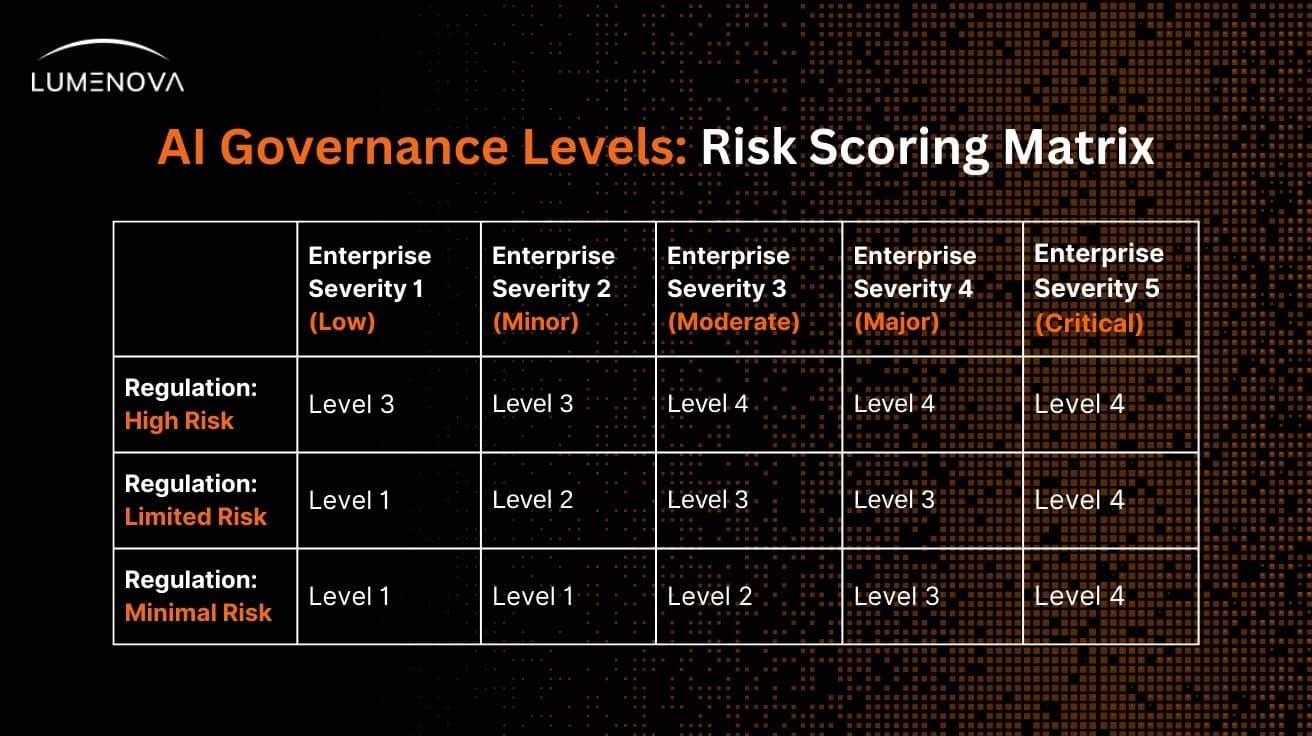
(Note: “Prohibited” AI is excluded as it is an automatic No-Go.)
Defining Enterprise Risk Tolerance Levels
Once you have determined your Composite Governance Level (1-4), what do you actually do with your AI models? This depends on your organization’s “risk personality.”
Below is how three different types of organizations would operationalize these levels.
Profile 1: The “Risk Averse” Enterprise
(Industry verticals: traditional Banking, Healthcare, Defense, Government)
- Philosophy: “Compliance First. Innovation Second.”
- Level 4 (Critical): Forbidden. We do not build/buy these tools.
- Level 3 (High): Requires board of directors approval + external audit. Mandatory “human-in-the-loop” for every transaction.
- Level 2 (Moderate): Requires C-level (CIO/CRO) sign-off.
- Level 1 (Low): Standard IT procurement process.
Profile 2: The “Balanced” Enterprise
(Industry verticals: Retail, Manufacturing, Logistics, Professional Services)
- Philosophy: “Managed Innovation.”
- Level 4 (Critical): Allowed only for strategic survival projects. Requires executive committee approval and full insurance coverage.
- Level 3 (High): Standard governance committee approval.
- Level 2 (Moderate): Department head approval.
- Level 1 (Low): Manager approval / Self-serve (with notification).
Profile 3: The “Aggressive / Pioneer” Enterprise
(Examples: Tech Startups, VC-backed Disrupters, Gaming)
- Philosophy: “Move Fast, Mitigate Later.”
- Level 4 (Critical): Allowed with CTO sign-off. “Red teaming” is required but fast-tracked.
- Level 3 (High): Project lead approval.
- Level 2 (Moderate): Notification only (post-deployment audit).
- Level 1 (Low): No approval required.
How to Create a Risk-Aligned AI Adoption Strategy
Now that you have the scoring system and the tolerance profile, here is how to build the strategy.
1. Segment AI Use Cases by Risk Profile
Stop treating all AI as a single entity. Your strategy needs to categorize every existing and planned AI initiative using the Dual-Axis model above.
This segmentation allows you to create different “lanes” for deployment. A Level 1 internal marketing tool should have a fast-track approval process to encourage experimentation. A Level 4 customer-facing financial advisor bot must go through a rigorous, multi-stage gate review. This segmentation is the only way to avoid creating bottlenecks for innovation while ensuring safety for critical systems.
2. Establish a Tiered Governance Model
Define distinct validation, documentation, and oversight processes for each governance level. These tiers should be documented in a single governance policy accessible to all teams.
- Level 1 (Routine): Log the system in your AI inventory. Check for basic terms of use.
- Level 2 (Managed): Require limited bias testing and a basic Data Privacy Impact Assessment (DPIA).
- Level 3 (Strict): Full EU AI Act conformity assessment. Mandatory adversarial “red teaming” (security testing) and an explainability (XAI) report.
- Level 4 (Critical): Strategic oversight. Implement a “kill switch” (instant shutdown capability). Require a third-party external audit and an algorithmic disgorgement plan (a pre-agreed method to delete the model if it goes rogue).
3. Integrate Risk Functions into the AI Lifecycle
A common failure mode in AI adoption strategy is bringing in legal, compliance, and security teams only right before deployment. By then, key decisions regarding data selection and model architecture have already been made, often baking in unacceptable risks.
Governance must be integrated into the entire lifecycle. Risk officers need a seat at the table during the initial use-case conception phase. They must be involved in evaluating training data for compliance and defining the “pass/fail” criteria for performance testing before development even begins.
Need some practical ideas on how to embed Responsible AI guidelines into your AI lifecycle? Read this post next.
4. Invest in Enabling Infrastructure
You cannot manage AI risk at scale using spreadsheets and emails. A robust AI adoption strategy requires dedicated infrastructure that provides visibility and control.
Organizations need specialized platforms that act as a “command center” for AI governance. This infrastructure must provide:
- Centralized AI inventory: A single pane of glass showing every model, its risk score, its owner, and its deployment status.
- Model/system cards: Standardized documentation detailing model lineage, intended use, limitations, and performance metrics for transparency.
- Automated risk scoring & drift detection: Continuous monitoring that alerts teams when a model’s performance degrades, or its output becomes toxic or biased in production.
- Comprehensive audit trails: Immutable logs of who approved a model, what tests were run, and why decisions were made – essential for regulatory compliance.
This is where platforms like Lumenova AI become indispensable. Lumenova AI provides the necessary infrastructure to operationalize these frameworks, offering automated risk assessments, real-time monitoring, and the governance guardrails needed to scale AI confidently.
5. Continuously Reassess Risk Tolerance
The AI landscape is moving too fast for static policies. A “High Risk” use case today might be “Moderate Risk” tomorrow as new safety techniques (like Constitutional AI or better guardrails) emerge. Conversely, new regulations may tighten the screws on previously unregulated areas.
Your AI adoption strategy must include a quarterly review of the risk tolerance profile itself. Are you missing out on opportunities because your settings are too conservative? Are you exposed to too many threats because you are too aggressive?
Conclusion
A successful AI adoption strategy is not about eliminating risk; that is impossible if you wish to innovate. It is about understanding your organization’s unique risk tolerance, accurately measuring the risks of your AI portfolio against that tolerance, and implementing the appropriate controls.
By adopting a tiered, risk-aligned approach supported by the right infrastructure, you can move faster on safe innovations while protecting your organization from systemic threats.
Ready to define (and safeguard) your organization’s AI risk profile?
Don’t rely on guesswork. Request a demo from Lumenova AI today. Let us help you perform your own enterprise AI risk level assessment aligned with your specific business objectives and corporate tolerance. We can help you establish the continuous monitoring and governance needed to ensure your AI systems remain safe, ethical, compliant, and profitable.