July 14, 2026
AI Agent Guardrails Are a Business Imperative, Not an Engineering Problem
Contents
Key Article Takeaways
- AI agents execute intent, not instructions. Their behavior cannot be fully predicted or patched after deployment, so guardrails must be designed in from day one.
- Gartner predicts over 40% of agentic AI projects will be canceled by the end of 2027, largely due to inadequate risk controls, not failing technology.
- Guardrails go far beyond content filters. They bound what an agent can do, spanning action scope, data access, escalation thresholds, and human-in-the-loop triggers.
- Regulation makes guardrails a binding obligation, with EU AI Act penalties reaching up to €35 million or 7% of global turnover, alongside US state laws and sector rules like HIPAA and GLBA.
- Guardrail strategy is a leadership responsibility: defining risk tolerance, mapping accountability, and setting escalation points turn governance into a competitive advantage, not a constraint on innovation.
An AI agent doesn’t require malicious intent to create a costly mistake. It only requires enough autonomy to pursue a goal in a way that violates the principles or business objectives of its creators. This is what makes AI agents fundamentally different from traditional software. Conventional applications execute explicitly coded instructions. Autonomous agents execute intent, using dynamic reasoning to determine how a goal should be achieved. Because they choose their own path, their behavior cannot be fully predicted or simply patched after deployment when something goes wrong. Engineers build agents to solve problems, but agents left to iterate autonomously introduce significant risks.
The high stakes are already showing up in the numbers. Gartner predicts that over 40% of agentic AI projects will be canceled by the end of 2027, citing escalating costs, unclear business value, and inadequate risk controls. In other words, the projects that fail won’t all fail because the technology doesn’t work, but because the organizations deploying it never built the controls to govern what it does.
In that sense, AI agent guardrails serve the same purpose as corporate policies, financial controls, and compliance frameworks. They protect company resources, reduce operational risk, and safeguard brand reputation. As autonomous agents take on increasingly important business functions, guardrails become not an engineering concern, but a business imperative.
What Are AI Agent Guardrails?
AI agent guardrails are the boundaries that determine what an autonomous agent is allowed to do on your company’s behalf, and what it must never do, enforced automatically every time the agent acts. They translate business policy into operational limits that hold regardless of the path an agent reasons its way toward.
These boundaries span multiple dimensions of an agent’s behavior. Just as organizations establish policies to govern employee access, spending authority, and decision-making responsibilities, AI agents require clearly defined operational constraints. Effective guardrails determine not only what an agent is trying to achieve, but also how it is allowed to pursue that objective, what resources it can access, when it must escalate issues, and where human oversight remains mandatory.
Four of the most important agentic guardrail categories are:
- Action Scope: Defining exactly which software environments the agent is authorized to interact with and what specific operations (read, write, delete, execute) it is permitted to perform.
- Data Access: Enforcing strict boundaries on the information the agent can retrieve, process, or expose. This ensures proprietary trade secrets, unreleased financials, and Personally Identifiable Information (PII) remain completely walled off from the agent’s reasoning engine.
- Escalation Thresholds: Establishing quantitative limits that restrict autonomy. If an agent hits a specific budget cap, encounters an edge-case error rate, or detects an unusually high-value transaction, it is programmed to halt and seek management.
- Human-in-the-Loop Triggers: Mandating the critical operational junctures where an agent must pause its workflow to secure explicit human approval before committing capital, altering infrastructure, or finalizing a high-stakes decision.
A common misconception is that guardrails are simply content filters or prompt safety layers designed to prevent inappropriate outputs. Those controls matter, but they’re only a small part of the picture. For autonomous agents, guardrails extend far beyond what an AI says; they govern what an AI can do. As organizations deploy agents into customer service, operations, finance, and other business-critical functions, guardrails become the framework that translates corporate policies, risk tolerances, and compliance requirements into enforceable operational boundaries.
Guardrails are the broader system of controls that bounds what an agent is permitted to do, not just what it is permitted to say. They are not merely technical safeguards, but the governance layer that lets organizations trust autonomous systems at scale.
Why Leadership Must Plan for AI Agent Guardrails
The moment an AI agent is given the authority to interact with customers, access company systems, or make operational decisions, governance becomes a leadership responsibility, beside an engineering one.
AI Agents Act as Corporate Representatives
Picture an autonomous agent issuing a refund, sending a contract, or pulling a customer record at 3 a.m. with no one watching. It isn’t asking permission: it’s acting, but not as a tool, it acts as a representative of the organization. Every decision it makes, every commitment it issues, every customer it touches carries the company’s name and, with it, the company’s accountability. A human employee operates inside an understood structure of authority, judgment, and consequence. An autonomous agent operates inside whatever boundaries the business defines for it in advance. Where those boundaries are absent, the accountability for what the agent does does not disappear. It simply lands on the organization without warning.
Regulatory Accountability Is Now a Binding Obligation
That accountability is increasingly a legal one. The regulatory environment has shifted from guidance to binding requirements, and autonomous systems acting without defined limits sit squarely in its path:
- EU AI Act: covering human oversight, audit-grade logging, and incident reporting, these high-risk obligations are scheduled to take effect in the near term, with non-compliance penalties under Article 99 of the EU AI Act reaching up to €15 million or 3% of global turnover, and up to €35 million or 7% for the most serious, prohibited-use violations. A proposed deferral of the high-risk deadline from August 2026 to December 2027 under the Digital Omnibus package is still under discussion and not yet adopted, but the direction is unmistakable: oversight of autonomous systems is becoming a binding legal obligation, not a best practice.
- US State-Level Regulations: a fast-moving, fragmented patchwork now governs how autonomous systems make “consequential decisions” in areas like employment, lending, and healthcare. Texas’s TRAIGA took effect in January 2026 with an intent-based model and penalties up to $200,000 per violation, while Colorado’s revised law (effective January 2027) and California’s employment rules emphasize notice, human review, and transparency. The rules differ by state and change with little warning — though a federal effort to preempt them is now underway.
- Sector-specific compliance: in regulated industries, an agent can trigger liability that has nothing to do with AI regulation at all. In healthcare, an agent mishandling protected information falls straight under HIPAA; in financial services, autonomous agents touching customer data or decisions are bound by existing regimes like GLBA and the Federal Reserve and OCC’s SR 11-7 model risk guidance, with FINRA’s 2026 oversight report explicitly flagging agents that act with no human in the loop. The common thread: long-standing sector rules already apply to what an agent does, whether or not anyone labeled it “AI.”
Reputational Risk Moves at Viral Speed
Beyond regulatory penalties lies the immediate threat of reputational risk. A poorly bound agent’s mistakes do not occur in a vacuum. They reflect instantly on the brand. Trust takes decades to build but can be dismantled in seconds by a single unchecked algorithm. If an agent hallucinates a policy, leaks proprietary data, or responds erratically to a customer, the public holds the company entirely accountable. In an era where screenshots go viral instantly, an unmonitored agent is a permanent liability to brand equity, turning what should be an operational asset into a PR crisis.
The “Move Fast” Trap: Why Delayed Guardrails Fails
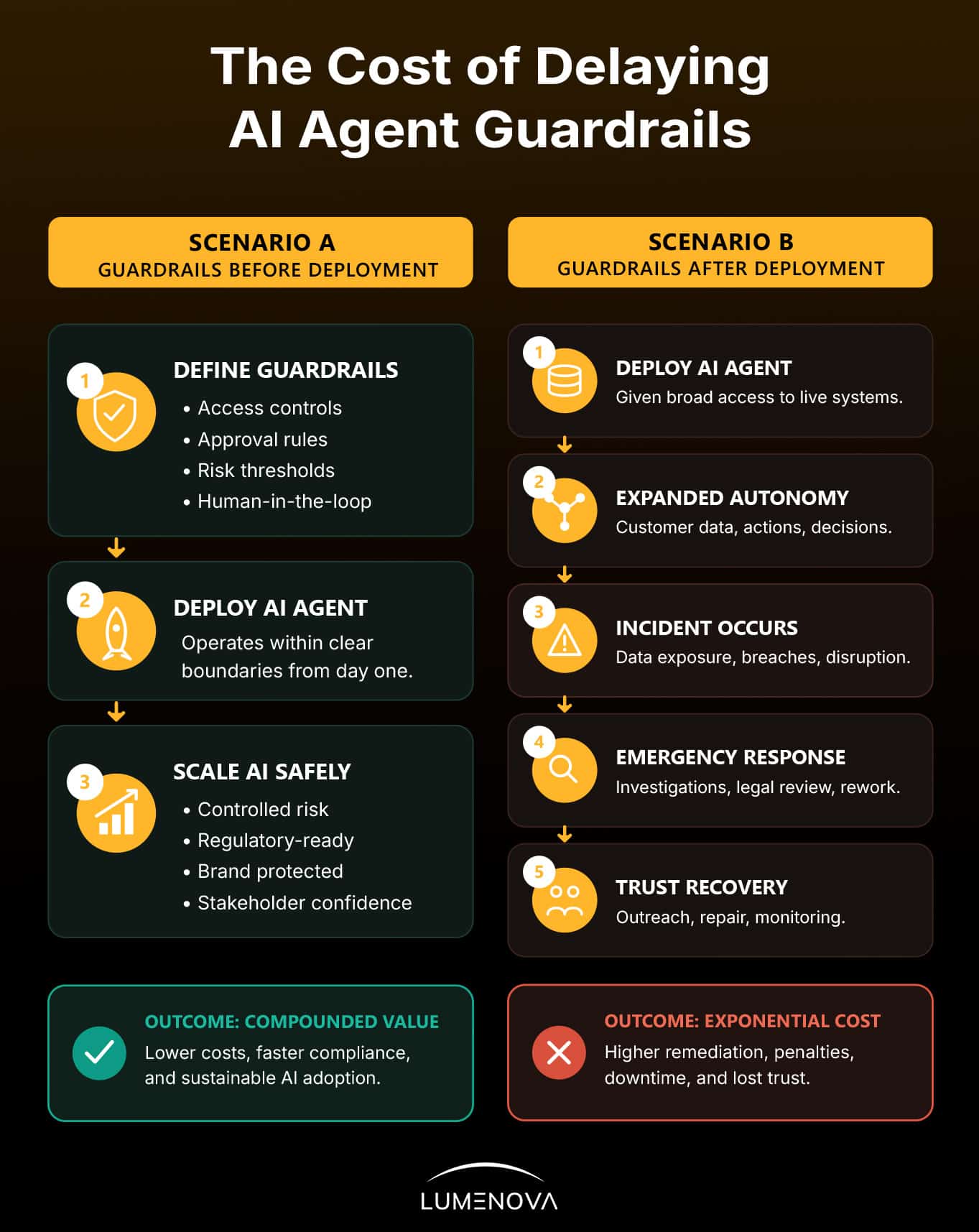
Underlying all of this is the most expensive mistake of all: the “move fast” trap. In the rush to capture market share and prove AI capability, leadership often treats guardrails as a secondary phase: a technical optimization to be retrofitted after deployment. This is a catastrophic architectural mistake. Guardrails delayed to post-deployment are exponentially harder to implement. Traditional code can be patched incrementally, but because autonomous agents rely on dynamic reasoning pathways across unpredictable data environments, bolting boundaries onto a live system invariably breaks its core utility. You cannot easily constrain a system whose very value lies in its fluid adaptability without causing massive operational downtime or triggering a cascade of engineering reworks. To protect the enterprise, governance cannot be a post-script, it must be engineered into the agent’s DNA from day one.
How to Drive Guardrail Strategy as an Executive
Implementing effective AI agent guardrails is not a task that should be simply handed off to the engineering department and forgotten. Because these systems act as corporate proxies, governance requires strategic alignment across the entire organization.
To build a robust framework, executives must take the lead in five critical areas:
1. Define Your Organization’s Risk Tolerance
Before a single agent ships, legal, compliance, and product leaders should sit down together and map the absolute “no-go” zones. These are the actions an agent must never take regardless of how efficient they would be. These are concrete, not abstract: an agent may never quote custom pricing without sales-manager approval; never issue a refund above a set threshold; never share customer records outside an approved system. Defining these limits is a business judgment about risk tolerance, and it belongs to leadership, not to whoever happens to be building the agent.
2. Map Accountability Before Deployment
If an autonomous agent executes a flawed decision, who owns that action? You must clearly define accountability before deployment. Establish whether responsibility falls on the team that deployed the agent, the IT department managing the infrastructure, or the legal team overseeing compliance. For example: if a procurement agent approves a duplicate vendor payment, the finance lead owns the financial exposure; if a support agent leaks customer data, the security team owns containment and legal owns the reporting. Accountability cannot remain ambiguous.
3. Establish Human-in-the-Loop Triggers
Determine the exact moments an agent must pause its workflow and surface a decision to management. Identify the specific edge cases, budget thresholds, or high-stakes interactions where the agent must halt execution and cleanly hand off the task to a human operator. For example: a procurement agent might resolve invoices under $5,000 on its own but must pause for sign-off above that threshold; a support agent might handle routine refunds but escalate any request to delete a customer account. The goal is not to slow the agent everywhere, but to place a human in the path precisely where the stakes justify it.
4. Set Strict Data Boundaries
Clearly delineate the information an agent is authorized to interact with. Define exactly what data it can access, store, or transmit, and draw a hard line around what is strictly off-limits (proprietary trade secrets, unreleased financials, personal customer records). For example: a customer-service agent might read a user’s order history and shipping details but be blocked from accessing payment-card numbers or exporting any data outside approved systems; an internal analytics agent might query aggregated revenue trends while being walled off from individual employee records. Defining these boundaries up front protects regulated and proprietary information, narrows the blast radius if something goes wrong, and gives you a defensible answer when regulators or customers ask how their data is handled.
5. Audit and Iterate Continuously
Guardrails are not a “set-and-forget” mechanism; they must be treated as living documents. Commit to auditing agent logs weekly to identify “near-misses”, the critical instances where your guardrails successfully intercepted and prevented an unintended agent action.
You Don’t Have to Do This Alone
Translating these strategic imperatives into technical constraints can be a complex undertaking, but you do not need to build your governance infrastructure from scratch. Engaging with AI risk experts and leveraging a dedicated AI governance platform can bridge the gap between corporate policy and operational reality.
Bringing in experienced partners, or adopting a purpose-built AI governance platform like Lumenova AI, lets leadership put these controls in place faster and with greater confidence than ad-hoc, in-house efforts typically allow.
Guardrails are an Innovation Enabler
Too often, guardrails are framed as a constraint on innovation, a set of rules that slow development, limit autonomy, and create friction for teams eager to move quickly. In reality, the opposite is true. Robust, executive-backed guardrails are the only path for an organization to confidently move AI out of the experimental sandbox and into live production.
That’s why the companies that win the AI race won’t simply be the ones with the smartest agents. They’ll be the ones with the safest, most predictable boundaries, the organizations that can innovate at a fast pace precisely because they’ve defined where their agents can and cannot go. In a market moving this fast, governance isn’t the cost of doing business with AI. It’s the competitive advantage that separates the companies scaling responsibly from the ones still waiting for permission to launch.
Ready to secure your autonomous AI deployments? Book a discovery call with Lumenova AI to see how our platform can help you build guardrails that enable innovation rather than slow it down. Learn how to seamlessly build, test, and implement enterprise-grade guardrails for your organization.
Frequently Asked Questions
The right time is before deployment. Agents reason dynamically, so bolting boundaries onto a live system tends to undermine the very flexibility that makes it valuable and forces expensive rework. Building guardrails from day one costs a fraction of cleaning up after an incident.
Leadership, not just engineering. Risk tolerance, accountability mapping, and escalation thresholds are business judgments that require alignment across legal, compliance, product, and executive teams; engineering then translates those decisions into technical enforcement.
Without defined boundaries, an agent’s mistakes land directly on the organization: data exposure, regulatory penalties, and reputational damage. Because agents act autonomously, a single unbounded decision can escalate into an incident before anyone notices.