August 4, 2026
How to Identify and Eliminate the Core Types of AI Bias in Enterprise Systems

Contents
At A Glance
- Understanding what bias in AI is makes for the first step toward enterprise AI safety. Unchecked bias leads to severe reputational damage, regulatory penalties, and flawed business decisions.
- There are multiple types of AI bias, including historical, representation, and measurement bias, each infiltrating systems at different stages of the machine learning lifecycle.
- Sectors like healthcare and finance are particularly vulnerable. AI bias in healthcare can literally mean the difference between life and death if algorithms systematically misallocate patient care.
- Bias in generative AI and agentic AI introduces new layers of complexity, as these systems don’t just score data – they create content and take autonomous actions.
- Manual reviews are no longer sufficient. Enterprises need to transition to automated governance platforms like Lumenova AI, utilizing comprehensive pre-deployment evaluations, 200+ built-in metrics, and continuous post-deployment observability to scale AI safely.
The High Cost of Unchecked AI – Don’t Make It Yours
In late 2023, a landmark enforcement action sent shockwaves through enterprise compliance departments: the U.S. Equal Employment Opportunity Commission (EEOC) settled its first-ever lawsuit over AI hiring bias. The case? An automated screening tool used by iTutorGroup had been systematically configured to instantly reject female applicants aged 55 or older and male applicants aged 60 or older. The software automatically disqualified more than 200 highly capable candidates before a human ever saw their resumes.
→ But did it survive long? No. This blatant algorithmic discrimination was eventually uncovered after a rejected applicant submitted a nearly identical application with a younger birth date and was instantly offered an interview.
This wasn’t just a simple coding glitch. It was a glaring example of machine learning bias – a catastrophic oversight in algorithmic design that resulted in a high-profile, six-figure settlement and served as a stern warning to enterprises scaling automated systems.
As enterprises increasingly scale their artificial intelligence capabilities, moving from predictive models to GenAI and autonomous agentic AI, the risks multiply. For enterprise leaders and compliance officers in highly regulated fields, understanding the different types of AI bias is no longer just a technical requirement; it is a critical business imperative.
This article will provide a clear AI bias definition, explore how ML bias develops, examine devastating AI bias examples, and offer a practical blueprint for moving from manual, fragmented reviews to automated governance using Lumenova AI.
What is AI Bias? A Clear AI Bias Definition
To build a robust AI governance framework, leadership teams need to first answer a fundamental question: what is bias in AI?
At its core, AI bias definition refers to an anomaly in the output of machine learning algorithms that produces prejudiced, unfair, or systematically inaccurate results. These skewed outcomes typically occur because of erroneous assumptions embedded in the machine learning process, flawed training data, or algorithmic design choices that fail to account for real-world nuances.
Bias in artificial intelligence is rarely a single, isolated bug. Instead, it is a systemic vulnerability. When a model is trained on historical data, it holds up a mirror to the society that produced that data. If the historical data contains human prejudices, structural inequalities, or sampling errors, the AI will not only learn those patterns but mathematically optimize and scale them.
Because modern businesses rely on AI for everything from credit scoring and resume screening to medical diagnoses and automated customer service, unchecked ML bias introduces severe legal, regulatory, and reputational risks. Regulatory frameworks like the EU AI Act are now mandating strict fairness requirements, making the identification and elimination of bias a legal necessity for enterprise deployment.
Core Types of Bias in Machine Learning
To effectively eliminate bias, data science and compliance teams should understand exactly where and how it enters the system. There are several primary types of bias in machine learning, each requiring a distinct mitigation strategy. Below is a breakdown of the core types of algorithmic bias that enterprise systems face.
1. Historical Bias
Historical bias occurs when the data used to train an AI model perfectly reflects the real world, but the real world itself contains systemic inequalities. Even if the data is sampled perfectly, the model learns and perpetuates historical prejudice.
- How it develops: A model trained on 20 years of hiring data in the tech industry will learn that men are statistically more likely to be hired for engineering roles.
- Enterprise Risk: When the model is deployed to screen resumes, it actively downgrades female candidates, penalizing them for historical trends that are now long outdated.
2. Representation (Sample) Bias
Representation bias happens when the training data does not accurately reflect the environment in which the AI will operate. It is a failure of sampling.
- How it develops: If a facial recognition system is trained primarily on images of lighter-skinned individuals, it will lack the mathematical features necessary to accurately identify darker-skinned individuals.
- Enterprise Risk: Security and identity verification systems fail disproportionately for certain demographics, leading to discrimination lawsuits and PR crises.
3. Measurement Bias
Measurement bias arises when there are issues with the way data points are captured, measured, or labeled. This often happens when teams use proxies (substitute variables) because the actual variable they want to measure is too difficult to quantify.
- How it develops: For instance, using “arrest rates” as a proxy for “crime rates,” or using “healthcare spending” as a proxy for “patient sickness.”
- Enterprise Risk: The model optimizes for the wrong metric, leading to fundamentally flawed enterprise decisions that inadvertently harm protected classes.
4. Aggregation Bias
Aggregation bias occurs when false conclusions are drawn for a subgroup based on observing a different, larger group, or when a “one-size-fits-all” model is used for diverse populations.
- How it develops: A medical algorithm assumes a certain drug dosage is optimal for all patients based on an average derived primarily from a specific demographic, ignoring how different populations metabolize the drug.
- Enterprise Risk: Widespread operational failures when models are scaled across diverse global markets.
| Type of Bias | Root Cause | Stage of AI Lifecycle | Typical Enterprise Impact |
| Historical Bias | Pre-existing societal prejudices | Data Collection | Perpetuates discrimination in hiring, lending, and housing. |
| Representation Bias | Unbalanced or skewed sampling | Data Curation | High error rates for minority demographic groups. |
| Measurement Bias | Flawed proxies or labeling | Feature Engineering | Model optimizes for incorrect, discriminatory metrics. |
| Aggregation Bias | Ignoring subgroup differences | Model Training | One-size-fits-all approach degrades performance globally. |
AI Bias in Healthcare: A Deep Dive into High-Stakes Disparities
While bias in marketing algorithms might result in a misplaced ad, AI bias in healthcare carries literal life-or-death consequences. Healthcare is one of the most heavily regulated and high-stakes verticals, making it crucial for healthcare leaders to understand the examples of AI bias.
In the healthcare sector, machine learning bias often manifests as diagnostic or patient-care algorithmic disparities.
Examples of AI Bias in Healthcare
- Dermatology Image Analysis: Many machine learning models designed to detect melanoma have been trained on vast datasets of skin lesions. However, because the majority of clinical images feature lighter skin tones, these models have historically demonstrated drastically lower accuracy rates when evaluating lesions on darker skin, leading to delayed diagnoses for minority patients.
- Resource Allocation Algorithms: When algorithms use previous medical costs as a proxy for medical need, they systematically score marginalized patients (who historically lack access to expensive care) as “healthier” than they actually are, denying them access to high-risk care management programs.
- Natural Language Processing (NLP) in Clinical Notes: AI systems designed to extract insights from doctors’ notes can inherit biases based on how clinicians historically describe patients. Studies have shown that NLP models can adopt negative stigmas associated with certain demographics regarding pain tolerance or drug-seeking behavior, influencing future automated care recommendations.
For healthcare enterprises, eliminating these types of AI bias requires more than manual review; it requires robust fairness metrics embedded directly into the machine learning pipeline before the algorithm ever interacts with a patient.
The Unique Risks of Bias in Generative AI
The explosion of Large Language Models (LLMs) and image generation tools has introduced an entirely new paradigm of risk. Bias in generative AI is significantly more complex to identify and eliminate than traditional predictive ML bias.
Unlike predictive models that output a score or a classification (e.g., “approve” or “deny”), Generative AI outputs unstructured text, code, or images.
Key Manifestations of GenAI Bias
- Stereotype Amplification: When prompted to generate an image of a “CEO,” biased GenAI models will almost exclusively output images of older, white men. When asked to write a story about a “nurse,” the model defaults to female pronouns.
- Toxic Content Generation: Because LLMs are trained on vast, unfiltered swaths of internet data, they can inadvertently generate racist, sexist, or highly polarized content if not properly constrained by alignment guardrails.
- Hallucinatory Bias: GenAI may confidently invent facts that align with historical prejudices found in its training data, presenting biased falsehoods as objective truth.
For enterprise compliance officers, bias in generative AI means that a customer-facing chatbot or an internal drafting assistant could spontaneously generate discriminatory language, resulting in immediate brand damage and legal liability.
Escalating Dangers: Risks of Bias in Agentic AI
As enterprises evolve beyond conversational GenAI, they are deploying Agentic AI – autonomous systems capable of reasoning, planning, and executing actions in a sequence without human intervention.
If bias infects an agentic AI system, the consequences compound rapidly:
- Automated Decision Loops: An HR Agentic AI tasked with finding, interviewing, and hiring candidates might autonomously scrape data, filter out specific demographics due to learned biases, and send automated rejection letters – all within seconds.
- Cascading Errors: Because Agentic AI takes sequential actions, a biased initial assumption (e.g., a financial trading agent undervaluing assets owned by minority-led businesses) will influence all subsequent actions in its workflow, creating a snowball effect of systemic discrimination.
Mitigating bias in agentic AI requires advanced observability and real-time guardrails capable of interrupting an autonomous agent’s workflow before a biased action is executed in the real world.
From Manual Reviews to Automated Governance: A Mitigation Blueprint
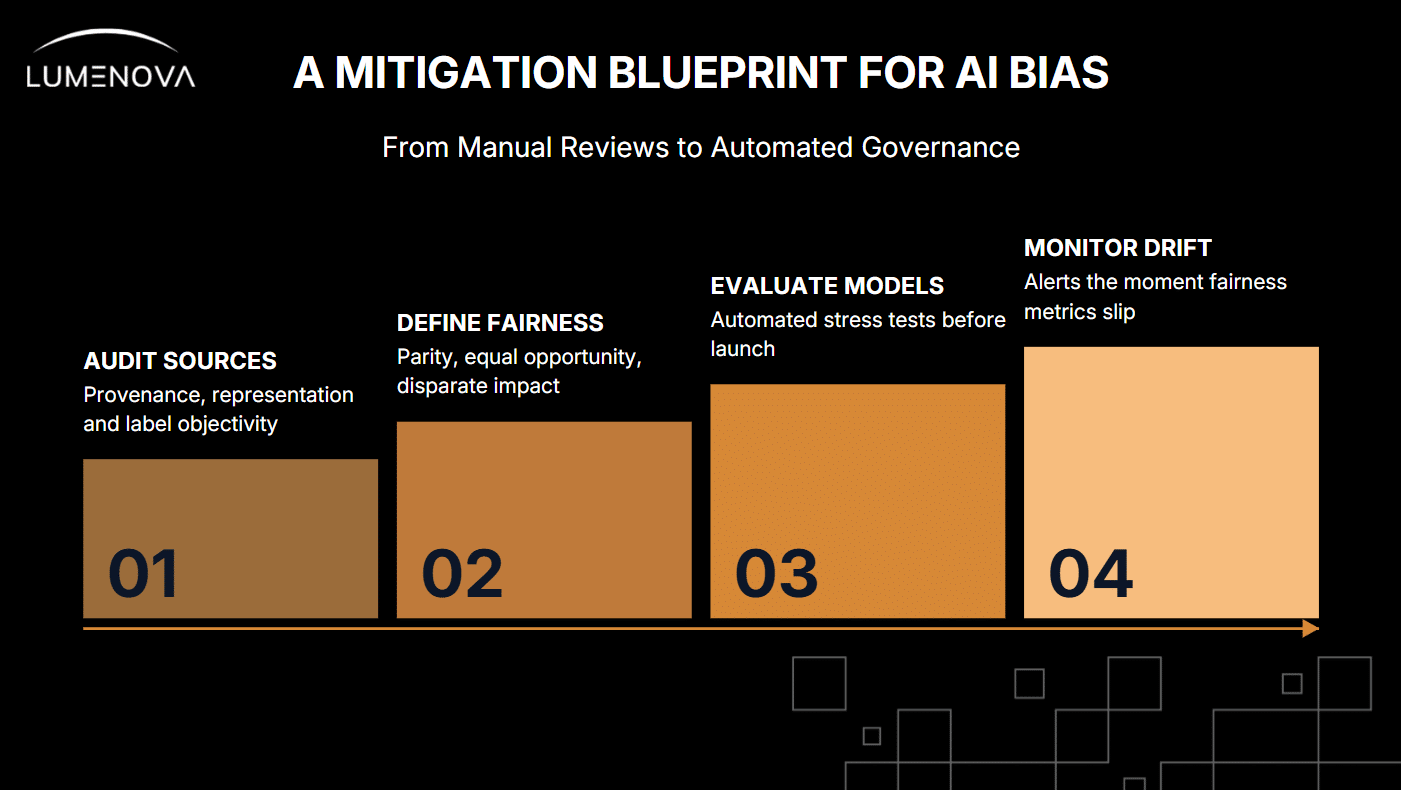
For enterprise leaders and compliance officers in highly regulated fields, the days of relying on ad-hoc, manual reviews by isolated data science teams are over. To scale high-performing AI safely, leadership teams have to implement a practical “How-To” blueprint for automated AI governance.
Here is a step-by-step framework to identify and eliminate the core types of AI bias.
Step 1: Audit and Map Data Sources
Before writing a single line of code, data teams are required to conduct rigorous exploratory data analysis. You need to understand the provenance of your data. Does it underrepresent certain demographics? Are the labels objective, or do they rely on subjective human proxies?
Step 2: Define Mathematical Fairness Metrics
“Fairness” is a subjective social construct, but algorithms require mathematical definitions. Businesses are expected to align legal requirements with specific fairness metrics, such as:
- Demographic Parity: Ensuring the outcome rate is the same across all demographic groups.
- Equal Opportunity: Ensuring the true positive rate is the same across groups (e.g., equally qualified candidates of different genders have the exact same chance of being hired).
- Disparate Impact Ratio: Ensuring the ratio of favorable outcomes for an unprivileged group compared to a privileged group meets regulatory thresholds (e.g., the 80% rule in US employment law).
Step 3: Run Comprehensive Pre-Deployment Evaluations
Never deploy a model without subjecting it to automated stress tests. Pre-deployment evaluations help simulate how the model behaves across various demographic slices and edge cases to catch historical and representation bias before the model impacts users.
Step 4: Implement Continuous Post-Deployment Monitoring
Model behavior degrades over time. Concept drift and changing real-world data mean a model that was fair in deployment can become biased three months later. Continuous observability is required to trigger alerts the moment fairness metrics slip below acceptable thresholds.
How Lumenova AI Detects Bias: A Comprehensive Solution
Translating complex bias and model metrics into clear business insights is incredibly difficult when using fragmented tools. Lumenova AI provides enterprises with an end-to-end, automated governance platform designed specifically to identify, measure, and mitigate all types of AI bias at scale.
Before A System Ships: Pre-Deployment Evaluations
At Lumenova AI, we see pre-deployment evaluations as the ultimate automated risk identification solution. Instead of relying on manual testing, enterprises can leverage Lumenova AI’s rigorous testing environment to catch flaws before they go live.
- 200+ Built-In Metrics: The platform comes equipped out-of-the-box with over 200 quantitative metrics. This allows compliance officers to instantly translate abstract fairness goals into mathematically verifiable tests.
- Deep-Dive Fairness and Bias Verticals: Lumenova AI doesn’t just look at general accuracy. It conducts deep-dive evaluation assessments specifically across fairness and bias verticals. It segments data across protected classes (race, gender, age, geography) to ensure Equal Opportunity and Demographic Parity are maintained, highlighting exact areas of representation and measurement bias.
- Comprehensive Guardrails for All Model Types: Whether you are deploying a traditional predictive ML model for credit scoring, a Generative AI model for content creation, or an Agentic AI for autonomous workflows, Lumenova AI provides tailored guardrails. It stress-tests GenAI for stereotype amplification and toxicity, ensuring that generative outputs align with enterprise values and regulatory mandates.
Post-Deployment: Continuous Monitoring and Human-in-the-Loop
Eliminating bias is not a one-time event; it is an ongoing process. Once a model is live, Lumenova AI seamlessly transitions from pre-deployment testing to live operational governance.
- Real-Time Observability: The platform continuously monitors model inputs and outputs in production, instantly detecting data drift and performance degradation that could signal emerging machine learning bias.
- Automated Guardrails: If a model begins producing biased outputs or violates predefined fairness thresholds, Lumenova AI’s automated guardrails can flag, block, or reroute the output before it causes harm.
- Human-in-the-Loop (HITL) & Human Annotations: Lumenova AI understands that algorithms cannot solve algorithmic bias entirely on their own. The platform seamlessly integrates Human-in-the-Loop capabilities. When the system detects ambiguous or high-risk outputs, it routes them to domain experts for review. Through robust human annotations, subject matter experts can correct biased outputs, feeding that data back into the system to continuously align the model with human values and enterprise standards.
By utilizing Lumenova AI, compliance officers and enterprise leaders can move from reactive firefighting to proactive, automated governance, gaining the confidence to scale high-performing AI systems while fully mitigating severe reputational and legal risks.
Conclusion
As artificial intelligence becomes the engine of the modern enterprise, the risks associated with bias in artificial intelligence have never been higher. From the insidious nature of historical and measurement bias in traditional predictive models to the complex stereotyping found in Generative and Agentic AI, unchecked bias threatens regulatory compliance, brand trust, and most importantly, human well-being.
However, enterprises no longer have to rely on manual, error-prone reviews to safeguard their systems. By understanding the core types of AI bias and implementing an automated governance blueprint, organizations can turn AI safety into a competitive advantage.
Lumenova AI empowers leadership teams to detect issues early through rigorous pre-deployment evaluations and maintain fairness through continuous post-deployment observability, Human-in-the-Loop oversight, and over 200 built-in metrics.
Ready to scale your AI systems safely?
Request a Discovery Call with Lumenova AI today and learn how to automate your AI governance, enforce rigorous fairness guardrails, and protect your enterprise from the hidden risks of algorithmic bias.
Frequently Asked Questions
The core types of AI bias (or types of algorithmic bias) include historical bias (data reflecting societal prejudice), representation bias (skewed or incomplete training data), measurement bias (using flawed proxies to measure data), and aggregation bias (using a one-size-fits-all model that ignores subgroup differences).
One of the most well-known AI bias examples in healthcare involved a clinical algorithm that used past healthcare spending as a proxy for a patient’s medical needs. Because less money was historically spent on minority patients due to systemic inequalities, the algorithm falsely concluded they were healthier than equally sick white patients, denying them access to critical care programs.
Traditional machine learning bias usually results in skewed scores or classifications (e.g., unfairly denying a loan). Bias in generative AI manifests in unstructured outputs, such as generating toxic language, producing culturally insensitive images, or heavily amplifying gender and racial stereotypes in generated content (e.g., always depicting nurses as female and engineers as male).
Pre-deployment evaluations allow teams to simulate and test a model’s behavior across diverse demographics before it interacts with real users. Using platforms like Lumenova AI, enterprises can apply hundreds of fairness metrics to automatically detect and fix bias in artificial intelligence before the system ships, preventing regulatory violations and PR disasters.
HITL refers to the process of involving human experts in AI decision-making loops. While automated platforms can detect statistical anomalies, humans provide the necessary context, ethics, and nuance. Through human annotations and review, experts can correct flagged biased outputs and continuously train the model to adhere to enterprise fairness standards.