Contents
Key Insights
An effective enterprise AI governance framework should enable organizations to:
- Define responsible AI principles and clear governance ownership.
- Identify and mitigate AI risks throughout the model lifecycle.
- Maintain a centralized inventory of AI models and governance assets.
- Align AI systems with evolving regulations such as ISO/IEC 42001 and the EU AI Act.
- Operationalize governance through continuous monitoring, automated guardrails, and policy-as-code.
This article walks through the seven essential steps for building an AI governance framework that supports responsible AI innovation at scale.
Why Every Organization Needs an AI Governance Framework
Artificial intelligence is transforming industries at an unprecedented pace, unlocking new opportunities for innovation and efficiency. As organizations increasingly rely on AI to support critical business decisions, they must also manage the ethical, operational, and regulatory risks that come with it.
Without a structured governance framework, AI systems can lead to:
- Bias and discrimination in hiring, lending, or healthcare decisions
- Lack of transparency in AI-driven decision-making
- Regulatory penalties under frameworks such as the EU AI Act, GDPR, and other emerging AI regulations
- Loss of customer trust and reputational damage
An AI governance framework provides the policies, processes, and technical controls needed to ensure AI systems are developed, deployed, and monitored responsibly. It is particularly critical for organizations operating in highly regulated industries such as finance, healthcare, and insurance, where AI decisions can have significant legal, financial, and societal consequences.
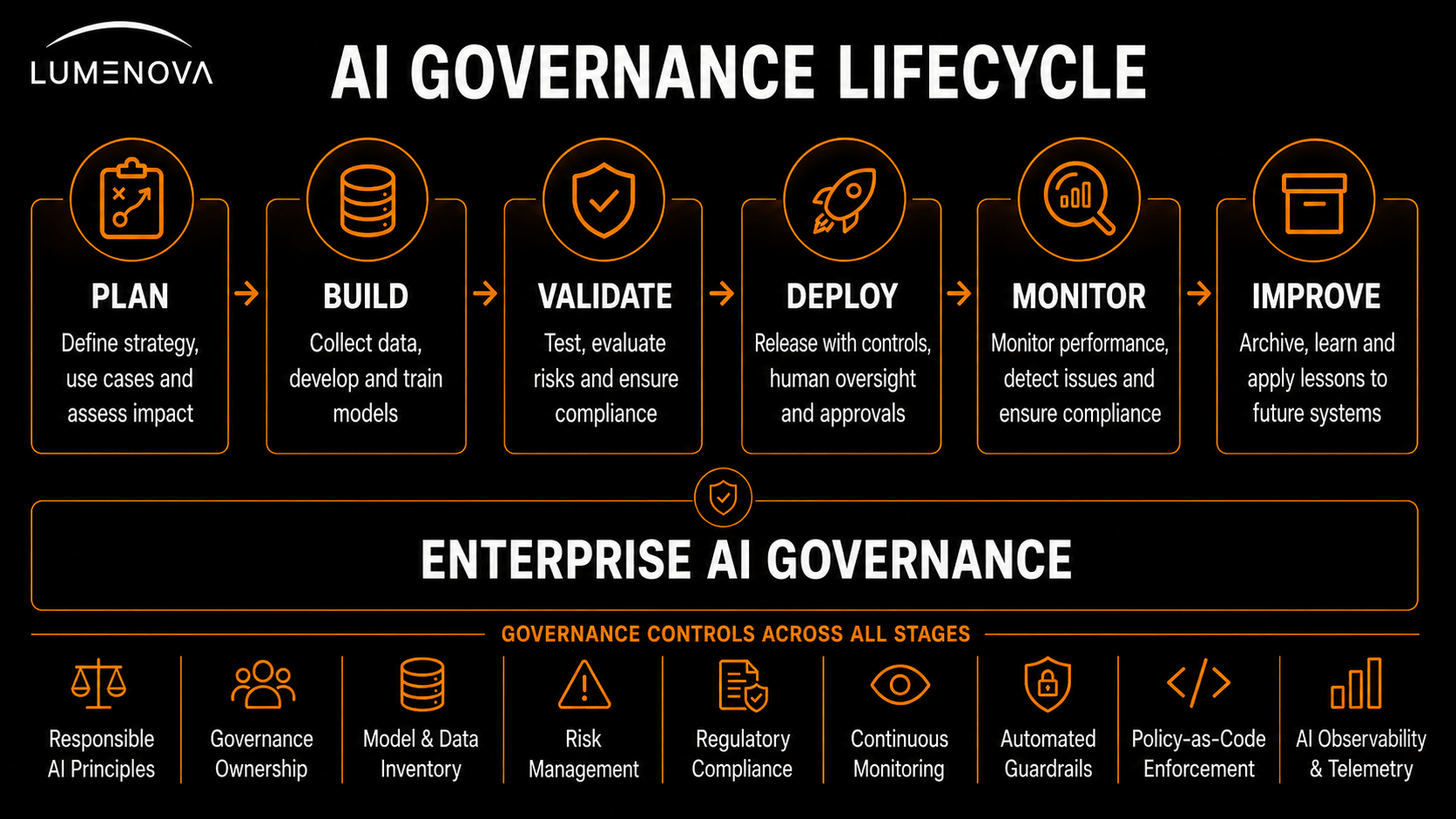
Unlike traditional software governance, AI governance must continuously adapt to evolving models, autonomous agents, and dynamic decision-making systems. Static governance documents remain an important foundation, but they are no longer sufficient on their own to govern AI systems operating in real time.
As enterprise AI adoption accelerates in 2026, organizations are increasingly operationalizing governance through policy-as-code. By translating governance policies into enforceable technical controls, policy-as-code enables consistent governance, traceable decision-making, and continuous compliance across AI systems.
The 7 Essential Steps to Building an Enterprise AI Governance Framework
While every organization tailors its AI governance strategy and framework to its industry, risk profile, and regulatory requirements, every effective framework is built on the same core components: responsible AI principles, clearly defined AI governance responsibilities, continuous risk management, regulatory alignment, and ongoing operational oversight.
The seven steps below provide a practical roadmap for AI governance framework implementation, helping organizations move from governance planning to operational execution.
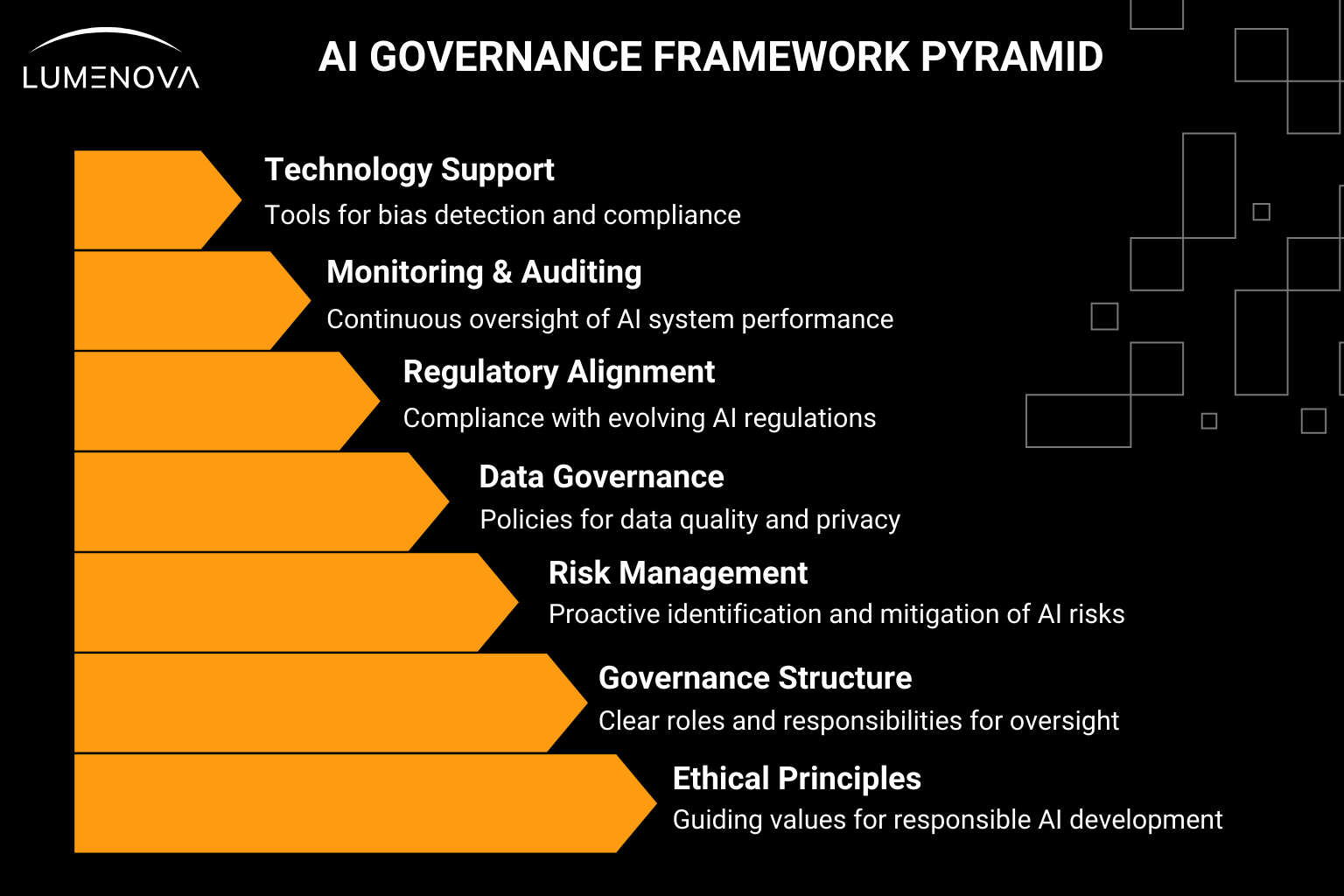
1. Define Responsible AI Principles
The foundation of a robust AI governance framework is a set of clearly defined ethical principles. This isn’t just about abstract ideals; it’s about codifying your organization’s values into actionable guidelines for your AI systems.
Key principles typically include:
- Fairness and equity: Mitigating bias and ensuring AI systems do not lead to discriminatory outcomes.
- Transparency and explainability: Making AI decision-making processes understandable to developers, users, and regulators.
- Accountability and responsibility: Clearly defining who is responsible for the outcomes of an AI system.
- Privacy and security: Ensuring personal data is protected and handled lawfully; ensuring the system is robust against malicious attacks.
- Human centricity (or human-in-the-loop): Guaranteeing meaningful human oversight in critical decision-making loops, to prevent errors and ensure ethical alignment.
- Sustainability: Considering energy use and long-term societal impacts.
Organizations should formalize these principles in an AI Ethics Charter that serves as the north star for every AI project, from conception to retirement.
2. Establish Clear AI Governance Ownership
A framework is useless without people to implement and oversee it. Establishing a clear governance structure with dedicated roles within the organization is crucial for accountability. Once the roles are defined, communication between them is also crucial; otherwise, governance often becomes fragmented or siloed.
This structure often includes:
| Role | Primary Responsibility |
| Governance Committee | Strategy & oversight |
| CAIO/ Head of AI | AI governance execution |
| Product and AI Teams | Model development & deployment |
| Data Stewards | Data quality & security |
| Legal & Compliance | Regulatory compliance |
| Business Leaders | Human oversight & accountability |
By assigning clear ownership, you ensure that someone is always accountable for the ethical and operational performance of your AI systems. Decision rights assigned to each role should also be defined, i.e., crystal clear escalation paths for approving, modifying, or suspending AI systems.
AI governance cannot succeed as a purely top-down initiative. An effective framework requires buy-in across all stakeholders:
- Employee training: Equipping teams with the skills to build and manage ethical AI.
- Customer transparency: Informing users when they interact with AI and how their data is utilized.
- Multidisciplinary collaboration: Legal, technical, and business units must collaborate rather than work in silos.
Embedding governance in company culture ensures adoption beyond checklists and audits.
3. Implement Continuous AI Risk Management
Just like enterprise infosec risk management, AI risk management should be proactive and ongoing. AI introduces a new spectrum of risks, from biased algorithms causing reputational damage to data privacy breaches resulting in regulatory fines. However, many of these risks don’t remain static. They emerge or evolve as AI systems interact with new data, users, external tools, and environments.
Managing these risks requires a structured risk management process that spans the entire AI lifecycle, from design and deployment to ongoing operation. Key practices include:
- Risk assessment at design stage: Conducting AI impact assessments to identify potential ethical, security, or operational risks before a project begins (similar to data protection impact assessments, or DPIAs, under GDPR).
- Ongoing model oversight: Assessing AI outputs for drift, anomalies, and potential harms over time. The framework must ensure up-to-date compliance with a growing patchwork of AI regulations.
- Impact assessment tools: Structured frameworks for evaluating social, legal, and ethical implications of new AI products.
Effective AI risk management doesn’t end at deployment. Organizations need constant visibility into AI behavior throughout the model lifecycle. This is where continuous monitoring comes in.
Continuous monitoring is the ongoing evaluation of AI systems to detect model drift, bias, performance degradation, security vulnerabilities, and compliance issues throughout the AI lifecycle.
By providing real-time visibility into AI behavior, modern AI governance platforms help organizations identify risks early, maintain continuous oversight, and strengthen governance throughout the AI lifecycle.
4. Build a Centralized Model Inventory and Data Governance Framework
AI models are only as good as the data they are trained on. However, before organizations can effectively govern their AI systems, they first need complete visibility into what they have deployed.
A model inventory is a centralized catalog of every AI model, agent, dataset, owner, deployment status, and risk classification across the organization. It provides the foundation for enterprise AI governance by enabling teams to track AI assets, assign accountability, support audits, and apply governance controls consistently throughout the AI lifecycle.
This is, however, only one part of effective AI governance strategy. Organizations must also establish robust AI data governance frameworks to ensure the data powering AI systems is accurate, secure, compliant, and suitable for enterprise AI applications.
Key data governance practices include:
- Data provenance controls: Tracking the origin, collection methods, and transformations applied to datasets.
- Data quality standards: Ensuring data is accurate, complete, and representative.
- Privacy and consent controls: Implementing robust measures to protect sensitive information and manage consent.
- Access management: Restricting sensitive data to authorized users only.
Without meticulous data governance, you risk building “garbage in, garbage out” models that create bias, fail to perform, and even break the law.
5. Align AI Governance with Global Regulations
The global landscape for AI regulation is rapidly evolving. An effective AI governance framework must ensure compliance across jurisdictions, such as:
- ISO/IEC 42001, the international standard for AI management systems that establishes governance requirements, accountability mechanisms, risk management processes, and continual improvement practices.
- The EU AI Act, which introduces mandatory obligations for providers and deployers of high-risk AI systems, including risk management, technical documentation, transparency, human oversight, accuracy, cybersecurity, and post-market monitoring.
- NIST AI Risk Management Framework (guidelines for trustworthy AI in the U.S.)
- Local industry requirements (e.g., HIPAA in healthcare, PCI DSS in finance).
Why Static AI Governance Policies Are No Longer Enough
Traditional AI governance relied on PDF-based policies, manual reviews, and periodic audits. While written documentation remains an important foundation, it cannot govern AI systems that generate new outputs, invoke external tools, or make autonomous decisions in real time.
The governance gap is becoming increasingly evident.
According to Grant Thornton’s 2026 AI Impact Survey, 78% of executives are not confident their organizations could pass an independent AI governance audit. As generative AI and agentic AI adoption accelerates, organizations need governance that is continuously enforced – not simply documented.
| Traditional AI Governance | Operational AI Governance |
| Static PDF-based policies | Machine-readable, policy-as-code controls |
| Periodic audits | Continuous governance and monitoring |
| Manual policy enforcement | Automated guardrails and runtime controls |
| Reactive compliance | Proactive risk prevention |
| Governance after deployment | Governance throughout the AI lifecycle |
Rather than relying on static documentation and periodic audits, leading organizations are operationalizing governance through policy-as-code, enabling governance requirements to be enforced automatically across AI models, agents, workflows, and runtime environments. This shift transforms governance from a compliance exercise into a continuous operational capability that scales alongside enterprise AI.
6. Continuously Monitor AI Systems
AI governance is not static; it requires continuous oversight. This involves:
- Automated monitoring of model performance, bias, and data drift.
- Independent audits, either internally or through third parties, to validate compliance.
- Incident reporting processes for when AI systems fail or cause unintended harm.
This feedback loop transforms AI governance from a compliance tool into an enabler of responsible innovation. Combined with AI observability, organizations gain real-time visibility into model behavior, performance, and governance controls, allowing them to detect issues before they impact users or compliance.
7. Deploy Automated Guardrails and Governance Tools
Finally, as AI systems become more autonomous, organizations need mechanisms that can prevent unsafe or non-compliant behavior before it occurs.
This is where automated guardrails come into play.
Automated guardrails are technical controls that enforce governance requirements by restricting prompt injection attacks, limiting tool usage, requiring human approval for high-risk actions, and blocking prohibited outputs before they reach users.
Together with policy-as-code, they enable organizations to operationalize governance across the AI lifecycle rather than relying on manual oversight.
Delivering these capabilities at enterprise scale requires purpose-built governance technologies that provide visibility, enforcement, and continuous oversight. Common examples include:
- Bias detection and fairness evaluation frameworks.
- Model monitoring platforms to track drift and accuracy in real time.
- Automated compliance reporting tools aligned with regulations.
- Secure cloud platforms with built-in auditing and role-based permissions.
- Policy-as-code engines that automatically enforce governance rules across AI models, agents, prompts, workflows, and external tool integrations.
When implemented effectively, such a framework doesn’t just protect against risks; it creates a foundation of trust that is critical for AI adoption at scale. Customers, regulators, and employees alike need confidence that AI systems are fair, transparent, and aligned with human values.
Organizations that get AI governance right will not only comply with regulations but also differentiate themselves in an increasingly competitive and trust-sensitive market.
How Lumenova AI Helps Operationalize AI Governance
An AI governance framework is not a one-size-fits-all solution. It must be tailored to organizational contexts, industry requirements, and regional regulations. However, the core building blocks (accountability, ethical principles, regulatory alignment, risk management, data governance, transparency, auditing, stakeholder engagement, and technical enablers) are universally applicable.
For businesses looking to streamline this process, the Responsible AI (RAI) platform of Lumenova AI is the all-in-one solution for managing the risk and compliance of their AI models.
With a library of pre-built, customizable frameworks based on major regulatory and industry standards, Lumenova AI provides tools to:
- Operationalize AI governance through policy-as-code, automating governance policies, model permissions, tool usage, human oversight requirements, intervention workflows, and runtime controls.
- Detect and assess AI risks across the model lifecycle.
- Maintain a centralized inventory of AI models and governance assets.
- Continuously monitor AI behavior for bias, drift, security vulnerabilities, and compliance issues.
- Deploy automated guardrails that enforce governance policies before risks reach production.
- Ensure ongoing compliance with major regulations and standards, including ISO/IEC 42001, the EU AI Act, and other emerging governance frameworks.
- Perform technical evaluations across key risk domains such as fairness, explainability, robustness, and security.
Request a demo today, and see real-life examples of how we can help bridge the gap between technical teams and business executives to foster a culture of responsible AI innovation for your company.
Frequently Asked Questions
An AI governance strategy defines an organization’s vision and objectives for responsible AI. An AI governance framework translates that strategy into policies, processes, roles, and technical controls.
AI governance responsibilities include defining policies, managing AI risks, ensuring regulatory compliance, overseeing model performance, and assigning accountability across technical, legal, and business teams.
AI governance framework implementation involves establishing governance principles, assigning ownership, managing AI risks, aligning with regulations, and deploying governance controls throughout the AI lifecycle.
AI data governance frameworks help ensure the data used by AI systems is accurate, secure, traceable, and compliant. Strong data governance improves model reliability and supports responsible AI adoption.
Organizations can scale AI governance by combining centralized model inventories, continuous monitoring, automated guardrails, and policy-as-code to maintain consistent oversight across AI systems.