September 15, 2026
Going All-In on AI: A Risk Primer on Overreliance, Governance Theatre, and the Industries Most Exposed
Contents
Key Takeaways
- Overreliance is not about how much AI you use, but whether anything is still positioned to catch the system when it gets something wrong.
- Exposure attaches to decisions, not to industries.
- Governance theatre is oversight that exists on paper but can no longer change an outcome.
- Automation bias is not prevented by training, and sustained deference erodes the judgment a control depends on.
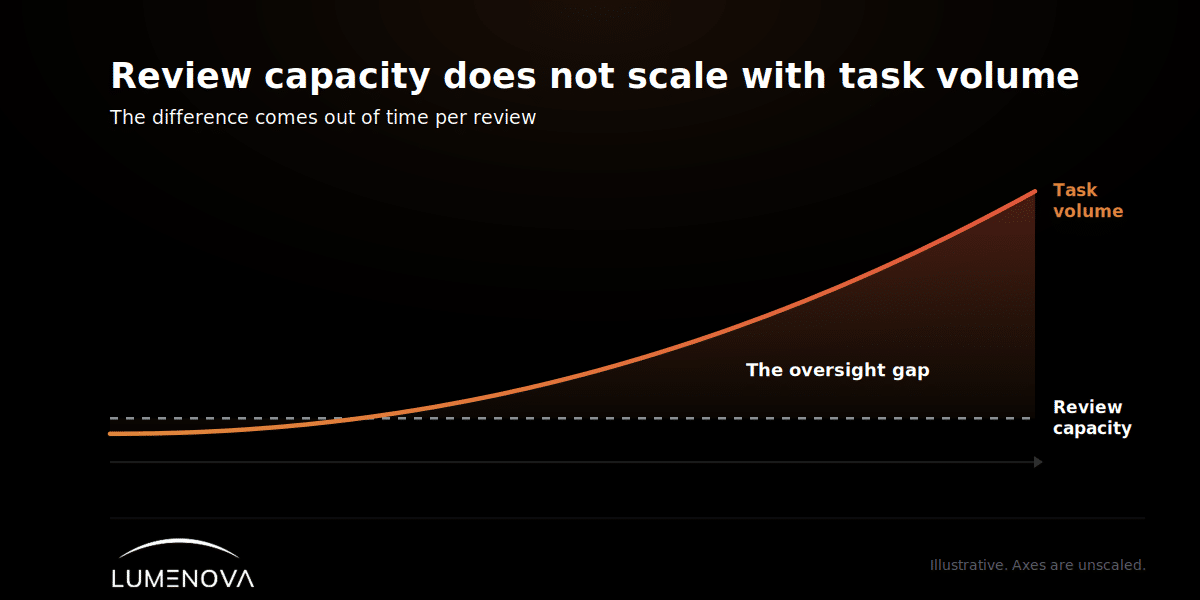
- Volume is what breaks oversight. Review capacity is close to fixed while agent task volume is not, so time per review absorbs the difference.
- Real oversight produces evidence. Implement continuous observability, structural guardrails, and a traceable record of every human decision.
Many organizations going all-in on AI have modeled the upside of using GenAI and agents in detail. Far fewer have modeled the downside with the same care. That asymmetry is what this primer is about.
Heavy delegation is often correct. For high-volume, low-stakes, reversible work, it produces real gains and the cost of being wrong stays small. The problem is that the decision gets made on those terms, then applied to work that meets none of them.
Overreliance on AI has less to do with how much AI you use than with whether anything in the organization is still positioned to catch the system when it gets something wrong. That capacity rarely disappears visibly. The policy stays in place, the review step stays in the workflow, the sign-off still happens. What changes is whether any of it does anything.
Overreliance on AI vs. Healthy Delegation
Oversight tends to break under volume, which puts two kinds of systems at issue: generative tools producing outputs someone will act on, and agentic systems taking actions on their own. Predictive models inside a single workflow raise related questions, but rarely outpace the people checking them.
What Going All-In Actually Means
Going all-in on AI describes three conditions rather than a level of usage:
- No parallel process. Decisions get delegated with no human workflow running alongside to compare against.
- No maintained fallback. Nothing is kept ready for when the system is unavailable or wrong.
- Single point of dependence. One model or one provider carries an entire category of work.
Where the line sits
Volume of use predicts little on its own. What separates healthy delegation from overreliance is whether the conditions that let someone catch an error survived the rollout, and those conditions are specific: a reviewer with time to look, enough context to disagree, the authority to override, and a path for escalating what they find. Remove one and the control stops working while continuing to appear in the workflow.
The research on this predates generative AI by decades. In their review of automation complacency and automation bias, Parasuraman and Manzey found that both effects appear in experts as readily as in novices, and that automation bias is not prevented by training or by instructions to verify the system’s output. The EU AI Act builds the same assumption into law: Article 14(4)(b) requires that people assigned to oversee a high-risk system be enabled to stay aware of their own tendency to over-rely on its output.
Healthy delegation vs. overreliance, across four dimensions
| Healthy delegation | Overreliance on AI | |
| Reversibility | Decisions can be undone, and someone has tested the rollback within the past quarter. | Decisions are technically reversible, but none have been reversed, and the procedure is untested. |
| Review cadence | Time spent per review is measured, and holds steady as volume grows. | Review still happens, but time per decision has fallen as volume rose, and nobody tracks by how much. |
| Override frequency | The rejection rate is tracked, reported, and investigated when it moves. | Rejections happen occasionally. No one can state the current rate. |
| Escalation clarity | The escalation path is named, and has been used at least once in the past year. | The escalation path is documented. No one recalls it being used. |
The same policies produce either column. What separates them is exposure: how costly a wrong call is, how hard it is to reverse, and who sees it when it goes wrong.
Who Should Go All-In, and Who Shouldn’t
The industries best positioned to go all-in on AI share four conditions: high decision volume, low cost per wrong call, reversible actions, and data already clean enough to act on. E-commerce personalization, internal IT service desks, and marketing content operations meet all four. A bad product recommendation costs a click. A misrouted ticket gets reopened.
Exposure rises where wrong calls are costly, hard to reverse, and visible to a regulator. Credit and underwriting decisions, insurance pricing and claims adjudication, clinical decision support, and control actions in critical infrastructure all qualify, and several of them appear by name in Annex III of the EU AI Act as high-risk. A wrong call here reaches a person, survives past the point where it could be caught, and leaves a record someone reads back to you later.
Annex III is organized by use case rather than by industry, and that distinction does more work than it appears to. The regulation that classifies credit scoring as high-risk explicitly excludes fraud detection. One bank runs both. Exposure attaches to decisions, not to companies, so the useful question is not whether your sector appears on a list but which of your own workflows would meet the exposed conditions if you mapped them.
The opposite failure: over-governance
Refusing to delegate carries costs that are easier to miss, because nothing visibly breaks. Review queues form on work that was never risky. Over-governance also produces its own theatre: controls applied so broadly that reviewers stop reading them closely, which weakens the controls that were justified in the first place.
Mapping your own workflows against these conditions is where this stops being theoretical. Lumenova’s AI risk assessments walk through that exercise.
Governance Theatre: The Operational Face of Overreliance
Governance theatre is oversight that exists on paper but can no longer change an outcome. The control retains its visible components, a written policy, a review step, a recorded sign-off, while losing the capacity to alter what happens. It is a failure of function, not of form, which is why it passes inspection.
The term borrows from security theatre, and the parallel holds: measures that produce the appearance of a control without the effect of one.
The Dutch childcare benefits scandal is the clearest case. From 2013, the Dutch tax authority used a self-learning model to flag childcare claims as possible fraud. Roughly 26,000 families were wrongly accused and ordered to repay their allowances in full, with human decision-makers present throughout and no point at which a flag was tested rather than acted on. The Dutch Data Protection Authority later found the processing unlawful, and the government resigned in January 2021.
None of this is specific to AI, or new. The Post Office Horizon inquiry documented roughly a thousand prosecutions built on 1990s accounting software treated as correct by default. AI changes the speed and volume, not the failure.
Four Ways Overreliance Shows Up in Practice
All four are compatible with a workflow that passes the audit. The first two are organizational and the last two happen inside the reviewer, and each makes the next more likely.
The Rubber-Stamp Queue
Approval workflows that reject nothing are the most common form, and volume is usually the cause rather than negligence. A reviewer facing hundreds of items a day cannot scrutinize each one, so scrutiny becomes a formality. Throughput looks healthy and the approval rate sits near 100 percent, which nobody notices because approval rate is rarely reported. A control that approves everything is indistinguishable from no control, and costs more to run.
Formality-Only Human-in-the-Loop
A reviewer can have time and still lack the power to use it. Human-in-the-loop designs fail this way when rejecting is expensive: escalation takes days, overrides need justification the system makes hard to produce, and whoever blocks a workflow absorbs the friction personally. The step runs exactly as designed, and the reviewer approves because approving is the only action the process makes viable. Authority that costs too much to exercise is not authority.
Automation Bias
Given both time and authority, a competent reviewer can still defer. Automation bias is the tendency to weight system output above other available evidence, including evidence directly in front of you. It produces two errors: accepting a wrong recommendation, and missing what the system failed to flag. The second is harder to catch, because nothing appeared on screen to disagree with.
Reviewer Deskilling
Bias is deferring. Deskilling is losing the ability not to. Reviewers keep their judgment by exercising it, and a system that is usually right removes the exercise. A mammography study in the same review measured this: when a computer-aided detection tool failed to mark a cancer, radiologists’ detection rate fell from 46 percent unaided to 21 percent aided. Experienced specialists, real films, every formal control intact. They had learned to read the absence of a prompt as the absence of disease.
The Scaling Trap: Why Agentic Systems Can Exaggerate Overreliance
Every pattern above depends on volume. Volume is what agentic systems change. Review capacity is close to fixed. Say a careful review takes ten minutes. That puts a full-time reviewer at roughly thirty real reviews a day. No process design moves that number much, because the constraint is human attention. Task volume has no such ceiling. A workflow producing 200 decisions a day before an agentic rollout can produce 2,000 after it spreads across teams. The numbers are illustrative, but the shape holds at any starting point: one side multiplies, the other does not.
Agentic systems widen the gap in three ways:
- More events per task. One delegated task generates a sequence of reviewable actions rather than a single decision.
- Review arrives late. The reviewable moment comes after the action has been taken, not before.
- Errors chain. A mistake early in a sequence is built into everything downstream before anyone looks at it.
Adding reviewers does not close this. Headcount grows by hiring, agent volume grows by configuration change. What gives is time per review. Ten minutes becomes four, then one, and reviewers stop opening the underlying records and start checking whether the output looks reasonable.
Oversight rarely fails by being removed. It fails by being compressed, while the control stays in place the whole time. Minutes per review is the number that collapses first, and almost nobody tracks it.
Concentration Risk: When One Model Becomes a Single Point of Failure
Chaining has a second consequence. If every agent in a sequence runs on the same model, a change in that model propagates through all of them at once, and nothing in the chain is positioned to notice. The patterns above are oversight problems. Concentration is a dependency problem.
Model behaviour is not stable. Providers update versions, adjust safety filters, and change defaults, sometimes without notice. A workflow tuned against one version can behave differently against the next while producing output that still looks correct. Outages announce themselves. Silent behaviour change is the one that reaches production.
The remedies are structural: a maintained fallback path, evaluation that runs across providers rather than one, and monitoring that detects behaviour change rather than downtime.
Replacing Theatre With Evidence: What Real Oversight Requires
Theatre is not fixed by adding more oversight. What closes the gap is oversight that leaves evidence behind.
Continuous Observability
Replaces the assumption that the record of what should have happened describes what did. Observability captures what systems and agents actually did: which tools they called, what they saw, what they decided, recorded as it happens rather than reconstructed afterwards. In a chained sequence, that record is the only way to find where an error entered.
Automated Guardrails
Guardrails can replace reviewer vigilance, which the rest of this article has already shown to be a weak foundation. A boundary that depends on someone noticing will fail exactly when volume is highest, which is when it matters most. A boundary enforced in the system holds whether anyone is paying attention or not.
Centralized, Traceable Governance Workflow
Replaces sign-offs nobody can reconstruct. Every human decision, approval, override and escalation alike, recorded with who acted, when, and on what basis. Without it, none of the measures below can be calculated.
The NIST AI Risk Management Framework makes the same distinction: its MEASURE and MANAGE functions treat monitoring and documented response as ongoing activities rather than a state an organization reaches once. Lumenova AI maps these controls to the framework’s functions so the evidence you collect already lines up with what MEASURE and MANAGE ask for.
How You’d Know It’s Working
Three numbers tell you whether oversight still functions:
- Tracked, reported, and investigated when it moves. A rate near zero means the control is either unnecessary or broken.
- Median minutes per review. Measured against volume. When it falls, judgment is being compressed into acknowledgment.
- Time to detection on behaviour change. How long a model behaves differently before anyone notices.
None of these require new policy. They require the record that makes them countable.
What to Check Before You Go All-In
Governance theatre rarely announces itself. The policies hold, the reviews run, the sign-offs accumulate, and none of it is load-bearing anymore. The only reliable signal is evidence: what the systems did, and what the people reviewing them decided. A good place to start is asking what your rejection rate is, and whether anyone can tell you.
Lumenova AI gives governance teams evidence: continuous observability across AI systems and agents, guardrails enforced structurally, and a traceable record behind every human decision. Book a discovery call to see it against your own workflows.
Frequently Asked Questions
Often, yes. For work that is high-volume, low-stakes, and reversible, heavy delegation produces real gains and being wrong stays cheap. The mistake is making the decision on those terms and then applying it to work that meets none of them. Go all-in where errors are cheap to catch and undo, and keep real oversight where they are not.
Financial services, insurance, healthcare, and critical infrastructure are the most exposed, because a wrong call there is expensive, hard to undo, and likely to be seen by a regulator. But exposure depends on the decision, not the industry. The same bank can safely delegate fraud detection while needing close oversight on credit scoring.
Three numbers: your rejection or override rate, your median minutes per review, and how long a model can behave differently before anyone notices. A rejection rate near zero means the control is either unnecessary or broken. If nobody can tell you the current rate, that is the finding.