July 30, 2026
A Short Guide on Choosing the Right AI Risk Management Tools for Enterprises in Highly Regulated Industries
Contents
Key Takeaways
- The most common AI risk management challenges are slow internal reviews, fragmented ownership across the lines of defense, and regulatory uncertainty. All three are infrastructure problems, not lack-of-effort problems.
- Manual oversight misses edge cases because it tests a limited set of scenarios. Automated AI risk assessment tools evaluate models continuously, across the full lifecycle.
- Ad-hoc processes don’t scale, and consulting isn’t continuous. An integrated platform with human escalation loops combines the strengths of both.
- Lumenova AI pairs 200+ built-in governance metrics, mapped to the EU AI Act, NIST AI RMF, and ISO 42001, with a Forward Deploy Team of embedded experts.
- Before committing to any tool, check five things: lifecycle coverage, framework mapping, explainability of results, human expertise, and scalability.
Banks, insurers, and healthcare organizations are under intense pressure to deploy AI fast. Competitors are automating underwriting, claims, diagnostics, and customer service, and standing still is no longer a neutral choice. But in most enterprises, oversight hasn’t kept pace with adoption. Models move into production faster than risk teams can review them, and the gap between the two is where reputational damage, financial loss, and regulatory exposure lurk.
For leaders in regulated industries, this makes choosing the right AI risk management tools a board-level question, not a compliance checkbox.
This guide answers three questions to help you address it well:
- What are the most common challenges in AI risk management?
- How can your organization effectively identify AI-related risks?
- What best practices separate the tools that work from the ones that just tick boxes?
What Are Common Challenges in AI Risk Management and How to Overcome Them?
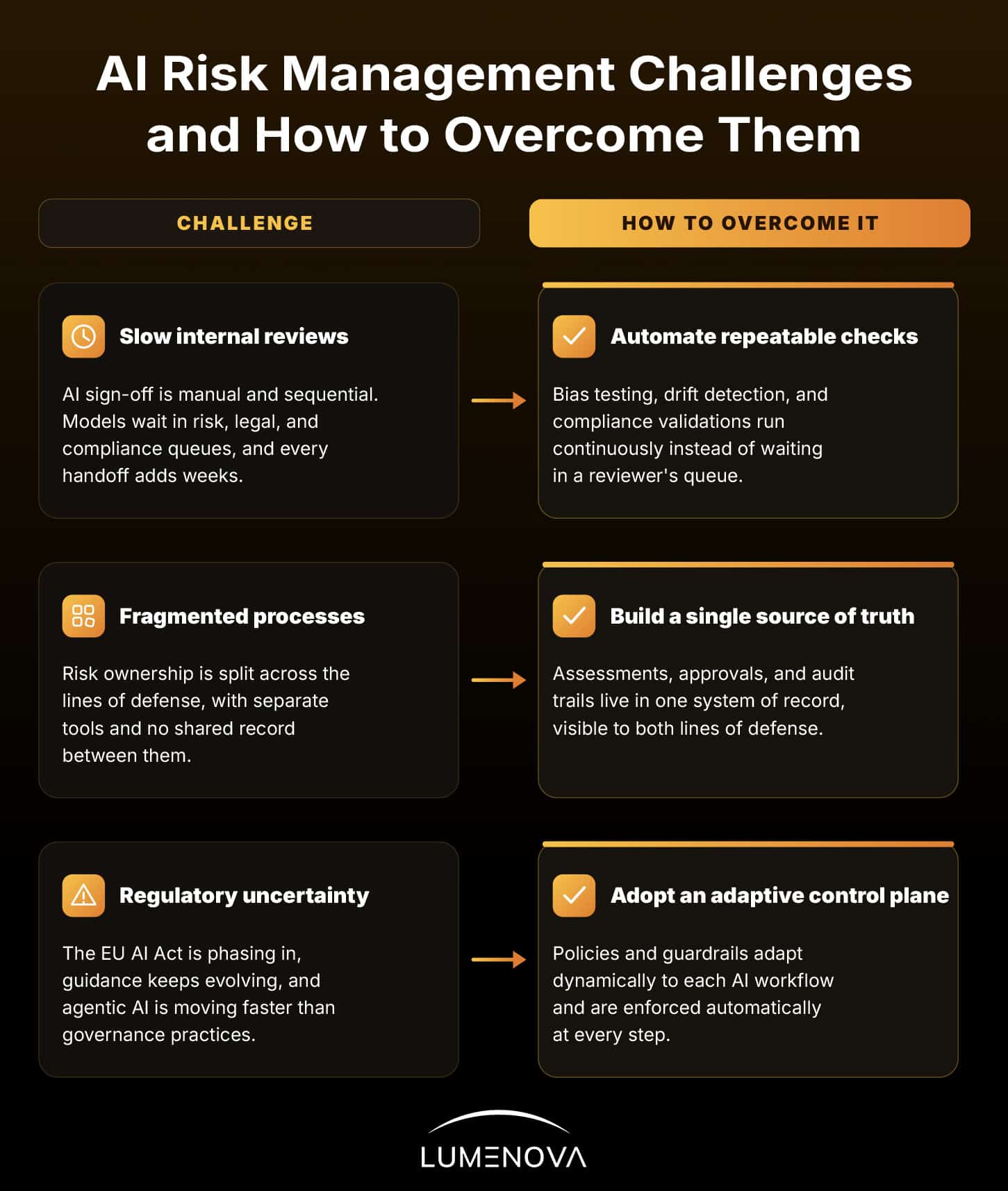
The most common challenges in AI risk management are slow internal reviews, fragmented ownership across the lines of defense, and regulatory uncertainty. Overcoming them requires a shared system of record, automated policy enforcement, and a governance framework that adapts as fast as the AI it oversees.
Slow Internal Reviews
In most enterprises, AI sign-off is still a manual, sequential process. Each model waits its turn through risk, legal, and compliance queues. In this way, every handoff adds weeks. The result is a bottleneck that frustrates business teams and, even worse, incentivizes them to route around governance entirely.
Fragmented Processes
Ask who owns AI risk in a large enterprise, and you’ll get three different answers. The teams building and operating AI applications run the assessments and generate the evidence. Legal, Compliance, and Model Risk Management set the policies and review what comes back. On paper, that’s a clean division of labor: the classic first and second lines of defense. In practice, each group works from its own tools and spreadsheets, so findings fall through the cracks, reviews get duplicated, and when a regulator asks for a complete audit trail, no one can assemble it.
Regulatory Uncertainty
Requirements are shifting under enterprises’ feet. The EU AI Act is phasing in, sector-specific guidance keeps evolving, and public pressure is pushing regulation that is slow to materialize and prone to reactive correction. Meanwhile, agentic AI capabilities and management pressure to deploy are advancing faster than most governance practices. Teams that wait for final rules will always be reacting. The only way to stay ahead is to build traceability, explainability, and automated enforcement into every actionable step. This applies to any AI system, including autonomous agents.
How to Overcome These Challenges?
The common thread across all three challenges is infrastructure, not effort. Adding more reviewers or longer checklists won’t fix a broken operating model. What leading organizations build instead:
- A foundational governance framework with a centralized control plane. The AI application defines the workflow; policies and guardrails adapt dynamically to it and are enforced automatically at every step.
- Automated execution of repeatable checks. Bias testing, drift detection, and compliance validations run continuously instead of waiting in a reviewer’s queue.
- A single source of truth for governance evidence. Assessments, approvals, and audit trails live in one shared system of record, visible to both lines of defense.
Together, these turn governance reviews from a bottleneck into a byproduct of how AI is built and run. But solving these challenges starts one step earlier, with how AI risks are identified in the first place.
How Can Companies Effectively Identify AI-Related Risks?
We suggest starting with our self-reporting AI risk assessment tools to identify gaps and operational risks. Automated tools that continuously evaluate models for bias, drift, and fairness across the entire lifecycle then watch for active risks in production.
The Limits of Manual Oversight
Most organizations still rely on spot-checks, ad-hoc reviews, and the undocumented knowledge of a few experienced people. This approach can’t keep up with a growing model portfolio, and it systematically misses edge cases: not because reviewers aren’t diligent, but because manual testing covers a limited set of scenarios. A human team can only think of so many ways a model might fail; the failure that matters is usually one nobody thought to test.
The Shift to Automated AI Risk Assessment Tools
Leading organizations are moving to automated, continuous evaluation that begins before deployment. Automating test execution is what makes robustness achievable at scale: instead of a handful of hand-picked scenarios, models are stress-tested against thousands, systematically and repeatedly.
What “Deep-Dive” Evaluation Looks Like in Practice
Effective risk identification covers bias detection, drift monitoring, and fairness testing applied across the model lifecycle, not just at launch. A model that passes every check at deployment can drift into unsafe territory six months later as data and conditions change. Identification has to be continuous to be real.
The Agentic AI Factor
Autonomous agents raise the bar further: they don’t produce a single output to review; they take sequences of actions which demand rigorous, real-time tracing and evaluation of every step an agent takes. Even if your organization isn’t deploying autonomous agents yet, putting automated AI risk tools in place now builds the muscle and the infrastructure for the additional automation agents will require.
Why This Matters More in Regulated Sectors
In banking, insurance, or healthcare, a missed risk doesn’t stay internal. It reaches customers as a biased credit decision or a flawed clinical recommendation and reaches regulators shortly after. Pre-deployment evaluation is the last point where a problem is still cheap to fix.
Identifying risk well, however, is only half the equation. Those findings have to map to the standards your regulators actually recognize, and that’s where the choice of approach comes in.
Ad-hoc Solutions vs. Consulting vs. an Integrated Platform
When enterprises get serious about AI risk, they typically choose between three approaches. Each has a distinct profile of strengths and trade-offs.
Ad-hoc and Manual Approaches
Spreadsheets, email approvals, and homegrown checklists are cheap upfront and easy to start with. But they don’t scale beyond a handful of models; they leave no defensible audit trail, and the risk of gaps grows with every new deployment. What looks free today becomes expensive the first time a regulator asks for evidence that doesn’t exist.
Traditional AI Risk Management Consulting
Consultants bring deep expertise and regulatory fluency, which matters when the questions are genuinely hard. The limitations are structural: engagements are slow, expensive, and project-based. A consulting report describes your risk posture at a point in time, but AI risk is continuous. When the engagement ends, the expertise leaves with it, and the organization is left without lasting infrastructure.
An Integrated AI Risk Management Platform
The right platform makes governance scalable, continuous, and systematized: automated assessments, standing audit trails, and monitoring that never sleeps. The honest caveat is that software alone can’t exercise judgment. Ambiguous or high-stakes calls, such as an edge case without an anticipated framework or a launch decision with major regulatory exposure, still need a human in the loop. The best platforms acknowledge this and are designed with human escalation loops built in, so those calls are routed to experts instead of forced through automation.
Seen this way, the choice isn’t really between people and software. It’s about finding an approach that combines the scale of a platform with the judgment of experienced practitioners. That combination is exactly what Lumenova AI was built to deliver. It pairs the scalability and continuous coverage of an integrated platform with consulting-grade human expertise, so ambiguous, high-stakes calls get expert judgment, and everything else gets automated.
| Ad-hoc/manual | Consulting | Integrated platform | |
| Upfront cost | Low | High | Moderate |
| Scales with portfolio | No | No | Yes |
| Continuous coverage | No | No (point-in-time) | Yes |
| Audit trail | None | Report-based | Standing system of record |
| Human judgment | Internal only | Deep, but leaves when the engagement ends | Yes, if escalation loops are built in |
| Lasting infrastructure | No | No | Yes |
How Lumenova AI Closes the Gap
Pairing software with human expertise is an easy claim to make, so here’s what it looks like in practice. Lumenova AI’s platform is built around three capabilities that map directly to the challenges covered earlier: continuous lifecycle management, out-of-the-box governance metrics, and embedded experts. If you’d rather see it than read about it, you can book a discovery call and walk through it with our team.
Automated Lifecycle Management
Lumenova AI monitors risk continuously, from pre-deployment evaluation through live production. Instead of a point-in-time audit that starts going stale the day it’s delivered, governance runs alongside your AI systems, catching drift, bias, and emerging risks as they appear.
200+ Built-in Governance Metrics
The platform assesses AI models across more than 200 quantitative and qualitative metrics out of the box, covering bias, drift, fairness, and robustness. Findings map directly to the frameworks regulators recognize, including the EU AI Act, NIST AI RMF, and ISO standards, so evidence is generated in the language of compliance from day one.
The Forward Deploy Team
This is where the consulting-grade layer comes in. Lumenova’s Forward Deploy Team is a group of specialists who integrate directly with your organization: they help unblock stalled AI projects, configure guardrails for your specific risk profile, and translate technical findings into plain-language insights your executives and board can act on. It’s the human escalation loop built into the operating model, not bolted on afterward.
What This Means for Your Organization
Less operational friction between the first and second lines of defense. Faster time-to-deployment, with safe, high-performing AI systems reaching production up to 50% faster. And the confidence that your reputation and model performance are protected by governance that never stops running.
Are There Industry Best Practices for Managing AI Risks?
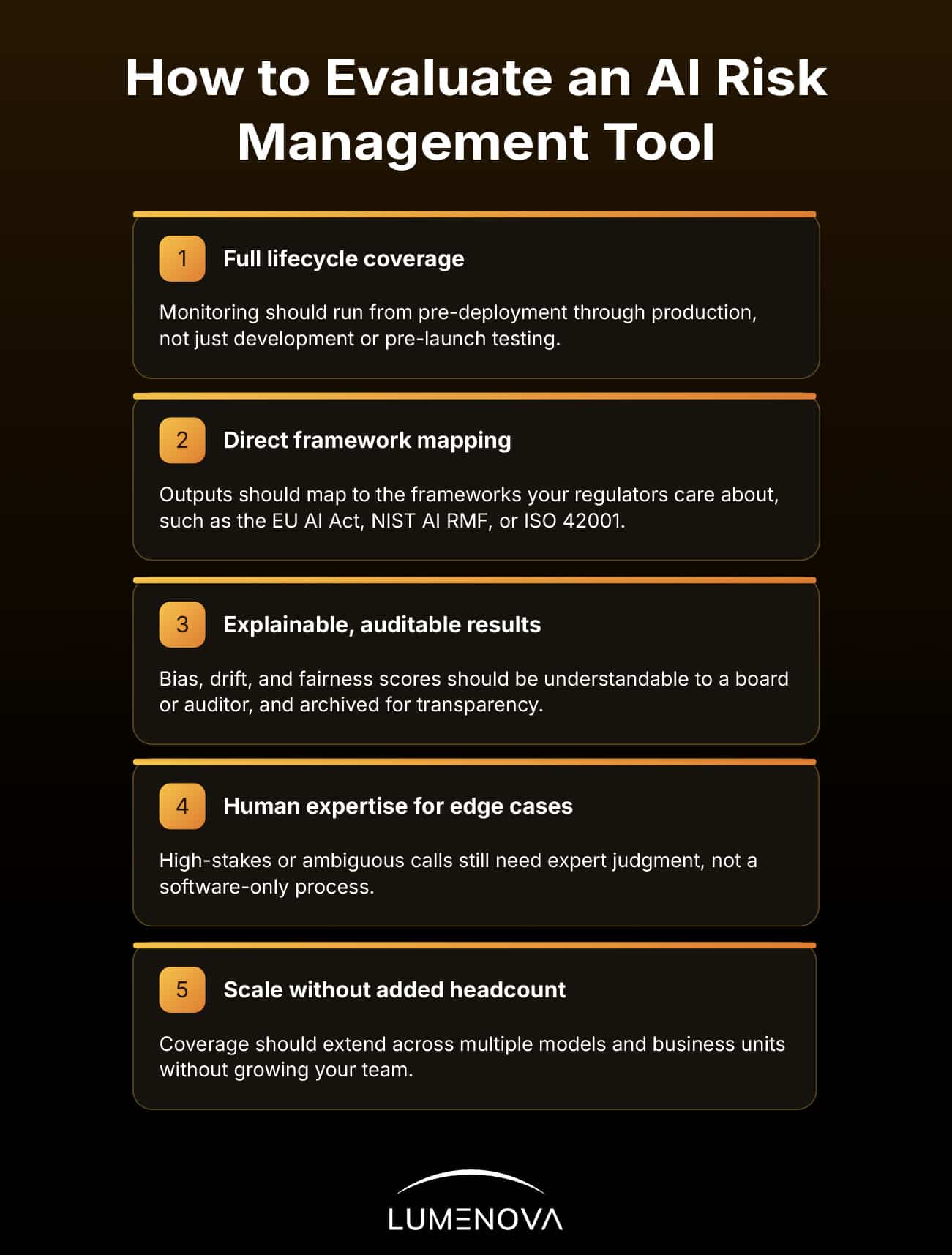
Yes. Across regulated industries, best practices for managing AI risks have converged on a few principles: govern the full AI lifecycle rather than a single checkpoint, map controls to recognized regulatory frameworks, keep evaluation results explainable and auditable, and combine automation with human expertise. The fastest way to apply them is to use them as an evaluation checklist. Before committing to any AI risk management tool, ask:
- Does it cover the full model lifecycle, not just development or pre-launch testing?
- Does it map directly to the frameworks your regulators care about, such as the EU AI Act, NIST AI RMF, or ISO 42001?
- Can it translate technical outputs into language a board or auditor can act on? Bias, drift, and fairness scores only matter if decision-makers understand them. Evaluation results should provide deep understanding and explainability, and be archived and fully auditable for transparency.
- Does it include human expertise for edge cases, or is it software-only?
- Can it scale across multiple models and business units without adding headcount?
A tool that clears all five questions isn’t just a compliance purchase. It’s infrastructure for deploying AI faster and more safely than competitors who are still running governance on spreadsheets.
Run Lumenova AI through this checklist yourself. Book a discovery call and ask all five questions to our team; we’ll answer them on your own use cases, not on slides.
Conclusion
AI adoption in regulated industries is no longer a question of if, but of how safely and how fast. The enterprises pulling ahead aren’t the ones with the most models in production. They’re the ones whose governance keeps pace with deployment: risks identified continuously instead of at spot-checks, evidence mapped to the frameworks regulators recognize, and human judgment built in where automation reaches its limits.
Choosing the right AI risk management tools is how that operating model becomes real. Treat the decision with the weight it deserves, because the cost of getting it wrong is measured in stalled projects, regulatory findings, and reputational damage. The profit of getting it right is a competitive advantage that compounds with every model you deploy.
Lumenova AI was built for enterprises that refuse to choose between speed and safety. Start with a self-serve AI risk assessment, or book a discovery call to see the platform on your own use cases.
Frequently Asked Questions
An AI risk management tool is software that identifies, assesses, and monitors the risks AI systems create, such as bias, drift, security vulnerabilities, and regulatory non-compliance. Enterprise-grade tools cover the full model lifecycle, from pre-deployment evaluation through continuous production monitoring, and generate audit-ready evidence mapped to regulatory frameworks.
AI governance is the broader discipline: the policies, roles, and processes that define how an organization develops and uses AI responsibly. AI risk management is a core function within it, focused specifically on identifying, measuring, and mitigating the risks AI systems pose. In practice, a strong governance program depends on risk management tooling to enforce its policies and produce its evidence.
The most widely adopted are the NIST AI Risk Management Framework, ISO/IEC 42001, and the EU AI Act’s risk-based requirements. Sector-specific guidance adds another layer, such as model risk management expectations in banking. Strong tools map their outputs to several frameworks at once, so one assessment produces evidence for all of them.
Responsibility is shared across the lines of defense: the teams building and operating AI systems run assessments and generate evidence, while Legal, Compliance, and Model Risk Management set policy and review it. What matters most is that all of them work from a single system of record, so ownership doesn’t fragment.