November 13, 2025
A Summary of EN 18286:2026: Quality Management System for EU AI Act Compliance
Contents
Approved by CEN-CENELEC on 12 July 2026 and published as EN 18286:2026, this is the first European standard developed in support of the EU AI Act to reach publication.
It establishes a Quality Management System (QMS) framework to help providers of high-risk AI systems demonstrate conformity with Article 17 of the EU AI Act. Publication, however, is not the final step: EN 18286:2026 has not yet been cited in the Official Journal of the European Union, meaning organizations implementing the standard do not yet benefit from a presumption of conformity under Article 40.
Once cited, the standard is intended to support a presumption of conformity with Article 17(1) and the first sentence of Article 11(1) through Annex ZA. The standard adopts a lifecycle-based approach spanning AI system design, development, deployment, monitoring, and retirement, while enabling organizations with existing sector-specific quality management systems to extend – not replace – their current compliance framework.
At a glance
- Status: Approved by CEN-CENELEC on 12 July 2026 and published as EN 18286:2026. As of this writing, it has not yet been cited in the Official Journal of the European Union, so presumption of conformity is not yet available.
- Path to publication: Following a public enquiry between 30 October 2025 and 22 January 2026, the revised text proceeded through formal approval before publication as EN 18286:2026.
- Purpose: Operationalize the EU AI Act’s Article 17 Quality Management System requirements for AI providers.
- Who it applies to: Organizations placing AI systems on the EU market or putting them into service, regardless of size or location, with providers of high-risk AI systems as the primary audience.
- Key focus: Lifecycle risk management, technical documentation, traceability, post-market monitoring, and maintaining the effectiveness of the Quality Management System through governance, review, and documented processes.
- Relationship to ISO/IEC 42001: Complementary rather than substitutable. ISO/IEC 42001 establishes an AI Management System for governance and risk management, whereas EN 18286 serves as the regulatory Quality Management System supporting EU AI Act compliance. The correspondence annexes align clauses between the standards but do not establish equivalence of requirements or concepts.
This article provides a detailed breakdown of EN 18286:2026, highlighting its key requirements, implementation considerations, and relationship with the EU AI Act. We will update this article as further guidance and harmonization developments become available.
EN 18286:2026: Detailed Breakdown
For this breakdown, we avoid referencing every clause and sub-clause individually, instead focusing on the standard’s core requirements and implementation considerations while broadly following its published structure.
Implementation Timeline
Before examining the standard’s requirements, it is helpful to understand its development and implementation timeline within the broader rollout of the EU AI Act.
- 2 August 2024: The EU AI Act entered into force, launching the phased implementation of its requirements and the development of harmonized European standards supporting compliance.
- October 2025: prEN 18286 became the first harmonized European standard supporting the EU AI Act to enter the CEN-CENELEC public enquiry process.
- 29 June 2026: The Digital Omnibus on AI postponed the application of obligations for standalone Annex III high-risk AI systems from 2 August 2026 to 2 December 2027.
- 12 July 2026: EN 18286:2026 was approved by CEN-CENELEC and published as the first European standard developed in support of the EU AI Act.
Overview
EN 18286:2026 establishes a Quality Management System (QMS) framework for AI providers seeking to demonstrate conformity with the EU AI Act, particularly Article 17, which sets out quality management system requirements for high-risk AI systems. The standard comprises ten normative clauses and five informative annexes and adopts a lifecycle-based approach covering AI system design, development, deployment, monitoring, and retirement. It is designed to complement existing quality and AI management systems while supporting implementation of the EU AI Act.
Important Note: Although EN 18286:2026 has been published, it has not yet been cited in the Official Journal of the European Union. Until that occurs, applying the standard does not provide a presumption of conformity under the EU AI Act. Once cited, its Annex ZA is intended to support a presumption of conformity for the relevant provisions it covers.
First and foremost, the standard centers on providers of AI systems (i.e., developers/entities placing AI systems on the market or into service under their name/trademark), effectively covering organizations of all sizes within or entering the EU market, and applying to systems functioning as standalone products or components of a broader system (e.g., AI modules). Ultimately, providers must show how their QMS ensures the protection of health, safety, and fundamental rights throughout the entire AI lifecycle. While we recommend that readers review the standard directly for all terms and definitions, we offer some key summaries below.
Definitions
- AI System: A machine-based and possibly adaptive (post-deployment) system that can generate outputs capable of influencing real or virtual environments.
- Provider: A natural or legal person, public authority, agency, or other body that develops an AI system or places it on the market or puts it into service under its own name or trademark.
- Deployer: An entity that utilizes an AI system under its authority (personal use excluded).
- Affected Person: Any individual or group that is impacted by an AI system’s operation.
- Fundamental Rights: The rights and freedoms protected by the EU Charter.
- Presumption of Conformity: A legal mechanism under EU harmonization legislation whereby compliance with a harmonized standard cited in the Official Journal of the European Union creates a rebuttable presumption that the
- Serious Incident: An event that causes serious harm, significantly infringes upon fundamental rights, or causes death.
- Substantial Modification: Any change that affects the intended purpose or compliance of an AI system, triggering a new conformity assessment.
How EN 18286:2026 Builds on ISO/IEC 42001
While EN 18286:2026 is designed to complement existing management system standards, particularly EN ISO/IEC 42001:2026, the two frameworks serve different purposes.
EN ISO/IEC 42001 establishes an organization-wide AI Management System (AIMS) focused on AI governance and risk management, whereas EN 18286:2026 translates the EU AI Act’s Article 17 requirements into a Quality Management System (QMS) that providers can use to demonstrate regulatory conformity. Rather than replacing an existing AIMS, EN 18286:2026 is intended to extend it with AI Act-specific quality management controls.
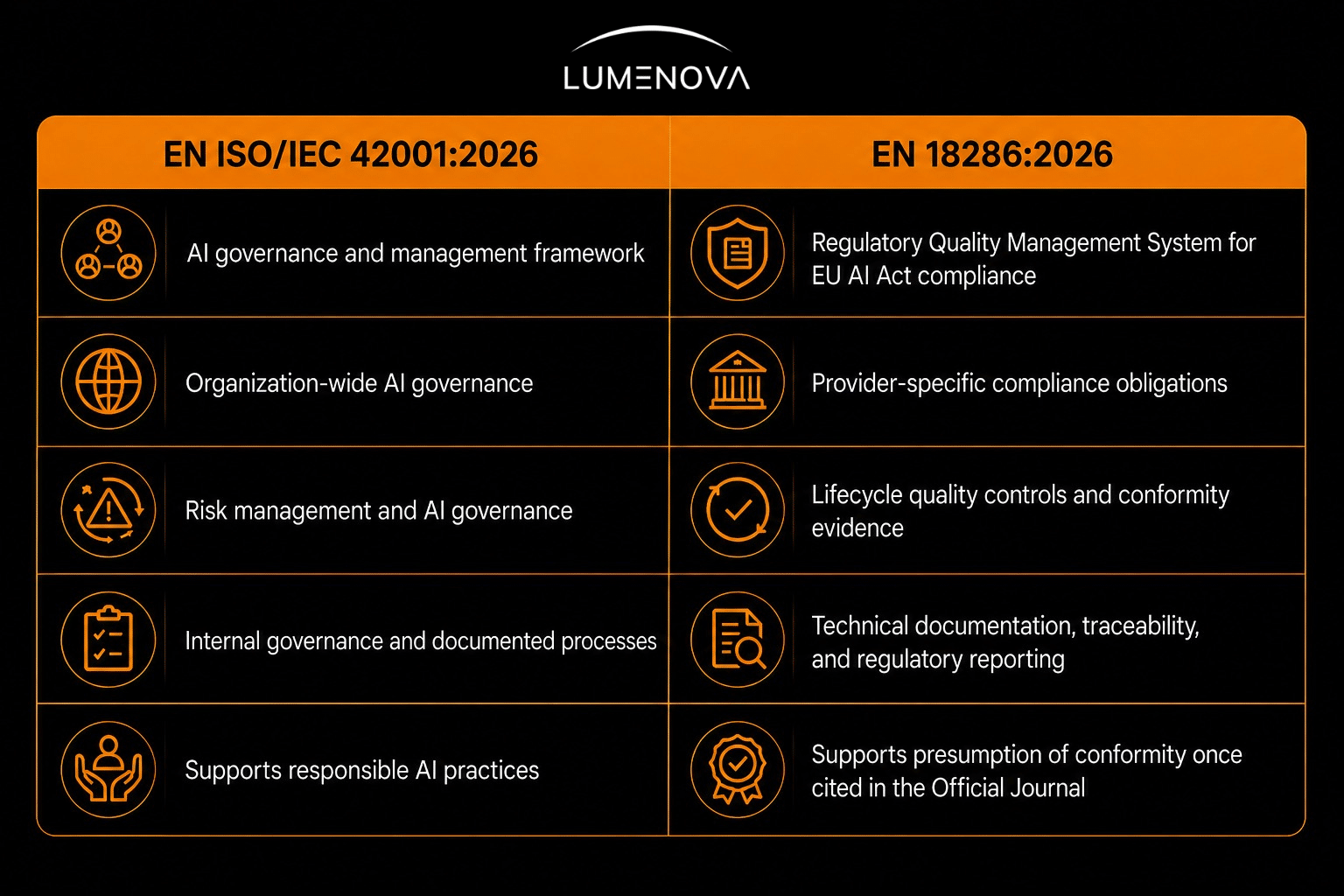
Organizations that have already implemented EN ISO/IEC 42001:2026 will find significant overlap in governance, risk management, documented processes, competence, and internal audits. However, EN 18286:2026 introduces additional provider-specific regulatory obligations, including:
- Technical documentation and lifecycle traceability supporting EU AI Act conformity.
- Post-market monitoring and serious incident reporting.
- Supplier oversight and conformity controls across the AI value chain.
- Evidence demonstrating compliance with Article 17 and related regulatory obligations.
EN ISO/IEC 42001 provides the governance foundation for managing AI responsibly, whereas EN 18286:2026 provides the regulatory quality management framework needed to support compliance with the EU AI Act. Organizations with an established AI Management System will therefore be well positioned to extend their existing governance framework rather than implement a separate quality management system from scratch.
How Organizations Can Operationalize These Requirements
The following comparison highlights how EN 18286:2026 translates regulatory obligations into operational activities and how Lumenova AI helps organizations manage those activities throughout the AI lifecycle.
| Compliance Area | EN 18286:2026 Requirement | How Lumenova AI Helps |
| Risk Management | Continuous AI lifecycle risk management | Centralizes AI risk identification, assessment, mitigation, and evidence collection |
| Documentation | Technical documentation, traceability, conformity evidence | Streamlines documentation workflows and maintains audit-ready evidence |
| Governance | Provider accountability and AI Act compliance | Assigns ownership, tracks obligations, and supports governance across the AI lifecycle |
| Monitoring | Post-market monitoring and incident reporting | Continuous monitoring and issue management |
| Suppliers | Supplier qualification and conformity controls | Maintains supplier assessments and third-party compliance records |
How EN 18286 Implements Article 17 QMS Requirements
The following sections outline how EN 18286:2026 operationalizes the Quality Management System requirements established under Article 17 of the EU AI Act.
General Requirements
AI providers are required to establish, document, implement, maintain, and continually improve their Quality Management System (QMS) to demonstrate compliance with the EU AI Act. At a minimum, the QMS should include:
- Plans for identifying and monitoring regulatory obligations.
- Processes for ensuring the protection of health, safety, and fundamental rights.
- Mechanisms for post-market monitoring and incident reporting.
- Protocols for maintaining traceability, documentation, and transparency.
Providers should also identify applicable EU and national legislation, determine essential regulatory requirements, define post-market monitoring and serious incident reporting obligations, and establish appropriate data management and retention strategies.
The QMS scope, which must be documented and updated when changes occur, should outline which AI systems/organizational units are included, necessary domain/sector/geographical coverage, and, for multi-organization providers, the roles and interfaces of each entity involved in the QMS. Crucially, the QMS must operationalize seven essential requirements, which mirror Chapter III, Section 2 of the EU AI Act:
- Risk Management System
- Data & Data Governance
- Technical Documentation
- Record-Keeping
- Transparency & Information Provision to Deployers
- Human Oversight
- Accuracy, Robustness & Cybersecurity
Finally, providers must demonstrate how they achieve compliance by identifying the harmonized standards, common specifications, or internal technical methods they apply, explaining how these measures address identified risks and essential requirements, and documenting the rationale for selecting each approach.
Documentation Requirements
Documentation requirements cover three core areas: QMS documentation, operational documentation, and document control.
- QMS Documentation → Includes the QMS scope, quality policy, and objectives, relevant processes, roles, procedures, and evidence, planning and control methods, and version-controlled, auditable, and accessible records written in official EU languages.
- Operational Documentation → Formal protocols for the planning, operation, and control of AI system processes, which include communication records, traceability files, and audit trails.
- Document Control → All documentation must guarantee format integrity and confidentiality, version control and approval workflows, change traceability, and retention for regulatory minimums.
Management Responsibility
Top management must integrate QMS requirements into business processes, allocate adequate resources to implement and maintain the Quality Management System, ensure its ongoing effectiveness, and communicate the importance of regulatory compliance to all relevant stakeholders.
Management must establish, document, communicate, and maintain a quality policy that demonstrates the organization’s commitment to applicable regulations, defines a framework for achieving quality objectives, and aligns with its regulatory strategy.
Providers must assign roles and responsibilities to personnel with appropriate competence, designate a compliance manager (or equivalent) to oversee QMS performance, and clearly document and communicate all relevant roles, authorities, and reporting lines.
Planning & Support Processes
Planning provisions target two domains: risk-based planning and quality objectives. Support processes, on the other hand, concern resources, competence, and communication.
- Risk-Based Planning: Providers must identify and address the array of risks and opportunities that can potentially affect their QMS and ability to fulfill regulatory objectives. Their final risk-based plans must ensure that all suggested actions are proportionate to an AI system’s possible impacts on health, safety, and fundamental rights.
- Quality Objectives: Objectives must be measurable, realistic, and consistent with the established quality policy, aligned with fundamental rights protection and EU AI Act obligations, and specify who, what, when, and how results will be evaluated.
- Resources: Providers must determine and provide the human, technical, and infrastructural resources required to implement and uphold their QMS, including any necessary data/computational resources and secure supply chain mechanisms.
- Competence: Procedures to guarantee core personnel competency via education, training, and evaluation must be implemented, and evidence of ongoing qualifications and training efficacy must be maintained.
- Communication: Internal and external communication protocols should cover relevant authorities (e.g., market surveillance authority, notified bodies), distributors/importers/deployers, incident and non-conformity notifications, and the delivery of compliance documentation.
Product Realization
Risk Management System
Providers must apply risk management processes continuously throughout the AI lifecycle. They must identify, evaluate, and mitigate risks, maintain traceability between lifecycle stages and design decisions, and document residual risks. Providers must also define each lifecycle stage (design, development, testing, deployment, maintenance, and retirement), and map appropriate controls, responsibilities, and verification activities to each stage.
- Note: Providers must also identify environmental impacts like energy use, emissions, and lifecycle materials, and correspondingly implement appropriate mitigation and sustainability measures.
For the design and development phases, providers must prepare relevant plans, define design input and output controls, and document their verification, validation, and change management processes. Providers must also assess the risks associated with every change and document the results.
Moreover, verification and validation approaches must establish and implement repeatable procedures that can ensure outputs consistently meet input and application requirements. Where/when high-risk AI systems are employed, providers should be ready to administer independent evaluations as necessary.
Separately, providers must establish comprehensive data management procedures for:
- Data acquisition, labelling, storage, filtration, mining, aggregation, and retention.
- Lifecycle-specific data handling (e.g., training, validation, testing, post-market monitoring, etc.).
- Data destruction and reuse policies when systems are decommissioned.
For each AI system, providers must maintain documentation that:
- Demonstrates its conformity with the EU AI Act.
- Describes design rationale, architecture, datasets, and testing protocols.
- Includes configuration and version information (i.e., software bill of materials).
- Contains and describes deployment instructions, accuracy, robustness, and cybersecurity information.
- Is continuously updated to reflect system modifications.
Operation & Control
For deployment and monitoring, providers must ensure the existence of deployer-facing mechanisms for risk reporting and mitigation guidance, while also establishing their own plans and procedures for deployment, feedback collection, and issue resolution. Additionally, all external suppliers (i.e., data, model, and service providers) must be qualified and monitored such that the extent of controls applied is proportional to the supplier’s potential impact on health, safety, and fundamental rights. All supplier contracts should clearly define conformity obligations, verification, and change management requirements.
Before any changes to AI systems are made, formal change-control procedures must be implemented, covering how changes are identified, evaluated, documented, and approved. These procedures should also include any pre-determined change plans for adaptive/continuous learning systems, as well as version identification and monitoring thresholds.
Every individual AI system (or family of systems) must be accompanied by a risk-proportional post-market monitoring plan, whose results are fed into continuous improvement and risk management updates, and that collects and analyzes data on:
- Usability, oversight efficacy, and user experience.
- Incidents, malfunctions, near-misses, and discriminatory outcomes.
- Environmental and operational context changes.
When a serious incident occurs, providers must investigate the incident, identify its root cause, implement corrective actions, document the lessons learned, update the relevant technical documentation, and notify the competent market surveillance authority and, where applicable, the notified body. Although reporting timelines vary according to the nature of the incident, providers should treat immediate notification as the default expectation.
On top of this, providers must continuously detect, record, and address nonconformities, evaluating causes and the need for action, verifying the efficacy of implemented corrections, and making appropriate QMS changes if necessary.
Performance Evaluation & Improvement
For their QMS to effectively maintain compliance with the EU AI Act while protecting health, safety, and fundamental rights, providers must regularly review risk-control efficacy, quality-objective achievement, and stakeholder feedback, including feedback obtained from affected persons.
More specifically, top management must periodically review the adequacy of the quality policy, quality objectives, performance results, incidents, corrective actions, and opportunities for improvement. Management must document these reviews in detail and establish escalation procedures and confidentiality mechanisms for internal whistle-blowing.
Finally, providers must plan, resource, document, and evaluate all QMS changes while continually enhancing the system’s effectiveness through the following mechanisms:
- Audits, continuous monitoring, and data analysis.
- Corrective and/or preventive actions.
- Innovation and feedback integration.
Annexes
EN 18286:2026 includes five informative annexes (Annexes A–C and ZA–ZB) that provide additional implementation guidance, mappings to related standards, and correspondence with the EU AI Act. Together, these annexes help organizations integrate the standard into existing management systems while supporting regulatory compliance.
- Annex A: Describes a structured process for engaging affected persons throughout the AI lifecycle, ensuring consultation outcomes inform risk identification, mitigation, and continual oversight.
- Annex B: Provides a clause-by-clause correspondence between EN 18286:2026 and EN ISO 9001:2015, supporting integrated management systems and audits. The annex explicitly notes that it maps clauses only, not requirements or concepts.
- Annex C: Provides a clause correspondence between EN 18286:2026 and EN ISO/IEC 42001:2026, illustrating how an AI Management System (AIMS) can complement an AI Quality Management System (QMS). As with Annex B, the mapping applies to clauses rather than demonstrating equivalence of requirements.
- Annex ZA: Maps the standard’s requirements to the corresponding provisions of the EU AI Act and specifies which legal obligations the standard supports for presumption of conformity once cited in the Official Journal of the European Union.
- Annex ZB: Lists the significant technical changes introduced between the draft (prEN 18286) and the published EN 18286:2026, providing transparency regarding the standard’s evolution.
The Lumenova AI Compliance Bridge
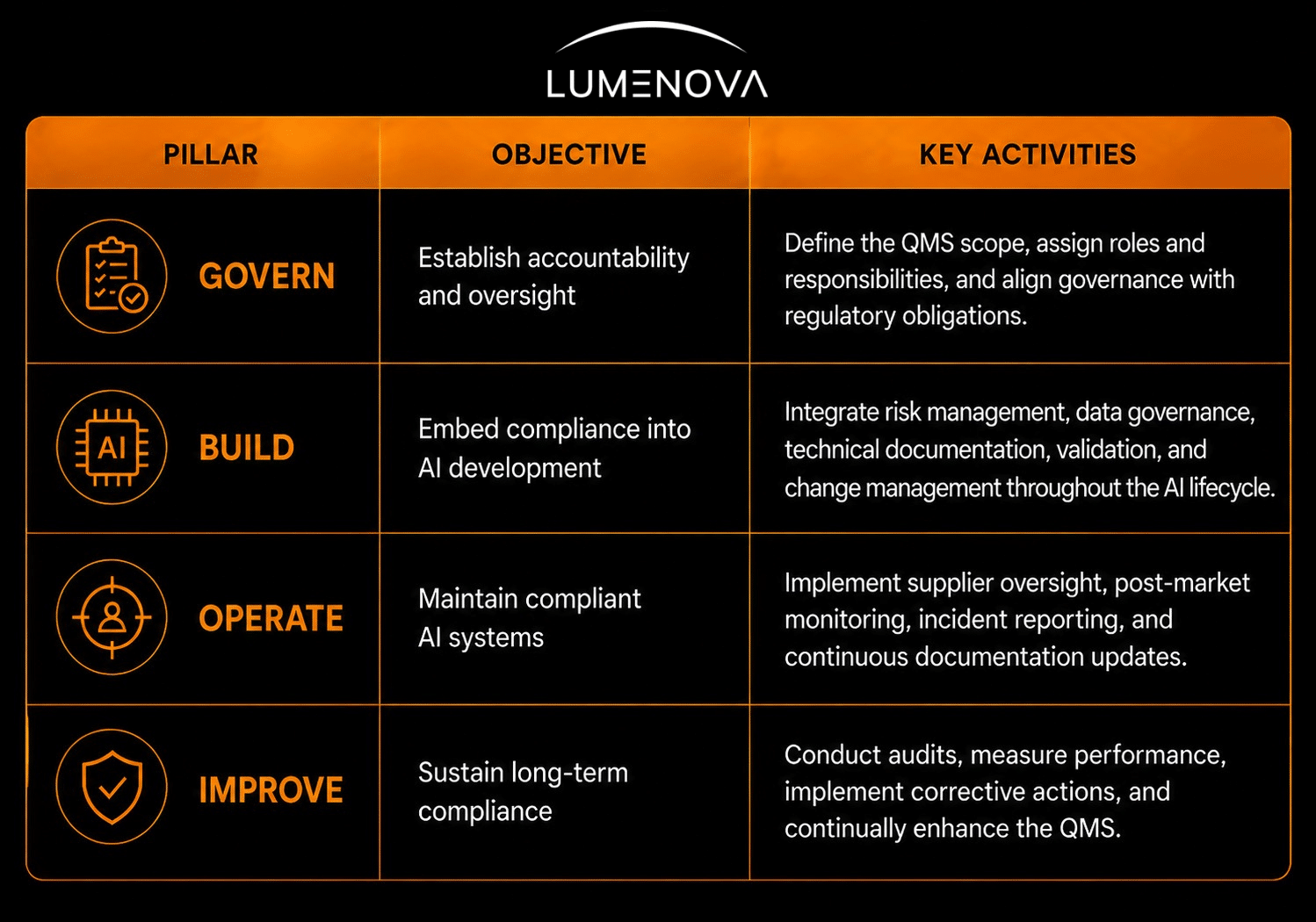
Implementing EN 18286:2026 requires more than documenting a Quality Management System; it requires embedding regulatory requirements into AI governance, development, deployment, and ongoing oversight. At Lumenova AI, we recommend approaching compliance as a continuous operational process rather than a one-time conformity exercise.
This means integrating governance, risk management, technical documentation, supplier oversight, post-market monitoring, and management review into everyday AI operations. By treating compliance as part of the AI lifecycle rather than a standalone project, organizations can strengthen regulatory readiness while reducing duplicated effort and improving long-term governance.
Conclusion
EN 18286:2026 provides the first published Quality Management System (QMS) framework developed specifically to support implementation of the EU AI Act. While it has not yet been cited in the Official Journal of the European Union and therefore does not yet confer a presumption of conformity, it offers the clearest regulatory blueprint available for operationalizing Article 17 requirements.
Key takeaways include:
- EN 18286:2026 operationalizes Article 17: It translates the EU AI Act’s quality management requirements into an auditable management system for AI providers.
- The standard is provider-centric: It applies to providers placing AI systems on the EU market or into service under their own name or trademark, requiring lifecycle accountability across design, deployment, monitoring, and retirement.
- Existing management systems provide a strong foundation: Organizations already implementing EN ISO 9001 or EN ISO/IEC 42001 can extend those systems with the additional regulatory controls introduced by EN 18286:2026 rather than building a separate QMS.
- Lifecycle risk management is central: Providers must identify, assess, mitigate, and monitor risks throughout the AI lifecycle while protecting health, safety, and fundamental rights.
- Documentation and traceability are essential: Organizations must maintain comprehensive technical documentation, lifecycle records, and evidence demonstrating ongoing conformity with the EU AI Act.
- Governance extends beyond internal processes: Top management, supplier oversight, post-market monitoring, incident reporting, and management review all form integral components of the QMS.
- Fundamental rights protection is embedded throughout the lifecycle: Providers must integrate risk management, data governance, human oversight, and stakeholder engagement throughout the AI lifecycle to protect fundamental rights from development through post-market monitoring.
To sum up…
Although EN 18286:2026 has now been published, organizations should continue monitoring developments related to its citation in the Official Journal of the European Union and any accompanying implementation guidance. In the meantime, strengthening AI governance through established management system standards such as EN ISO 9001 and EN ISO/IEC 42001 can significantly reduce the effort required to implement EN 18286:2026 and prepare for full EU AI Act compliance.
For readers interested in exploring more content on AI regulation, risk management, and governance, we recommend following Lumenova AI’s blog, especially if you need to track and understand the latest updates in the AI landscape.
For those who wish to take practical steps toward improving and streamlining their AI governance and risk management initiatives, we invite you to check out Lumenova AI’s responsible AI platform and book a product demo today.