July 7, 2026
Governance Frameworks for Multi-Agent Systems: Designing for Observability, Control, and Trust
Contents
Key Insights
- Multi-agent systems introduce governance challenges that traditional AI frameworks weren’t designed to address.
- Effective governance extends beyond model oversight to runtime operations, including agent orchestration, tool use, and agent-to-agent interactions.
- Three pillars underpin successful multi-agent governance: observability (visibility into agent behavior), control (policy-driven constraints and intervention), and trust (auditability, accountability, and continuous validation).
- Organizations should adapt governance frameworks to their unique architecture, risk profile, and regulatory obligations rather than applying them as one-size-fits-all solutions.
- Embedding governance into the design of multi-agent systems helps organizations scale agentic AI safely and responsibly.
What Is a Governance Framework for Multi-Agent Systems?
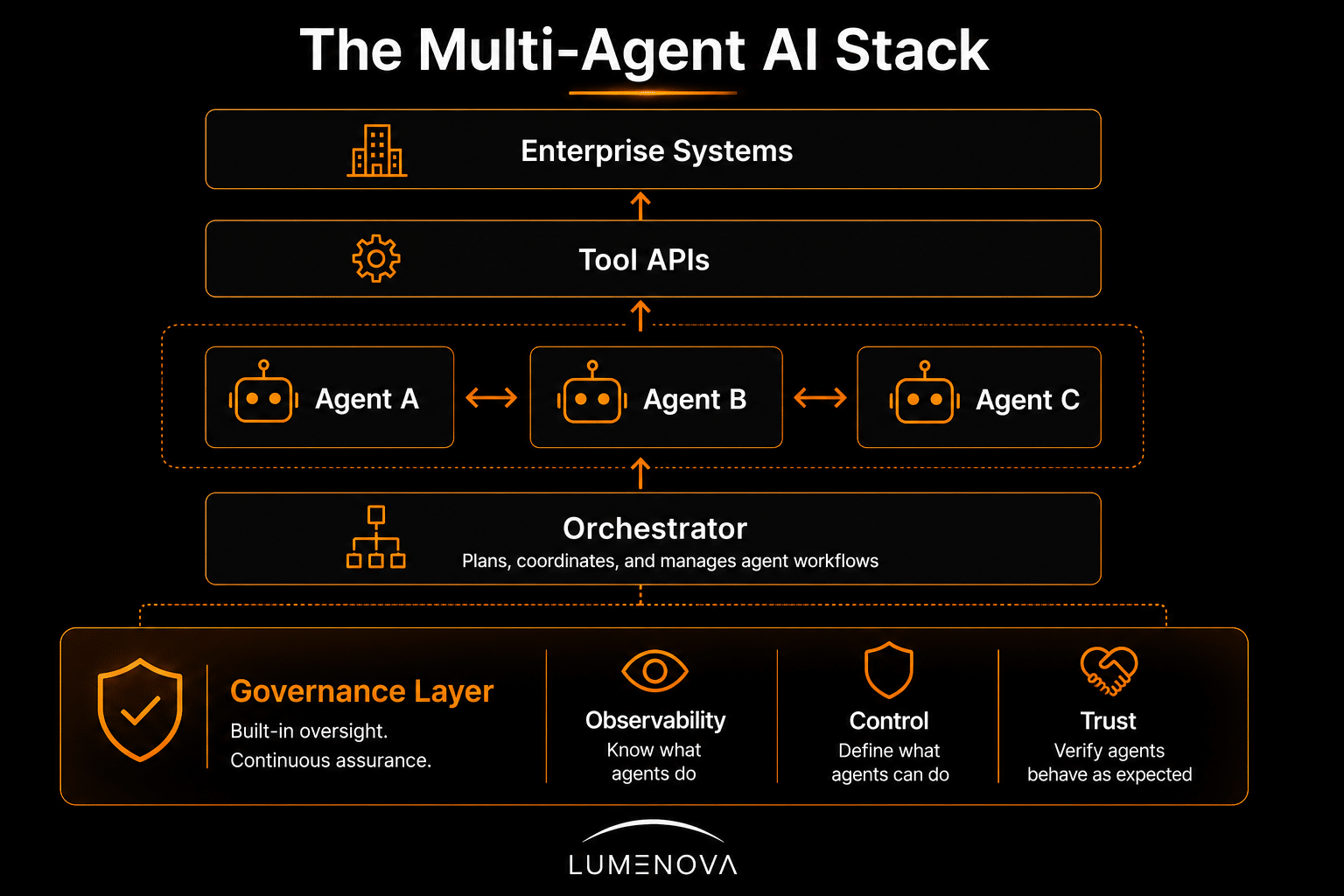
Governance frameworks for multi-agent systems are combinations of policies, technical controls, monitoring capabilities, and organizational processes that ensure autonomous AI agents operate safely, transparently, and in alignment with business objectives, regulatory requirements, and organizational risk tolerance.
Governance for multi-agent systems builds on the foundations of traditional AI and machine learning (ML) governance rather than replacing them. While traditional ML governance focuses on the lifecycle of individual models – including development, validation, deployment, and monitoring, multi-agent governance expands that scope to include how autonomous agents interact, delegate tasks, access external tools, and make decisions collectively at runtime.
An effective agentic governance framework should define:
- agent identities and responsibilities
- permission boundaries
- acceptable tool usage
- audit and logging requirements
- human oversight mechanisms
- intervention procedures
- accountability across complex workflows
Rather than treating governance as a compliance exercise, organizations should view it as an operational capability that enables agentic AI to scale safely.
Why Standard Frameworks Don’t Cover Multi-Agent Systems
Most AI governance standards were developed before today’s rapid adoption of agentic architectures.
Existing frameworks establish valuable principles around transparency, accountability, fairness, model inventory, and risk management. However, they rarely provide implementation guidance for systems composed of multiple autonomous agents coordinating toward shared objectives.
In a multi-agent environment, governance challenges become fundamentally different.
Agents may:
- delegate tasks to other agents
- dynamically select tools
- exchange intermediate reasoning
- create long-running execution chains
- modify plans based on changing context
- interact with external APIs and enterprise systems
These distributed interactions create failure modes that traditional governance frameworks do not explicitly address.
For example, determining responsibility becomes difficult when multiple agents contribute to a final output. Similarly, runtime risks such as recursive delegation, unauthorized tool usage, prompt injection propagation, or unexpected coordination failures require controls that extend beyond conventional model governance.
This doesn’t mean organizations should abandon existing frameworks. Instead, governance principles must be interpreted through the lens of agentic workflows, translating high-level guidance into technical safeguards that reflect how modern AI systems actually operate.
How to Adapt Governance Frameworks for Your Organization’s Multi-Agent Systems
No governance framework is plug-and-play. While standards provide valuable principles for responsible AI, they don’t prescribe how those principles should be implemented in every environment. Organizations need to interpret governance frameworks based on their AI architecture, risk profile, regulatory obligations, and operational requirements.
The table below highlights some of the key considerations when adapting a governance framework for multi-agent systems:
| Consideration | Questions to Ask | What to Prioritize |
| Agent architecture | How are agents orchestrated? Can they delegate tasks, use tools, or share memory? | Runtime observability, distributed tracing, and clear accountability across agent workflows |
| Risk profile | What is the potential impact if an agent behaves unexpectedly or makes an incorrect decision? | Risk-based governance controls, escalation paths, and continuous monitoring |
| Data sensitivity | Will agents access confidential, regulated, or proprietary information? | Least-privilege access, data governance policies, monitoring for sensitive data exposure |
| Regulatory requirements | Which regulations, standards, or internal policies apply to your AI systems (e.g. EU AI Act, ISO/IEC 42001, etc)? | Policy enforcement, audit-ready documentation, evidence collection for compliance |
| Human oversight | Which decisions should require human approval, and when should operators be able to intervene? | Human-in-the-loop checkpoints, approval workflows, pause/override mechanisms, kill switches for high-risk actions |
| Operational maturity | What governance processes, tools, or controls already exist in your organization? | Build on existing AI, security, and risk management practices rather than creating separate governance practices |
While the specific implementation will vary by organization, these considerations help translate high-level governance principles into practical controls for multi-agent systems. From there, organizations can focus on the three operational pillars that underpin effective governance: observability, control, and trust.
Key Focus Areas for Governing Multi-Agent Systems
Multi-agent systems introduce governance challenges that extend beyond individual models. Organizations must govern not only model outputs but also how agents interact with one another, external tools, enterprise systems, and human users.
A comprehensive governance framework should address:
Agent Identity
- The ability to uniquely identify and authenticate every AI agent within a multi-agent system.
Every agent should have a unique identity that supports authentication, authorization, and traceability. Clear identities make it possible to determine which agent performed a given action and establish accountability across complex workflows.
Permissions and Access
- The policies and controls that determine which data, tools, APIs, and resources an AI agent can access.
Agents should only have access to the data, APIs, and tools required for their role. Applying the principle of least privilege helps reduce the risk of unauthorized actions and limits the potential impact of compromised agents.
Agent Orchestration
- The coordination and management of how multiple AI agents collaborate, communicate, and execute tasks.
Governance should define how agents collaborate, delegate tasks, and share information. Organizations should establish rules for delegation, communication, and workflow execution to prevent unintended behaviors.
Auditability
- The ability to record, reconstruct, and review agent actions, decisions, and interactions.
Every significant interaction, from tool invocations to state changes, should be recorded. Comprehensive audit logs support compliance, incident investigations, and continuous improvement.
Human Intervention
- The mechanisms that allow human operators to review, approve, pause, or override AI agent actions.
Organizations should determine when humans remain part of the decision-making process. High-risk actions may require approval workflows, while runtime controls such as pause, override, or kill switches enable operators to intervene when necessary.
Accountability
- The ability to assign responsibility for AI agent behavior and explain how decisions were made.
Governance should clearly define ownership for agent actions, ensuring organizations can explain who (or what) made a decision and why.
Traditional AI and ML governance assumes oversight of individual models throughout their lifecycle. Multi-agent systems introduce an additional layer of complexity, with autonomous agents collaborating, delegating tasks, and interacting with external tools in real time.
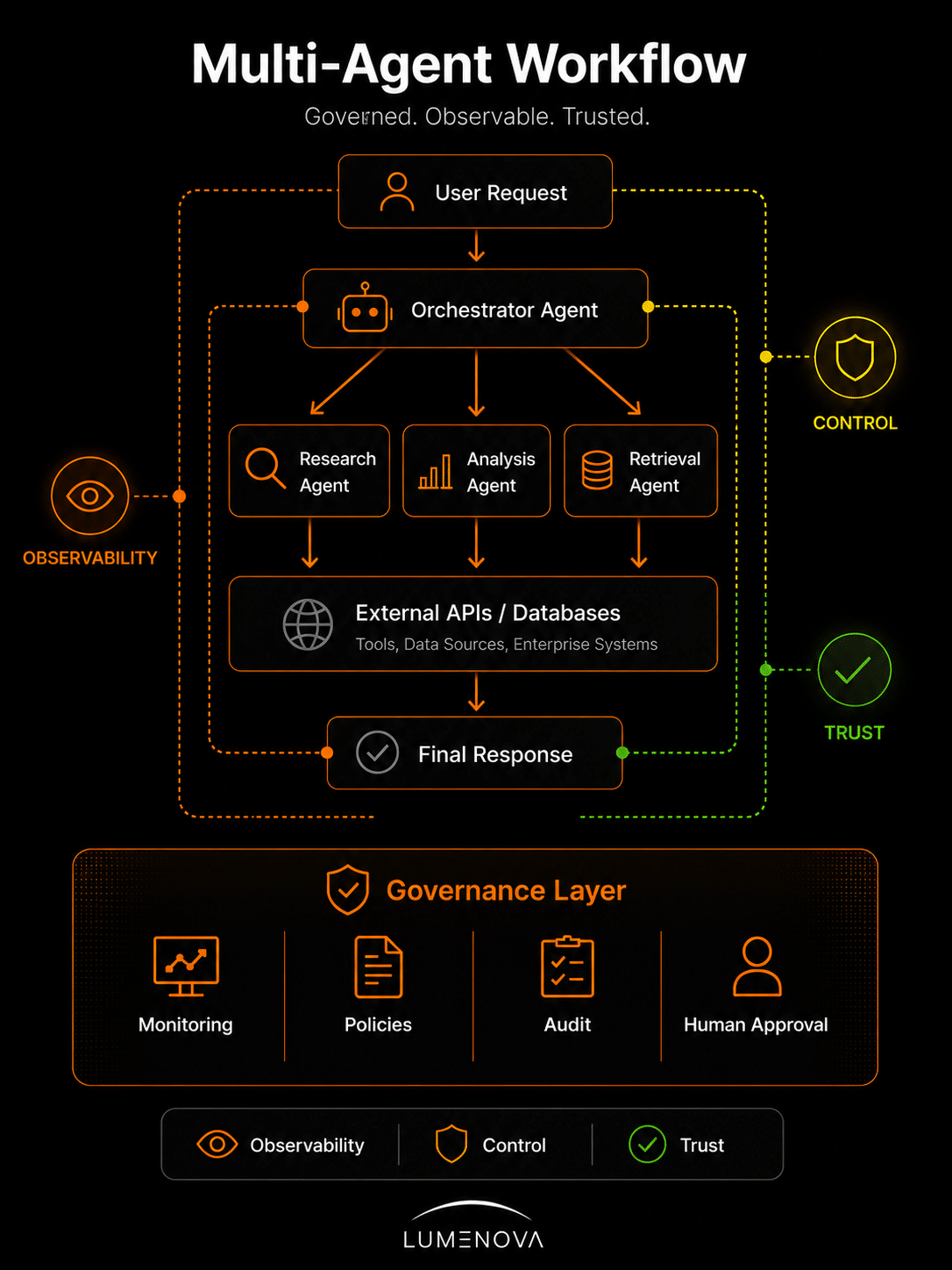
As a result, governance must extend beyond model oversight to continuous runtime governance built on observability, control, and trust.
Observability: Knowing What Your Agents Are Doing
You cannot govern what you cannot see.
Observability provides continuous visibility into how agents behave during runtime, making it possible to diagnose failures, investigate incidents, and improve system performance.
Unlike single-model applications, multi-agent systems generate complex execution graphs rather than linear workflows. Understanding these interactions requires tracing every step across the agent network.
Key observability capabilities include:
- distributed tracing across agent chains
- correlation IDs linking execution paths
- logging inter-agent communication
- monitoring tool invocations
- tracking state transitions
- recording decision points
- runtime anomaly detection
High-quality telemetry allows engineering, security, and governance teams to reconstruct exactly how a particular decision was made, even when dozens of agents participate.
Emerging observability platforms provide valuable operational visibility. However, observability should also connect directly to governance workflows by enabling auditability, policy validation, and incident investigation.
Lumenova AI extends AI observability beyond application monitoring by providing governance-focused runtime visibility. Organizations gain centralized insights into agent behavior, execution paths, policy compliance, and operational risks, enabling continuous oversight across complex agentic systems.
Control: Limiting What Your Agents Can Do
Observability explains what happened.
Control determines what is allowed to happen.
As agent autonomy increases, organizations must establish clear operational boundaries that prevent unintended behavior without unnecessarily restricting productivity.
The foundation of control begins with identity.
Every agent should possess a clearly defined identity, associated permissions, and explicitly scoped responsibilities. Applying the principle of least privilege ensures agents receive access only to the tools, data, and systems required for their designated tasks.
Effective control mechanisms include:
- role-based agent permissions
- scoped API access
- tool allowlists
- sensitive data restrictions
- execution budgets
- workflow approval gates
- runtime intervention hooks
Organizations should also design intervention capabilities that allow operators to pause, override, or terminate agent execution when anomalous behavior is detected.
For high-risk workflows such as financial decisions, legal approvals, or healthcare recommendations, human-in-the-loop checkpoints remain an essential governance safeguard.
Lumenova AI enables policy-as-code to automate governance while supporting human oversight through configurable policies, agent permissions, and runtime controls.
Trust: Building Verifiable Agent Behavior
In multi-agent systems, trust depends not only on individual model quality but also on the integrity of interactions between agents.
Organizations should establish explicit trust boundaries defining which agents may communicate, what information may be exchanged, and which outputs require additional verification before downstream execution.
Additional trust-building practices include:
- provenance tracking for agent outputs
- cryptographic signing where appropriate
- immutable audit logs
- continuous alignment evaluation
- monitoring for behavioral drift
- adversarial testing of multi-agent workflows
Red-teaming becomes particularly important in agentic systems. Security teams should regularly test for prompt injection attacks, role confusion, privilege escalation, unauthorized delegation, and cascading failure scenarios that emerge only through coordinated agent interactions.
Building trust therefore becomes an ongoing operational process rather than a one-time validation exercise.
How Lumenova AI Helps Organizations Govern Multi-Agent Systems
Multi-agent systems represent the next evolution of enterprise AI, but they also redefine what effective governance requires.
As autonomous agents become capable of coordinating complex workflows, organizations must move beyond static compliance checklists toward operational governance built on continuous observability, enforceable control, and verifiable trust.
Lumenova AI helps organizations operationalize governance through:
- Governance Consulting: Develop an AI governance strategy tailored to your organization’s use cases, risk profile, and regulatory requirements.
- Technical Implementation: Implement runtime observability, policy-as-code, AI risk assessments, and continuous monitoring to govern multi-agent systems at scale.
- Forward Deploy Team: Work alongside Lumenova AI engineers to integrate governance into your AI stack, accelerate deployment, and operationalize governance with minimal disruption.
Organizations that succeed with agentic AI will treat governance not as a constraint on innovation, but as the foundation for safe, scalable autonomy.
Ready to build trustworthy multi-agent AI? Book a discovery call with Lumenova AI to learn how our governance platform and expert team can help you design, deploy, and govern agentic systems with confidence.
Frequently Asked Questions
Governance should be established before multi-agent systems are deployed in production, not after issues arise. Embedding governance early helps organizations define policies, assign responsibilities, and implement controls that can scale as agent autonomy increases.
Effective governance is a cross-functional effort. While technical teams implement controls, governance should also involve stakeholders from security, risk, legal, compliance, and business leadership. Clear ownership ensures governance policies are consistently defined, enforced, and reviewed.
Organizations should define metrics that go beyond system performance. Examples include policy violation rates, response times to incidents, audit completeness, human intervention frequency, unauthorized tool access attempts, and the time required to investigate agent behavior.
Some of the most common risks include uncontrolled agent delegation, privilege escalation, prompt injection that propagates across multiple agents, conflicting agent objectives, excessive tool access, and a lack of traceability when incidents occur.
Not when it’s implemented correctly. Effective governance provides standardized guardrails that allow teams to deploy and iterate on AI systems with greater confidence. Rather than becoming a bottleneck, governance reduces operational risk and accelerates responsible adoption.
Governance shouldn’t be treated as a one-time exercise. Organizations should regularly review policies as agent capabilities evolve, new tools are introduced, business objectives change, or regulations and internal risk requirements are updated.