Contents
For years now, model risk management (MRM) has been the bedrock of institutional stability, particularly in highly regulated sectors like banking and insurance. Guided by frameworks such as SR 11-7 (now obsolete), the traditional MRM lifecycle was built on a core assumption: models are discrete, predictable functions that map a specific input to a specific output. Validation was a point-in-time exercise, rigorously designed to ensure a model’s logic remained sound before it reached production.
However, as we move through 2026, the arrival of agentic AI has rendered this legacy approach not just inefficient but fundamentally risky. Unlike the passive models of the past, agentic systems possess autonomy. They do not merely suggest an answer; they plan multi-step workflows, call external APIs, and execute actions within enterprise environments – exponentially increasing the risk of unintended error or intentional exploitation.
By reading this article, you will find out:
- Why traditional, static MRM fails in the face of autonomous AI agents and multi-agent systems (MAS).
- How to transform a passive “spreadsheet graveyard” into a dynamic, context-aware model registry.
- How to move from subjective “gut-feeling” ratings to automated, quantitative risk scoring through Data-Driven Risk Assessment (DDRA).
- The technical requirements for real-time drift detection and automated kill-switches to prevent systemic failure.
- How to use explainability (XAI) and automated reporting to meet the strict transparency mandates of the EU AI Act and ISO/IEC 42001.
Legacy vs. Modern MRM: The Shift from Static Code to Agentic Behavior
To understand the requirements of a modern solution, we must first contrast it with the manual, siloed processes that still dominate many enterprises.
Legacy MRM was designed for a world of small data, linear regressions, and statistical accuracy. Modern MRM must be built for the era of the autonomous AI agent.
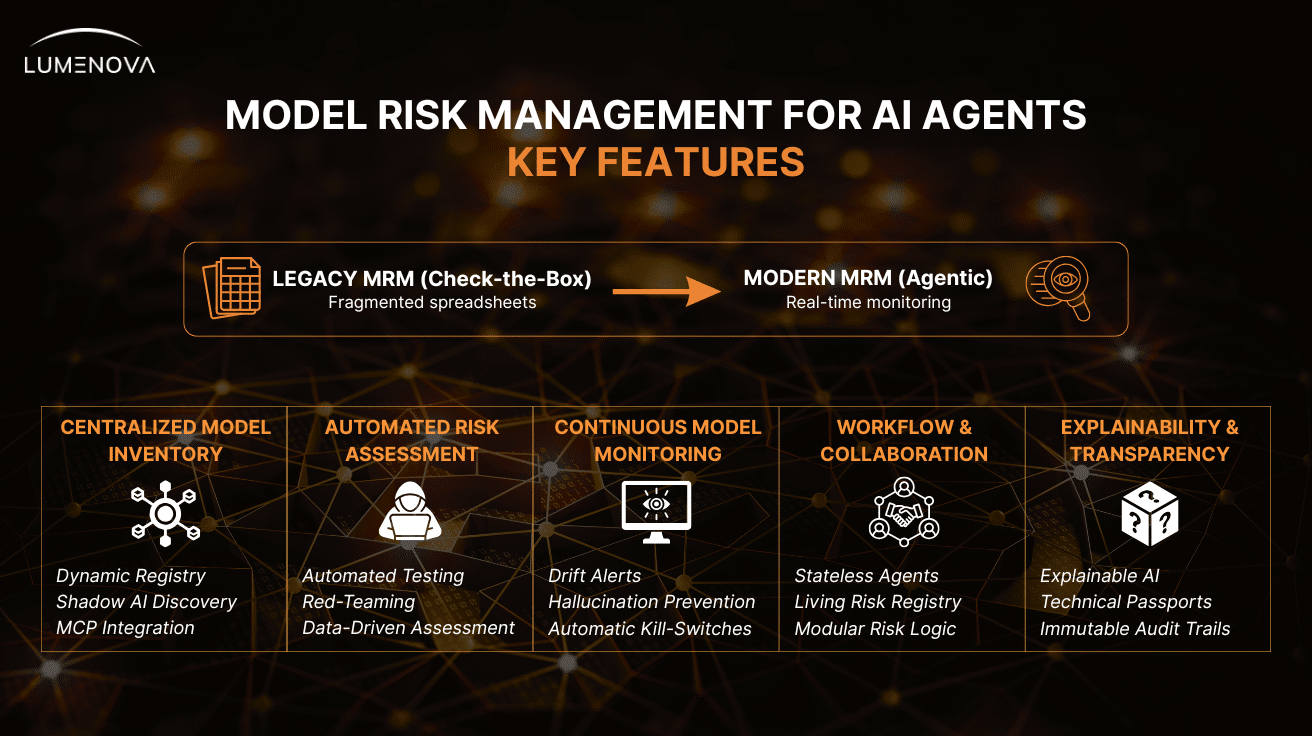
| Capability | Legacy MRM (The “Check-the-Box” Era) | Modern MRM (The “Agentic” Era) |
| Model Inventory | Fragmented spreadsheets and manual PDFs. | Centralized, real-time “Source of Truth” with automated discovery. |
| Lifecycle Speed | Months of manual validation; reactive reviews. | Continuous CI/CD integration; automated “pre-flight” testing. |
| Risk Scope | Statistical accuracy and data quality. | Behavioral risks: autonomy, tool-use, and multi-agent loops. |
| Monitoring | Periodic (quarterly/annual) performance checks. | Real-time observability with automated kill-switches and guardrails. |
| Transparency | Static documentation for human auditors. | Dynamic, machine-readable audit trails and explainable AI (XAI). |
The transition to a modern risk management solution is driven by three specific technical shifts that legacy systems cannot accommodate:
1. From Input-Output to Goal-Action
Traditional MRM validates a model’s output based on a set input. In an agentic workflow, the input is often an abstract goal (e.g., “optimize the supply chain budget”), and the output is a series of actions. A modern MRM solution must validate the reasoning path, not just the final result. If an agent achieves a goal but violates a secondary safety constraint (like bypassing a procurement approval step), legacy MRM would miss the failure entirely.
2. The Multi-Access Points
Agentic systems regularly access and use tools (APIs, browsers, and internal databases). This introduces token sprawl and permission drift.
Modern MRM must incorporate identity-centric governance, treating each agent as a digital entity with its own “least privilege” access rights. You are no longer just managing a model; you are managing a privileged user. Treating it in accordance with the principles of the zero-trust architecture is the wise choice.
3. Emergent Systemic Behavior
When multiple agents interact (in a Multi-Agent System/MAS), behaviors can emerge that were never explicitly programmed into any individual model. In other words, the old roles and tasks we once knew are now replaced by defining interactions in specific environments – then letting the agents’ adaptive knowledge take its course. Which, of course, opens the door to new risks of a systemic nature, the same as the collaborative environment these agents are working in.
Legacy validation, which looks at models in isolation, is blind to these systemic risks. A modern solution utilizes automated stress-testing to simulate these interactions in a sandbox before they can impact the production environment.
For a starting point on MAS risk management, read this article next: A Guide to Governing Multi-Agent Systems
Key Feature #1: The Centralized Model Inventory
The first pillar of a modern MRM solution is the transition from a passive list to an active, centralized intelligence hub. In the legacy era, a model inventory was often a graveyard of metadata; an Excel spreadsheet updated maybe quarterly, that captured where a model lived, but rarely how it behaved.
In the age of agentic AI and modular risk stacks, the inventory must evolve into a dynamic model registry. This is no longer just about compliance; it is about operational visibility in an ecosystem where models are increasingly interconnected.
A modern model risk management solution treats the inventory as the single source of truth. As organizations deploy specialized agents, ranging from behavioral analytics to automated fraud response, the risk of shadow AI (unauthorized or untracked models) grows exponentially. Without a centralized view, cross-model dependencies remain invisible, leading to systemic failures when one model’s output becomes another’s corrupted input.
Granular Metadata Tracking
To govern effectively, a modern inventory must track more than just a model’s name. It must capture a comprehensive set of metadata that defines the model’s identity and its boundaries:
- Ownership and Accountability: Clear attribution to the data science “owner” and the business “steward.” In agentic systems, this also includes identifying the Open Policy Agent (OPA) configurations that govern the agent’s permissions.
- Model Purpose and Scope: A technical definition of what the model is designed to do – and, crucially, what it is not allowed to do.
- Risk Tiering: Not all models are created equal. Modern solutions use automated scoring to categorize models into risk tiers (e.g., Critical, Significant, Low) based on their impact on financial stability, brand reputation, or regulatory standing.
- Lifecycle Stage: Real-time tracking of whether a model is in Development, Validation, Production, or Retirement.
The Model Context Protocol (MCP) Integration
Building on the insights of industry leaders, a modern inventory should leverage standards like the Model Context Protocol (MCP). When the inventory is context-aware, it allows the organization to track not just the model, but the logic path it takes.
If an agent dynamically chooses a specific model based on real-time data, the inventory must record that relationship. This ensures that when a risk officer looks at the risk register, they aren’t just seeing a static list of assets, but a map of how those assets collaborate across the enterprise.
Multi-Stakeholder Visibility
A siloed inventory serves no one. A modern MRM solution provides tailored views for different tiers of the organization, ensuring that risk management becomes a shared responsibility rather than a back-office burden:
- For Risk and Compliance Teams: A command center view to monitor high-risk tiers, track validation backlogs, and ensure that every model aligns with the EU AI Act or NAIC AI Model Bulletin requirements.
- For Leadership (CRO/CTO): High-level dashboards that visualize risk concentration, identifying if too many critical business processes rely on a single model or a third-party API.
- For Practitioners: Integration into existing CI/CD pipelines. Data scientists should be able to register a model via API, ensuring the inventory is updated as part of the development workflow, not as an afterthought.
From Periodic Inspection to Continuous Capability
As Prafull Sharma notes regarding Industry 4.0, the shift from point-in-time assessments to monitoring-enhanced inspection is vital (and this is true across industries, as well). A centralized inventory is the prerequisite for Data-Driven Risk Assessment (DDRA).
By aggregating data from various sources (financial records, cybersecurity logs, and model performance metrics) into a centralized registry, organizations move away from merely hoping that nothing changes between annual reviews. Instead, the inventory becomes a proactive tool: if a model’s performance drifts or its Probability of Failure (PoF) increases due to changing market conditions, the inventory flags it for immediate reassessment.
Key Feature #2: Automated Risk Assessment and Testing
Traditional MRM often acted as a bottleneck, where models languished in validation queues for months. In a modern solution, the goal is to shift risk assessment left into the development pipeline. This requires a robust, automated engine capable of performing both quantitative and qualitative evaluations without human intervention as the primary driver.
Standardized Testing Templates
A modern MRM platform provides pre-configured testing suites tailored to specific model architectures. Whether it is a classical credit scoring model or a generative agent using the Model Context Protocol (MCP), the system should automatically apply:
- Stress Testing and Sensitivity Analysis: Quantifying how a model reacts to extreme market volatility or ”garbage” input data.
- Backtesting: Automatically comparing model predictions against historical outcomes to validate accuracy.
- Agentic Edge-Case Testing: For autonomous agents, this includes red-teaming the goal-action logic to ensure the agent doesn’t circumvent security protocols to achieve its objective.
Consistent Risk Scoring
Following the principles of Data-Driven Risk Assessment (DDRA), organizations must move away from subjective “gut-feeling” risk ratings. A modern solution calculates risk scores based on standardized formulas, such as:
Risk Score = Probability of Failure (PoF) x Consequence of Failure (CoF)
By automating this calculation across the entire inventory, leadership gains an objective view of risk concentration. If a model’s PoF increases due to data quality issues, the risk score updates in real-time, potentially triggering an automated block on deployment.
For more details on how to risk-score your AI strategy, read this next: How to Build an AI Adoption Strategy that Aligns with Corporate Risk Tolerance
Key Feature #3: Continuous Model Monitoring
An adage of asset integrity is that risk is not static. In the software world, this is even more pronounced. A model that is safe on Monday can become toxic or inaccurate by Friday due to concept drift or changes in the underlying data environment.
Beyond Periodic Reviews
Legacy MRM relies on annual or bi-annual reviews. Modern MRM utilizes Continuous Condition Monitoring. This involves:
- Drift Detection: Monitoring for shifts in input data distributions that might invalidate the model’s training assumptions.
- Performance Degradation Alerts: Real-time triggers that notify risk owners the moment a model’s precision or recall drops below a predefined threshold.
- Emerging Risk Identification: Scanning for hallucinations in LLMs or unexpected tool-use patterns in agentic workflows.
The Automated Kill-Switch
In high-stakes environments – such as real-time fraud detection, monitoring must be actionable. A modern solution integrates with the Agent2Agent (A2A) protocol to pause a transaction or revoke an agent’s permissions in milliseconds if a threshold is breached. This transforms MRM from a reporting function into an active layer of the enterprise defense stack.
Key Feature #4: Workflow and Collaboration
The complexity of modern AI means that risk cannot be managed in a vacuum. A modern MRM solution serves as a collaboration platform that bridges the gap between the three lines of defense: model developers + risk validators + internal auditors.
- Modular Risk Logic: By treating risk tools as stateless agents, organizations can plug in specialized services directly into the MRM workflow.
- Centralized Risk Register: This isn’t just a list; it’s a living document where developers can see pending validation tasks, auditors can access machine-readable logs, and compliance officers can track the status and progress of mitigation strategies in real-time.
Key Feature #5: Explainability and Transparency
For many stakeholders, AI remains a black box. However, the EU AI Act and many other global regulations now mandate transparency. A modern MRM solution must translate complex algorithmic decisions into human-readable narratives.
Tools for Interpretability
Modern solutions integrate Explainable AI (XAI) techniques to provide:
- Local Explainability: “Why did the agent deny this specific loan application?”
- Global Explainability: “What are the most influential features driving the model’s behavior across the entire population?”
Stakeholder-Specific Reporting
A technical data scientist needs a different report than a board member or a regulatory auditor. Modern MRM platforms automate the generation of these documents:
- Technical Passports: Deep dives into architecture and hyperparameters for validators.
- Executive Summaries: High-level risk/reward profiles and compliance status for leadership.
- Audit Trails: Immutable, time-stamped logs of every decision, version change, and validation sign-off, ensuring traceability as required by ISO/IEC 42001 and other frameworks.
Conclusion: Modern MRM as a Competitive Advantage
The shift from legacy Model Risk Management to a modern, automated solution is no longer a matter of “if”, but “how fast”. In an era defined by agentic AI and real-time data flows, relying on manual spreadsheets and periodic reviews is an invitation to systemic failure and business loss.
A modern MRM solution does more than just mitigate risk – it accelerates innovation. By automating validation and providing real-time guardrails, organizations can deploy AI agents with the confidence that they are governed, explainable, and aligned with institutional values.
Is your organization ready to move beyond point-in-time risk assessments?
The future of risk management is built one agent at a time. To see how a centralized, automated, and explainable MRM platform can transform your AI strategy, book a discovery call with Lumenova AI today and move from reactive compliance to proactive resilience.
Frequently Asked Questions
Traditional MRM was designed for “passive” models – static algorithms that produce a single prediction from a set of inputs. Agentic AI is “active”; it plans, uses tools, and interacts with other systems. Legacy frameworks lack the capabilities to monitor reasoning paths, tool-access permissions, or emergent behaviors that arise when multiple agents collaborate. A modern solution is required to govern the actions of the AI, not just its mathematical outputs.
The EU AI Act (and similar global frameworks) mandates strict documentation, transparency, and risk management for high-risk AI systems. A modern MRM solution automates the creation of technical passports for AI models and maintains immutable audit trails of every model version and validation result. By integrating explainable AI (XAI) tools, it ensures that organizations can meet the regulatory requirement to explain how an AI arrived at a specific decision.
Yes. The most effective approach is to build a modular risk stack. By using protocols like Agent2Agent (A2A), you can wrap legacy models and tools as stateless agents. This allows you to plug existing assets into a centralized modern registry, providing a single source of truth without requiring a full “rip-and-replace” of your current infrastructure.
Standard model monitoring usually focuses on basic performance metrics (like accuracy or latency). Continuous MRM is broader; it involves Data-Driven Risk Assessment (DDRA), which links performance drift directly to business risk scores. For example, while a monitor might flag a drop in accuracy, a modern MRM solution identifies if that drop pushes the model into a higher risk tier and automatically triggers a mitigation workflow or a kill-switch.
On the contrary, it empowers them. Automation handles the repetitive, quantitative pre-flight testing (such as backtesting and stress tests), freeing up human validators to focus on high-impact qualitative assessments. Humans shift from being data collectors to risk strategists, focusing on edge-case logic, ethical alignment, and the broader systemic implications of the AI ecosystem.