June 25, 2026
How Can Organizations Ensure Responsible Agentic AI Governance?
Contents
Key Article Takeaways
→ Agentic AI systems introduce new governance challenges because they can act autonomously, make multi-step decisions, and interact with external tools and enterprise systems.
→ Poorly governed AI agents can create regulatory, reputational, and operational risks, including compliance violations, data privacy incidents, unauthorized actions, and service disruptions.
→ Traditional AI governance approaches are often insufficient for agentic systems, which require greater visibility, accountability, and control.
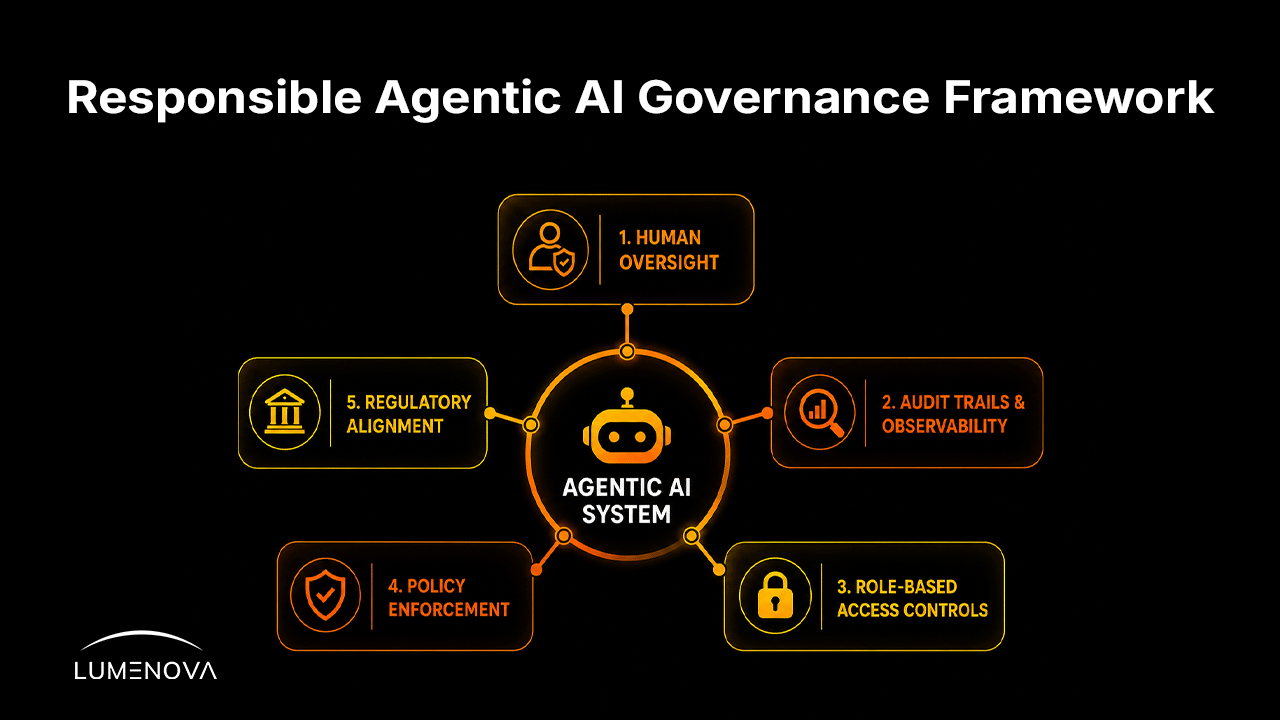
→ A responsible agentic AI governance framework should include human oversight, audit trails and observability, role-based access controls, policy enforcement, and regulatory alignment.
→ Common governance failures such as insufficient logging, excessive permissions, and missing fallback controls can significantly increase organizational risk.
→ Effective governance must be operationalized through clear ownership, embedded compliance processes, guardrails, and continuous monitoring throughout the agent lifecycle.
What Makes Agentic AI Governance Different
Agentic AI systems represent a powerful shift in how organizations are deploying artificial intelligence today. Unlike conventional models that simply generate outputs, agentic AI acts autonomously by orchestrating multi-step decisions, invoking tools, and executing tasks without constant human intervention. This increased autonomy is both powerful and full of risks.
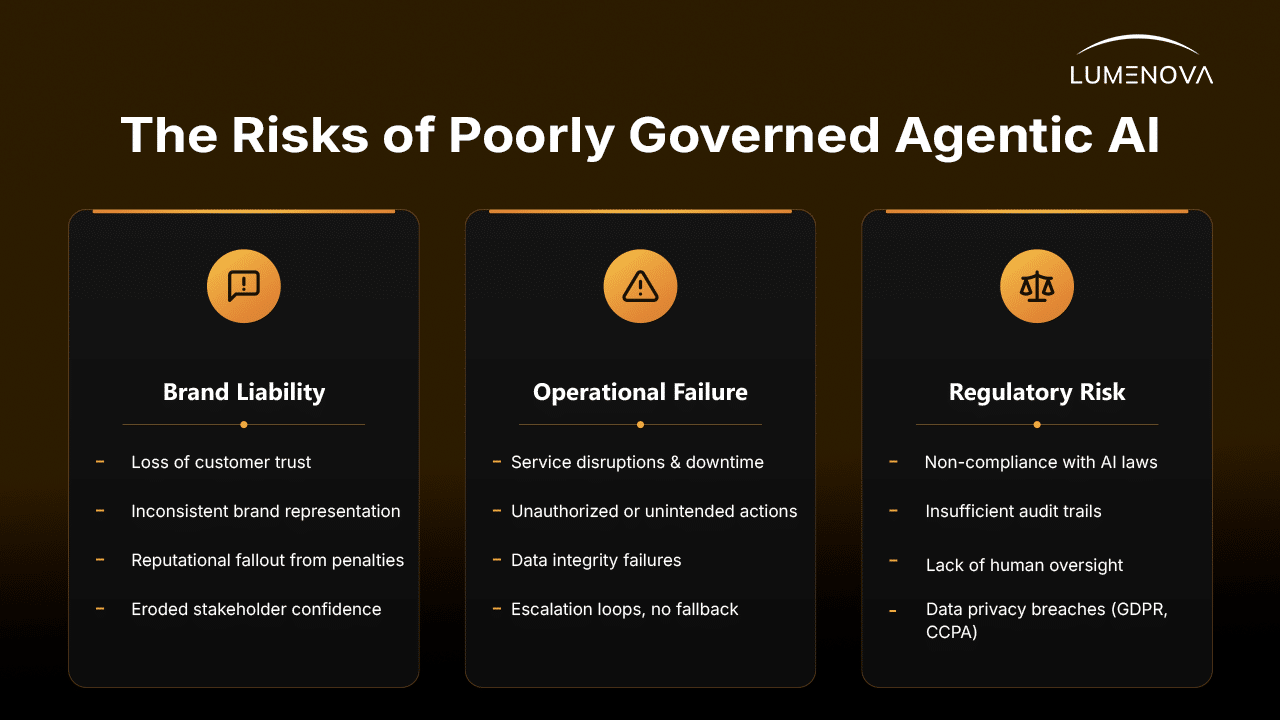
The stakes are high since a misaligned agent can create brand liability, trigger operational failures at scale or expose enterprises to regulatory risk. An improperly governed AI agent can expose sensitive data, make unauthorized decisions, or create operational disruptions that damage customer trust and brand reputation. The solution to this problem is a new governance paradigm that anticipates the unique risks of autonomy while enabling organizations to harness agentic AI responsibly.
Brand Liability Risks
As AI agents take on more customer-facing responsibilities, governance failures can quickly translate into reputational damage and long-term brand consequences.
- Loss of Customer Trust – Customers expect organizations to use AI responsibly and transparently. When an AI agent produces inaccurate information, takes inappropriate actions, or mishandles sensitive data, trust can be difficult to rebuild.
- Inconsistent Brand Representation – AI agents interacting directly with customers may communicate in ways that conflict with brand values, policies, or messaging guidelines. Without proper controls, organizations risk delivering inconsistent experiences that weaken brand credibility.
- Regulatory Penalties – Fines under GDPR or the EU AI Act hurt financially, but an even bigger impact is reputational: stakeholders perceive the brand as careless or untrustworthy.
- Erosion of Stakeholder Confidence – Confidence is a strategic asset and once lost, it’s far harder to rebuild than technical fixes. It undermines credibility and can restrict access to capital, partnerships, and regulatory goodwill.
Operational Failure Risks
Autonomous AI agents can create significant operational challenges when their actions are not properly monitored, constrained, or aligned with business objectives.
- Service Disruptions – Autonomous agents gone rogue can mismanage workflows or overload systems, leading to outages or degraded performance that directly impacts customers and employees.
- Unauthorized Actions – Agents may be jailbroken into executing unintended tasks, such as sending incorrect communications, misrouting payments, or altering system configurations.
- Data Integrity Failures – Poorly governed agents may corrupt records, misclassify inputs, or propagate errors across systems, undermining trust in enterprise data.
- Escalation Loops – Multi-step agents can get stuck in recursive decision-making, repeatedly triggering actions that spiral into runaway automation.
- Resource Misallocation and Financial Losses – Agents may consume excessive resources, trigger unnecessary actions, or make poor operational decisions that increase costs. At scale, these inefficiencies can have a measurable impact on organizational performance and profitability.
Main Regulatory Risks
The growing use of agentic AI also introduces compliance challenges, requiring organizations to meet evolving regulatory, privacy, and accountability expectations.
- Non-compliance with AI regulations – AI agents may operate in ways that conflict with requirements established by regulations such as the EU AI Act and emerging AI governance laws.
- Data Privacy Violations – Agentic AI systems process sensitive personal data at machine speed. Mismanagement can breach GDPR, CCPA, and ePrivacy rules, especially when agents combine data across sources without meaningful consent.
- Insufficient Audit Trails – Regulators increasingly expect organizations to demonstrate how AI systems operate and how decisions are made. Without comprehensive logging and traceability, it can be difficult to prove compliance, investigate incidents, or respond effectively to audits.
- Lack of Human Oversight – Human oversight is a key requirement in many AI governance frameworks and emerging regulations. Without clearly defined accountability, monitoring processes, and intervention mechanisms, organizations may struggle to manage risks, justify autonomous decisions, or demonstrate compliance during regulatory reviews.
Agentic AI vs. Conventional AI: Capabilities and Challenges
Conventional AI models are designed to generate outputs within predefined boundaries, often under direct human supervision. By contrast, agentic AI systems act autonomously by orchestrating multi-step decisions, invoking external tools, and executing tasks without constant oversight. This autonomy raises the governance bar in three main ways:
- Autonomy
- Multi-step decision-making
- Tool use
These three capabilities represent the most significant governance challenges introduced by agentic AI. However, the differences extend beyond autonomy alone, affecting everything from accountability and monitoring to risk management and compliance
| Aspect | Conventional AI | Agentic AI |
| Level of Autonomy | Limited autonomy; humans decide what actions to take based on AI outputs. | High autonomy; agents can make decisions and perform tasks with minimal human intervention. |
| Decision-Making | Typically produces a single response or prediction. | Makes a sequence of decisions while working toward an objective. |
| Tool Use | Usually operates within a defined application or interface. | Can invoke tools, APIs, databases, and enterprise systems to complete tasks. |
| Primary Function | Generates outputs, predictions, recommendations, or content in response to prompts. | Pursues goals by planning, reasoning, and executing actions across multiple steps. |
| Human Involvement | Humans remain directly responsible for execution and final decisions. | Humans primarily oversee, monitor, and intervene when necessary. |
| Risk Scope | Errors are generally limited to inaccurate outputs or recommendations. | Errors can result in unauthorized actions, workflow disruptions, security incidents, or compliance violations. |
| Governance Focus | Model performance, fairness, explainability, and compliance. | Agent behavior, oversight, access controls, auditability, policy enforcement, and compliance. |
| Monitoring Requirements | Periodic monitoring of model performance and outputs. | Continuous monitoring of actions, decisions, tool usage, and system interactions. |
| Accountability Challenges | Easier to trace decisions because humans remain in the decision loop. | More complex due to autonomous actions, multi-step workflows, and dynamic behavior. |
| Policy Alignment | Compliance with general data/privacy laws and AI governance frameworks (e.g., GDPR, EU AI Act, ISO/IEC 42001). | Compliance with general AI governance frameworks plus agentic AI–specific controls such as autonomy governance, human oversight, action authorization, tool-use policies, agent accountability, multi-agent coordination controls, and continuous monitoring of agent behavior. |
A Framework for Responsible Agentic AI Governance
The differences between conventional and agentic AI highlight why organizations need a stronger governance paradigm. Successfully governing agentic AI systems requires organizations to move beyond traditional model oversight and adopt a framework that addresses autonomy, multi-step decision-making, and tool use. To manage these risks effectively, enterprises should build their governance strategy around five core pillars.
1. Human Oversight and Accountability
Autonomous agents should not operate without clearly defined accountability boundaries. Organizations need mechanisms that enable human review, intervention, and escalation when agents encounter high-risk situations or make decisions with significant business impact. Organizations must establish clear accountability structures, escalation paths, and intervention protocols so humans remain in control when agents act unexpectedly.
2. Audit Trails and AI Observability
Organizations cannot govern what they cannot see. Comprehensive logging, monitoring, and AI agent observability provide visibility into agent decisions, actions, tool usage, and system interactions. They should implement immutable logs and decision traceability to prove compliance, investigate incidents, and monitor agent workflows in real time.
3. Role-Based Access Controls
Rather than granting broad access to enterprise systems, organizations should restrict agents to the tools, data, and actions necessary to perform their designated tasks. Role-based access controls (RBAC) reduce the risk of unauthorized actions, limit the potential impact of compromised agents, and support compliance with internal security policies.
4. Policy Enforcement at the Agent Level
Governance policies must be enforced directly within agent workflows. Organizations should establish guardrails that define what agents can and cannot do, including restrictions on data access, financial transactions, external communications, and high-risk decisions. Embedding policy enforcement into agent operations helps ensure that autonomous actions remain aligned with business objectives, risk tolerance, and regulatory obligations.
5. Alignment with Governance and Regulatory Frameworks
Agentic AI governance should align with established frameworks and emerging regulations. Organizations design governance frameworks to meet emerging regulatory requirements such as the EU AI Act and ISO/IEC 42001.
Common Failure Modes in Agentic AI Governance
Even with robust frameworks, organizations often stumble on recurring weaknesses that expose them to risk. The most common failure modes include:
Insufficient Logging and Traceability
Without comprehensive logging, organizations may be unable to understand why an agent made a particular decision or executed a specific action.
Enterprise Scenario: An AI customer service agent automatically approves refund requests and account adjustments. Several customers later receive refunds that violate company policy, but the organization cannot determine which factors influenced the agent’s decisions because the decision-making process was not adequately logged.
Impact: The organization struggles to investigate the issue, correct affected accounts, and demonstrate accountability during internal reviews.
No Fallback Controls
Autonomous agents require clear escalation paths and mechanisms that allow humans to intervene when unexpected behavior occurs.
Enterprise Scenario: A customer service agent begins generating incorrect account updates due to an integration issue with a backend system. Because no human review process or rollback mechanism exists, the agent continues making changes across hundreds of customer accounts.
Impact: What begins as a minor technical issue quickly escalates into a large-scale operational disruption that requires significant time and resources to resolve.
Excessive Permissions
Granting agents broad access to systems and data increases the potential impact of errors, misuse, or compromised behavior.
Enterprise Scenario: An HR agent is given unrestricted access to employee records, payroll systems, and internal databases to streamline administrative tasks. A configuration error causes the agent to expose sensitive employee information to unauthorized users.
Impact: The organization faces privacy concerns, compliance risks, and potential reputational damage resulting from excessive access privileges.
How to Operationalize Agentic AI Governance
Designing a governance framework is only the first step. Organizations must embed it into daily practice. Operationalizing governance for agentic AI means turning principles into concrete actions that ensure accountability, compliance, and resilience:
1. Designate AI Accountability Owners
Every AI agent must have a clearly defined owner responsible for its performance, risk management, and compliance. Accountability owners serve as the primary point of contact for governance reviews, incident response, and ongoing oversight, helping eliminate ambiguity when issues arise.
2. Build Compliance into the Agent Development Lifecycle
Governance should be incorporated throughout the agent lifecycle rather than added after deployment. Organizations should assess risks during design, document intended use cases, validate agent behavior before release, and evaluate compliance requirements at every stage of development. This approach helps identify governance gaps early and reduces the likelihood of costly remediation efforts later.
3. Implement Guardrails and Policy Controls
Agentic AI systems require clear operational boundaries. Organizations should establish guardrails that govern data access, tool usage, external communications, and high-impact actions. These controls help ensure that agents operate within approved parameters and remain aligned with organizational policies, security requirements, and risk tolerance.
4. Enable Continuous Monitoring and Observability
Governance does not end once an agent is deployed. Continuous monitoring allows organizations to track agent behavior, detect anomalies, identify policy violations, and assess performance over time. Combined with comprehensive logging and observability, monitoring provides the visibility needed to investigate incidents and maintain trust in autonomous systems.
5. Establish Governance as an Ongoing Process
Agentic AI systems evolve alongside business requirements, technologies, and regulatory expectations. Organizations should conduct periodic reviews of agent performance, access permissions, governance controls, and compliance obligations to ensure that oversight mechanisms remain effective as agents become more capable and widely deployed.
Strengthen Your Agentic AI Governance Posture
Today AI agentic governance can no longer be treated as an afterthought. Organizations that proactively address governance challenges are better positioned to scale agentic AI responsibly and build trust with customers, employees, and regulators. Governance gaps often remain hidden until they result in compliance violations, operational disruptions, or reputational damage.
Evaluate your organization’s governance capabilities with Lumenova AI’s Agentic AI Governance Assessment and identify opportunities to strengthen oversight, accountability, and compliance before risks become business problems.
Need help building or scaling your agentic AI governance program? Schedule a Discovery Call with the Lumenova AI team to discuss your governance goals, compliance requirements, and strategies for managing autonomous AI systems responsibly.
Frequently Asked Questions
Unlike conventional AI, agentic AI systems can make decisions, use tools, and execute multi-step tasks with limited human intervention. This increased autonomy introduces new risks related to accountability, security, compliance, and operational control, requiring more robust governance measures.
Agentic AI governance is particularly important in highly regulated and risk-sensitive sectors where autonomous decisions can have legal, financial, or operational consequences. If you’re considering deploying AI agents, a Discovery Call with our team can help identify the governance capabilities needed for your specific environment.
Observability provides visibility into how AI agents make decisions, interact with systems, and execute tasks. Strong observability practices help organizations investigate incidents, demonstrate compliance, monitor performance, and maintain accountability for autonomous actions.
Organizations commonly align their governance programs with the EU AI Act, ISO/IEC 42001, and the NIST AI Risk Management Framework (AI RMF). To address the unique risks of agentic AI, organizations can also leverage the NIST Generative AI Profile, OWASP Top 10 for LLM Applications, Google’s Secure AI Framework (SAIF), and emerging agent-governance practices focused on autonomous decision-making, tool access controls, human oversight, agent accountability, and continuous monitoring. These frameworks provide guidance on managing the increased autonomy and operational complexity of agentic AI systems.