August 18, 2026
The Hidden Data Exposure Risks of Multi-Agent Systems
Contents
Key Takeaways
- Every handoff between agents is a new exposure point.
- Risk compounds across an agent chain. Downstream agents inherit the upstream agent’s data and its mistakes, then act on both.
- Four failure modes hide inside most agent chains: over-collection at the source, context bleed, permission mismatch, and missing chain-level visibility.
- Per-agent controls do not produce chain-level safety. A workflow can pass every individual checkpoint and still leak data across the chain.
- Agentic AI data protection needs three capabilities: chain-wide data lineage, permissions scoped per handoff, and continuous monitoring end to end.
In the agentic era, AI risks pose some never-before-foreseen challenges for data governance. And its amplitude multiplies exponentially when we deal with systems rather than individuals (of an agentic nature, that is).
A single AI agent with read access to your customer database may still be a problem you can deal with fairly easily. Five agents passing that same record between them, each with its own tools, memory, and credentials, is a different problem, and most enterprise data protection programs were not designed for it.
Agentic AI data protection fails in multi-agent systems for a structural reason. Traditional controls assume a boundary you can draw a line around: a database, an application, a user session. Multi-agent systems dissolve that boundary. Data moves through a chain of autonomous decisions, and each agent decides for itself what to keep and what to pass along. No human approves those decisions in real time, and in most deployments nothing records them in a way anyone can reconstruct later.
The resulting exposure never triggers an alert. No firewall is breached, and no credential is stolen. Customer data travels further into the workflow than anyone intended, gets reused for purposes nobody authorized, and lands in logs, prompts, and outputs never scoped to hold it. This article maps where that exposure hides and which controls contain it.
Why Multi-Agent Systems Multiply Risk
Consider an insurance claims workflow built from four agents:
- An intake agent pulls the claimant’s record and supporting documents.
- An enrichment agent adds policy history, prior claims, and third-party data.
- A decisioning agent evaluates the claim against coverage rules.
- A communications agent drafts the response to the claimant.
Each agent is individually sensible. The workflow has three internal handoffs, and every one is a place where data protection can quietly fail.
Every Handoff Is a New Exposure Point
At each handoff, an agent decides what context the next agent receives. A model makes that decision, not a policy. The intake agent might pass the full claimant file when the enrichment agent needs only a policy number. The enrichment agent might pass third-party credit data into a decisioning step with no legal basis to consider it. The communications agent might restate internal notes in a message to the claimant.
None of these are attacks. They are ordinary model behavior applied to data never scoped for the next step. In a traditional pipeline, a developer defines the payload that crosses each boundary. In an agent chain, the payload is generated at runtime and changes with the input.
Risk Compounds Rather Than Adds
Three agents in sequence do not produce three times the risk of one. Each downstream agent inherits two things from upstream: the data and the upstream agent’s errors.
If the intake agent over-collects, every subsequent agent operates on an over-broad dataset. If the enrichment agent misclassifies a record as low-sensitivity, the decisioning agent treats it that way too, and the communications agent may surface it externally. An early mistake does not stay contained in the step that made it. It becomes the premise for everything that follows.
| Failure at one stage | What the next agent inherits | Where it surfaces |
| Over-broad data pull at intake | A dataset wider than any downstream task requires | Prompt logs, vector stores, model context |
| Misclassified sensitivity label | Wrong handling rules applied to protected data | Retention, sharing, and export decisions |
| Unscoped tool credential | Access the task never required | External API calls, writes to systems of record |
| Unrecorded reasoning step | No basis for reconstructing what happened | Audit findings, regulator requests, incident review |
This breaks conventional risk modeling. Reviewing each agent in isolation gives you four clean assessments and tells you almost nothing about the chain. Our guide to measuring AI agent performance across multi-step workflows covers the same failure of single-step evaluation.
Where Exposure Hides in Agent Chains
Four patterns account for most data exposure in multi-agent systems. Each is hard to spot because it looks like normal operation from inside the agent causing it.
1. Over-Collection at the Source
The first agent in a chain almost always pulls more data than its own task requires.
Agents are built for flexibility. An intake agent that fetches the complete customer record works for every downstream scenario, so engineers scope it broadly and move on. The task might need three fields. The agent retrieves ninety.
The exposure is not in the retrieval. That ninety-field record becomes the working context for the entire chain, and every agent downstream now holds data nobody assessed for that purpose.
Signals that over-collection is happening in your environment:
- Agents use service accounts scoped to the broadest use case they support
- Retrieval queries are written as SELECT * equivalents rather than field-scoped
- One data-fetching agent serves several workflows with different sensitivity profiles
- No one can state, per agent, which fields the task requires
2. Context Bleed
Context bleed is data intended for one task’s context being carried into an unrelated downstream task.
It takes several forms. Shared memory across agent sessions leaves a record retrieved for Customer A in context when the agent begins work on Customer B. Conversation history passed wholesale between agents carries fragments of earlier, unrelated work. Vector stores populated during one workflow get queried by agents serving a different one.
The regulatory consequence is purpose limitation failure. Data lawfully collected for claims processing gets reused for marketing analysis because both workflows share an agent and neither enforces a boundary. Under GDPR, purpose limitation and data minimisation are separate obligations, and context bleed can breach both without any data leaving the organization. It is also the main pathway for the adversarial version of the problem, covered in our analysis of AI agent access controls and prompt injection.
3. Permission Mismatch
Downstream agents frequently operate with broader access than their task calls for.
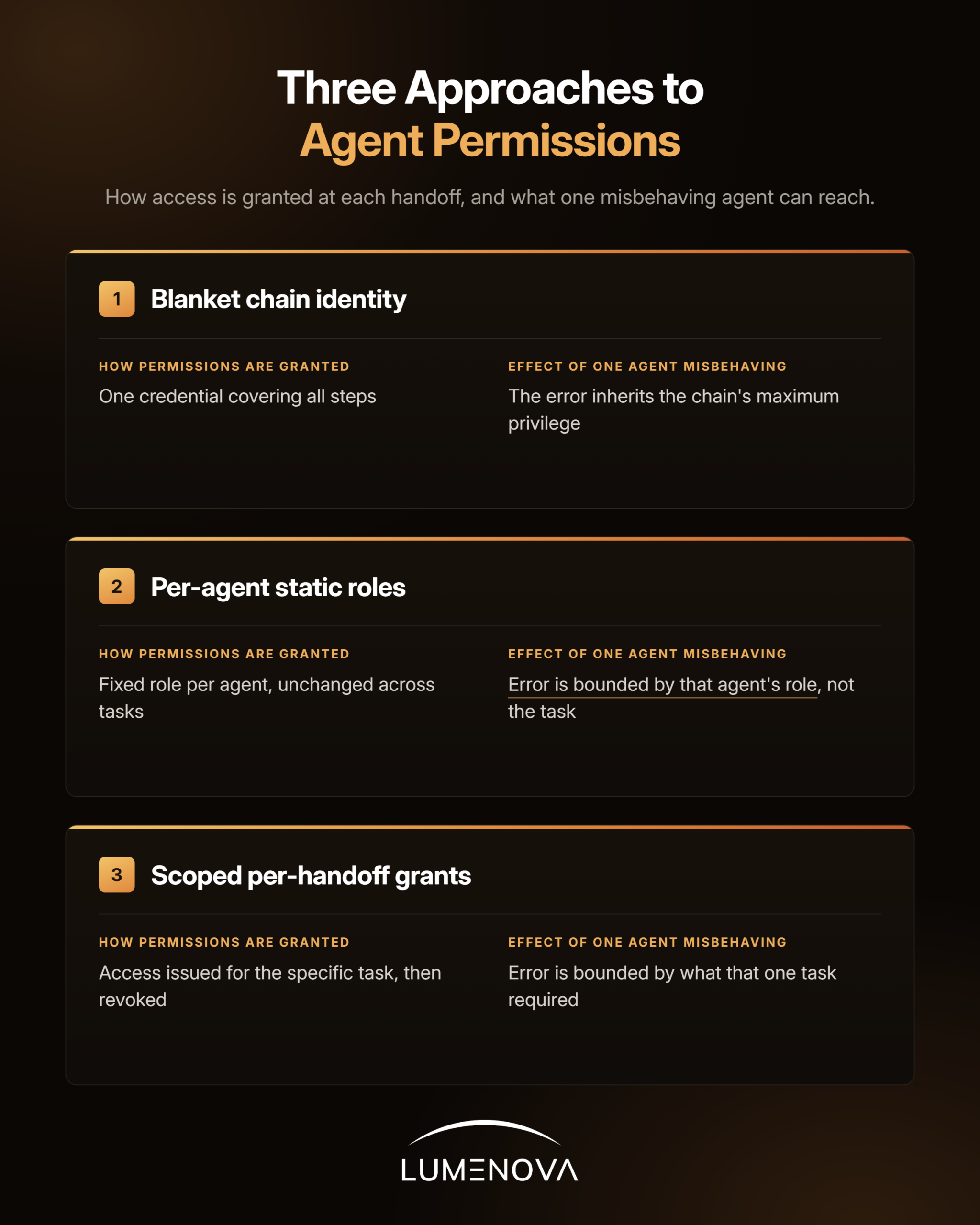
This happens in two ways. Credentials propagate, so a chain running under one identity provisioned for its most demanding step gives a summarization agent write access to a system of record it should only read. Or the task narrows while the permissions do not: agent three is asked to draft a paragraph and holds the same database rights as agent one, which needed them.
The gap matters because agents act autonomously. Excessive read access exposes data; excessive write access lets an agent modify records, trigger transactions, or send external communications. On blanket permissions, the blast radius of a single reasoning error expands to whatever the most privileged step could reach.
- Missing Chain-Level Visibility
Each agent may be logged, monitored, and evaluated while nobody sees the full data trail across the chain.
This is the most consequential gap, because it makes the other three invisible. Per-agent logs answer “what did this agent do?” They cannot answer the questions governance and compliance teams need:
- Which agents touched this customer’s data, in what order?
- Where did this field first enter the workflow, and where did it exit?
- Which step introduced the record that ended up in the external communication?
- Can we reconstruct the full decision path for a regulator or an auditor?
Without chain-level lineage, incident investigation becomes archaeology across disconnected log stores with no shared identifier. The EU AI Act’s record-keeping and traceability obligations for high-risk systems assume an end-to-end account, as does any credible response to a data subject access request touching an agentic workflow. As we argued in our article about AI agent monitoring versus traditional application monitoring, tooling built for deterministic systems misses the failures that matter most in agentic ones.
What Reduces Compounding Risk
Three capabilities carry most of the weight in agentic AI data protection. Each targets a failure mode above.
Chain-Level Data Lineage Tracking
Track what data touched which agent, in what order. The other two controls depend on knowing where data has been.
Practical lineage for agent chains means:
- A persistent trace identifier that follows one workflow execution across every agent, tool call, and model invocation
- Field-level provenance recording where each data element entered the chain and which agent introduced it
- Handoff records capturing what was passed between agents, not only what each agent did internally
- Sensitivity labels that travel with the data, so a classification made at intake is still enforceable at step four
The test: given any output the workflow produced, can you name every agent that contributed data to it and every source that data came from? If answering requires manual correlation across three log systems, you do not have lineage.
Scoped, Task-Specific Permissions Per Handoff
Grant access for the task in front of the agent, not for the chain it belongs to.
Scoped permissions treat each handoff as a fresh authorization decision. The enrichment agent gets policy history because this task requires it, and the grant expires when the step completes. The communications agent gets the drafted decision and the claimant’s contact details, and nothing more.
This runs against the convenience of a single service account, which is why it rarely happens by default. The payoff is containment: damage from an unexpected action is bounded by what one task needed rather than by what the most privileged step could reach.
A working implementation includes:
- Least-privilege grants defined per handoff, derived from the task specification rather than the agent’s general role
- Time-bounded or execution-bounded credentials that do not persist past the step
- Explicit denial of inherited context unless the next task requires it
- Human approval gates at handoffs that cross a sensitivity or irreversibility threshold
Continuous Monitoring Across the Full Workflow
Monitor the chain, not the checkpoints. Individual agent evaluations tell you whether each component behaves. They do not tell you whether the workflow, running end to end on real data, stays inside its boundaries.
Chain-level monitoring watches for conditions no single agent can detect: data appearing in a step it was never scoped for, sensitivity labels dropped between handoffs, an agent’s context growing across executions, or an output containing fields that entered three steps earlier under a different purpose. It also catches drift, where a workflow that behaved correctly at deployment widens its data footprint as agents meet inputs the original scope never anticipated.
Guardrails belong at this layer, applied to handoffs rather than only to final outputs. A guardrail inspecting what the second agent hands to the third stops the problem from propagating at all.
How Lumenova AI Governs Multi-Agent Systems
Lumenova AI treats agent chains as governed systems rather than collections of independent components, so agentic AI data protection is enforced across the workflow rather than agent by agent. Our platform’s capabilities map directly to the failure modes above:
| Exposure pattern | Lumenova AI capability | What it provides |
| Over-collection at the source | AI Inventory | A centralized, auditable registry of every AI system and agent, with the data and access each one holds |
| Context bleed | Guardrails for GenAI and AI agents | Usage boundaries enforced at agent handoffs, not only at final output |
| Permission mismatch | AI Risk Management | Risk assessment templates mapped to global frameworks or your own policies, applied per agent and per workflow |
| Missing chain-level visibility | AI Observability | Real-time tracing and decision-path visibility across LLM and agent interactions, including costs and latencies |
| Silent drift over time | AI Evaluations | Ongoing assessment across performance, security, and data integrity, with alerts before gaps escalate |
Two design choices matter most for multi-agent deployments. Observability operates at the trace level across agent interactions, so the data trail through a chain is reconstructable rather than assembled by hand after an incident. And governance artifacts stay aligned to the EU AI Act, NIST AI RMF, and ISO/IEC 42001, so the evidence produced during normal operation is the evidence an auditor asks for.
For teams building the surrounding program, our guide to governance frameworks for multi-agent systems covers the organizational structure that supports these controls.
Where to Start
The exposure described here is already present in most production agent chains, unsurfaced because nothing in the stack is designed to surface it.
Answer one question about a workflow you already run: can you name every agent that touched a specific customer record last week, in order, and state what each one received? If that takes a manual investigation, chain-level exposure exists whether or not it has caused visible harm yet.
Lumenova AI’s Agentic AI Risk & Governance Assessment shows where your agent deployments stand across data protection, access control, observability, and oversight, and what to prioritize next.
Take the 15-Minute Agentic AI Risk & Governance Assessment →
Frequently Asked Questions
Agentic AI data protection is the practice of controlling how data is collected, passed, reused, and retained across autonomous AI agents and the workflows they run. It differs from conventional data protection in one respect: models decide at runtime what data moves where, so controls must operate on agent behavior rather than only on storage and network boundaries.
A single model has one input boundary and one output boundary. A multi-agent system has a boundary at every handoff, and each is a place where data can be over-shared or repurposed. Because downstream agents inherit both the data and any upstream errors, an early mistake propagates through the rest of the chain.
Context bleed is data intended for one task’s context being carried into an unrelated downstream task, through shared agent memory, wholesale conversation-history passing, or vector stores queried across workflows. Data collected for one lawful purpose then gets used for another, which can breach GDPR purpose limitation requirements without any data leaving the organization.
Generally not. Data loss prevention tooling inspects traffic at network and application boundaries, and identity systems govern access at authentication. Agent handoffs happen inside a workflow, often under a single identity, with payloads generated at runtime. Covering them requires trace-level visibility and permissions scoped per task.
GDPR applies, since data minimisation and purpose limitation hold regardless of whether an agent or a human moves the data. The EU AI Act’s record-keeping and traceability obligations for high-risk systems assume an end-to-end account of system behavior. Sector rules such as HIPAA or model risk guidance in financial services apply on top, while ISO/IEC 42001 and the NIST AI RMF provide the structure for meeting them.