October 29, 2026
AI Bias in Credit Decisions: How to Test for It and Prove Fairness in AI
Contents
Key Takeaways
- AI bias in lending can enter at multiple stages of the credit and insurance underwriting pipelines, from data collection to model deployment.
- Effective bias testing requires clear evidence, measurable fairness criteria, and consistent evaluation across relevant demographic groups.
- Fair AI decision-making requires ongoing monitoring, not just a one-time model audit.
- The same principles of AI fairness apply across banking, insurance, healthcare, hiring, and other high-impact decisions.
- As AI agents take on more autonomous decision-making, fairness testing must account for their actions, outputs, and downstream impacts.
A credit or underwriting model is only as defensible as the evidence you can produce about it, on the day someone asks. That someone may be a model validator, a state examiner, a market conduct team or a plaintiff’s expert, and none of them will accept a one-line claim that “the model is unbiased”. AI bias in credit decisions has become an evidence problem as much as a modeling problem.
The federal ground moved in 2026. The CFPB’s amended Regulation B, effective July 21, 2026, removed disparate impact from its reading of ECOA, and the banking agencies replaced SR 11-7 with SR 26-2: Revised Guidance on Model Risk Management in April. Neither change ends the need for proof. The Fair Housing Act, state fair lending laws, state insurance rules and private litigation still reach discriminatory outcomes, and proxy discrimination remains prohibited.
How Does AI Bias Affect Credit Decisions?
AI bias in credit decisions shows up as systematically different outcomes for applicants who present similar risk. It can change who is approved, what price or limit they receive, who is routed to manual review, and which reason appears on an adverse action notice.
The harm is rarely one bad variable. More often it is a chain: historical data encodes past exclusion, an AI credit scoring model learns that pattern efficiently, and a business rule applied after the score amplifies it. Because machine learning models find correlations no analyst would write into a scorecard, they can rebuild a protected characteristic from many weak signals without anyone intending it.
For a lender or carrier, the consequences land in three places:
- Fair lending exposure under the Fair Housing Act, state lending laws and state insurance codes.
- Fair lending model risk, because a model that performs differently across segments is mis-specified for part of its population.
- ECOA adverse action defensibility, because every declined applicant must receive specific, accurate reasons, whatever the model architecture.
Where Bias Enters Credit and Underwriting Pipelines
Bias can enter at five stages of a decisioning pipeline, and only some of them sit inside the model. The stage most often left untested is the one after the model: the cut-offs, overlays and pricing rules that turn a score into a decision.
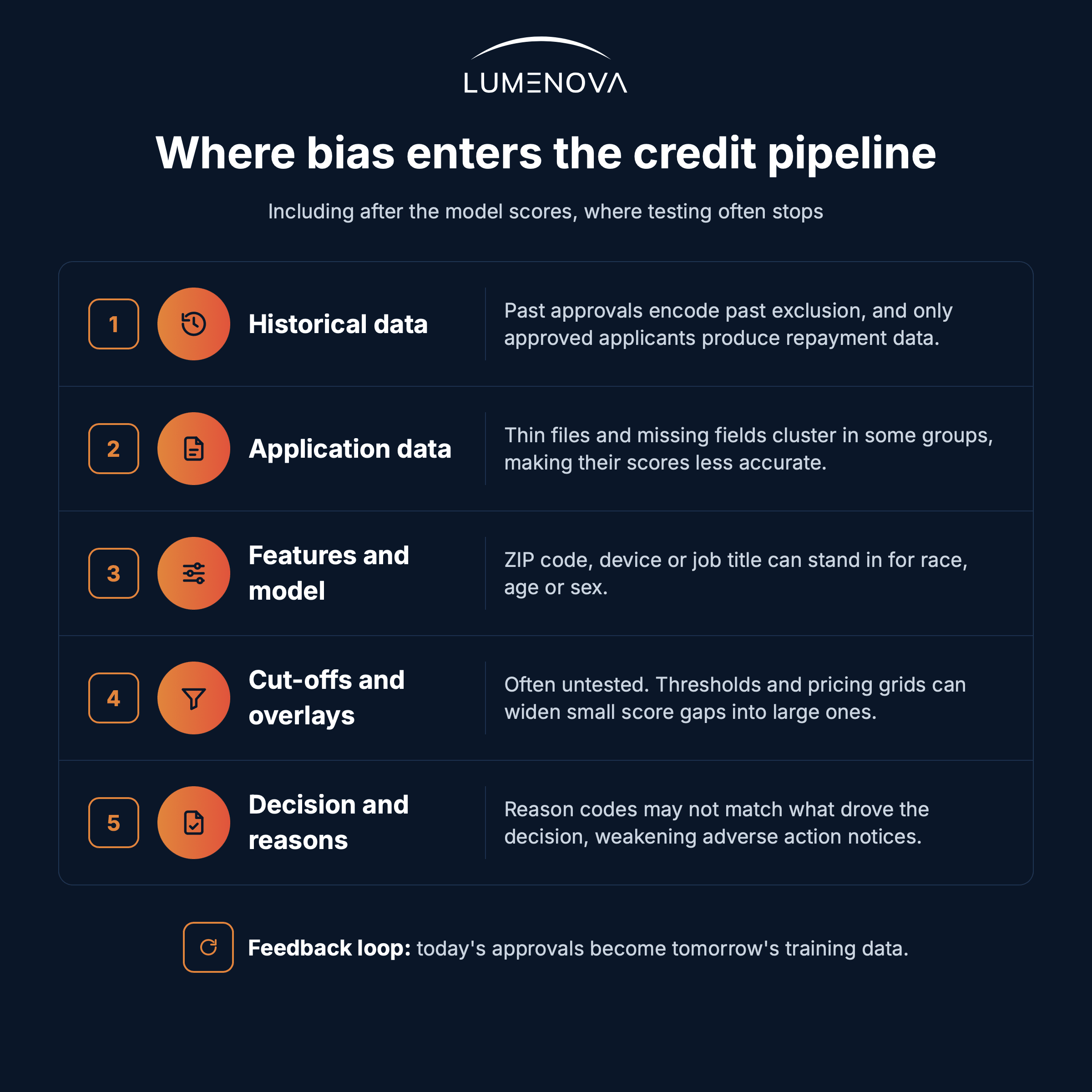
- Historical data. Past approvals encode past exclusion. Only approved applicants produce repayment data, so the model learns from a filtered history.
- Application data. Thin credit files and missing fields cluster in some groups, which makes their scores less accurate.
- Features and model. Inputs such as ZIP code, device type or job title can stand in for race, age or sex. The model can also rebuild a protected characteristic from many weak signals.
- Cut-offs and overlays. Thresholds, pricing grids and manual review rules are business decisions, so validation teams often treat them as out of scope. Yet a cut-off placed where one group’s scores cluster can widen a small score gap into a large disparity in approvals.
- Decision and reasons. Reason codes may not match what actually drove the decision, which weakens the adverse action notice.
A feedback loop connects the last stage back to the first. Today’s approvals become tomorrow’s training data, while declined applicants never generate repayment outcomes, so yesterday’s bias becomes tomorrow’s ground truth. Reject inference and periodic challenger testing are the usual mitigations.
The same five stages describe algorithmic underwriting bias in insurance, with “loss” in place of “default” and “rating tier” in place of “cut-off.” External consumer data, which Colorado regulates directly, usually enters at the features and model stage.
What is Proxy Discrimination in Credit Models?
Proxy discrimination happens when a facially neutral input stands in for a protected characteristic close enough that applicants are treated differently because of who they are, not how risky they are. A proxy discrimination credit model rarely looks discriminatory on paper; the problem only shows up when you measure what each input actually tracks.
Common proxies in lending and underwriting include:
- Geography: ZIP code or census tract, which can track race and national origin.
- Digital signals: device type, email domain or time of application, which can track age and income.
- Education and employment: school attended or job title, which can track race, sex and disability.
- External consumer data in insurance: credit-based insurance scores and purchasing data.
Proxy discrimination matters more after the 2026 changes. The amended Regulation B keeps intentional use of proxies for protected characteristics prohibited. If your team knew a variable was a strong proxy, kept it, and has no record of a business-necessity review or a search for a less discriminatory alternative, that file reads badly as evidence of intent. A proxy test is the record of what you knew and what you did about it.
What Evidence Do Regulators Expect for Fair Lending in AI Models?
Regulators expect evidence that a model’s outcomes were tested, that adverse action reasons are accurate, and that someone accountable reviewed both. What changed in 2026 is who asks, not whether they ask. The table below summarizes the regimes that matter most for disparate impact AI questions today.
| Regime | What it means for AI models (October 2026) |
| ECOA and Regulation B | Disparate impact removed from the CFPB’s reading; specific, accurate adverse action reasons and the ban on proxy-based disparate treatment remain |
| Fair Housing Act and state fair lending laws | Disparate impact claims still available; New York’s DFS reminded lenders of this the day the CFPB rule was published |
| Colorado SB21-169 | Life, auto and health insurers using external consumer data need governance and testing for unfairly discriminatory outcomes |
| NAIC AI Model Bulletin | Adopted by more than half of states; insurers stay accountable for vendor models |
| SR 26-2 | Replaced SR 11-7 in April 2026; AI-specific guidance still to come |
| EU AI Act | Credit scoring and hiring are high-risk; obligations apply from December 2, 2027 |
The practical conclusion is simple. A lender that stops disparate impact testing because of the Reg B change still faces the Fair Housing Act, state law and private plaintiffs, and it loses its best evidence against an intent claim. US law firm Venable put it plainly in its analysis of the rule: creditors should not scrap their fair lending controls and disparate impact testing. Insurers face the same logic: the NAIC bulletin holds the carrier accountable even when the model came from a vendor.
How Do Lenders Test AI Models for Disparate Impact?
Effective bias testing of credit decisioning models covers the whole funnel, not just the final approve-or-decline. A model can look balanced at the decision while bias concentrates earlier or later: in who gets prescreened, who is sent to manual review, who is offered a worse price, or whose credit line is cut after origination.
The protocol below can be run on a live model before your next validation cycle or exam:
- Inventory and tier every model, vendor model and AI agent that touches a credit or underwriting decision.
- Establish group membership from reported data where it exists, or a documented proxy method such as BISG, and record its known error.
- Test outcomes at every stage (prescreen, score, decision, pricing and adverse action reasons) by group and by intersection.
- Test for proxies by measuring how well each input, and the model as a whole, predicts protected class.
- Search for less discriminatory alternatives and document the trade-off between accuracy and fairness.
- Validate explanations so the reason codes on adverse action notices match what actually drove each decision.
- Package the evidence: date, version and sign every result.
The Evidence Standard: What Holds Up Under Scrutiny
Testing only helps if the results survive review. Evidence holds up when it uses metrics suited to the decision, covers the right subgroups, rests on enough data to mean something, and is repeated whenever the system changes. Anything less is an assertion.
In practice, that means five things:
- Use several metrics. Adverse impact ratio (0.80 is a common first flag), standardized mean difference for pricing, calibration by group, and error rates by group. Fairness metrics conflict, so state which one governs the decision and why; a single passing number hides the trade-off.
- Test subgroups and intersections, such as older women or young Black applicants, plus product, channel and geography. Aggregate parity can mask a failing segment.
- Respect sample size. Set a minimum cell size, report confidence intervals, and monitor small groups rather than declaring them clean.
- Retest on change: a retrain, a new data source or vendor model, new cut-offs, a prompt or foundation model change, drift alerts, or a new market.
- Build one evidence set for two audiences. Model risk validation and fair lending review should read the same versioned record rather than run separate exercises that produce two versions of the truth.
Fairness in AI Beyond Lending: A Multi-Industry Use Case
The same bias mechanics appear wherever a model allocates opportunity, so the same evidence standard applies. Standardizing it across business lines is what turns AI fairness from a one-off project into a governance capability.
Banking
Customer segmentation and collections models decide who sees a premium offer, a hardship program or an aggressive collections path. Because none of these is an application decision, they often escape fair lending review, yet they can steer protected groups toward worse outcomes. Underwriting models face the same scrutiny at the state level.
In July 2025, the Massachusetts Attorney General settled with student lender Earnest for $2.5 million. It alleged that the lender’s AI underwriting used a college “cohort default rate” variable that penalized Black and Hispanic applicants, auto-declined applicants based on immigration status, and was never tested for disparate impact.
Insurance
External consumer data, telematics and credit-based insurance scores can act as proxies, and claims triage models decide who gets paid quickly and who is investigated.
In Huskey v. State Farm, Black homeowners allege that the insurer’s claims algorithms flagged their claims for extra scrutiny. A survey cited in the complaint found Black policyholders were 39% more likely to be asked for additional paperwork than white policyholders. A federal court let the Fair Housing Act claims proceed in 2023.
Healthcare
A 2019 study in Science found that a commercial algorithm used healthcare cost as a stand-in for health needs. Because less had historically been spent on Black patients with the same illness burden, the model under-referred them for extra care.
The scrutiny has since moved to coverage decisions. Patients suing UnitedHealth allege that its nH Predict model was used to cut off rehabilitation care for elderly Medicare Advantage members against their doctors’ advice. In 2026, a court ordered UnitedHealth to hand over documents about how the algorithm was used.
HR & Recruitment
Recruitment produces some of the clearest real-world examples of bias in AI hiring processes, and they carry direct lessons for lenders and carriers. In Mobley v. Workday, a court let disparate impact claims proceed, conditionally certified an age-based collective and accepted that the vendor could plausibly be an agent of the employers using its tool. In a 2025 complaint, the ACLU of Colorado alleged that an AI video interview tool used by Intuit performed worse for a deaf, Indigenous applicant; both companies deny the claims. Research points the same way: a University of Washington study found that AI models screening résumés preferred white-associated names 85% of the time.
Evidence decides these cases on both sides. In September 2026, a federal judge dismissed Harper v. Sirius XM, which alleged that an applicant tracking system scored candidates on proxies such as ZIP code and schools attended, because the applicant offered no group-level statistics. Plaintiffs need data to prove disparate impact, and employers need their own data to rebut it.
The common thread across all four industries is that vendor models are not a liability shield. Whether the system screens job applicants, loan applicants or insurance claims, the deploying institution needs its own outcome evidence.
Agentic AI: When Human-in-the-Loop Stops Scaling
Agentic systems break the assumption that a person reviews each consequential decision. An underwriting agent can gather documents, call a scoring model, query external data and draft an adverse action letter in seconds, across thousands of files a day. Manual review of every step first becomes a bottleneck, then a formality.
This creates new fairness risks. Bias can enter at any tool call, for example when an agent requests extra documentation more often from some applicants. Behavior can change overnight with a prompt edit or a foundation model update, without any retrain. And the reason for a decision may be spread across many steps. Meanwhile, the new model risk guidance leaves AI-specific principles to future guidance, so institutions have to govern these systems before regulators tell them how.
What Are the Main Challenges in Achieving Transparency in AI Algorithms?
Transparency is hard for structural reasons, not just technical ones. The main obstacles are:
- Model complexity: ensembles and deep models have no single coefficient to point to.
- Approximate explanations: post-hoc methods such as SHAP approximate the model, so their accuracy must itself be tested.
- Distributed decisions: in agentic workflows, the outcome emerges from several components.
- Vendor opacity: third-party models may come with limited documentation.
- Audience mismatch: a feature attribution chart means little to a compliance officer, an applicant or a board.
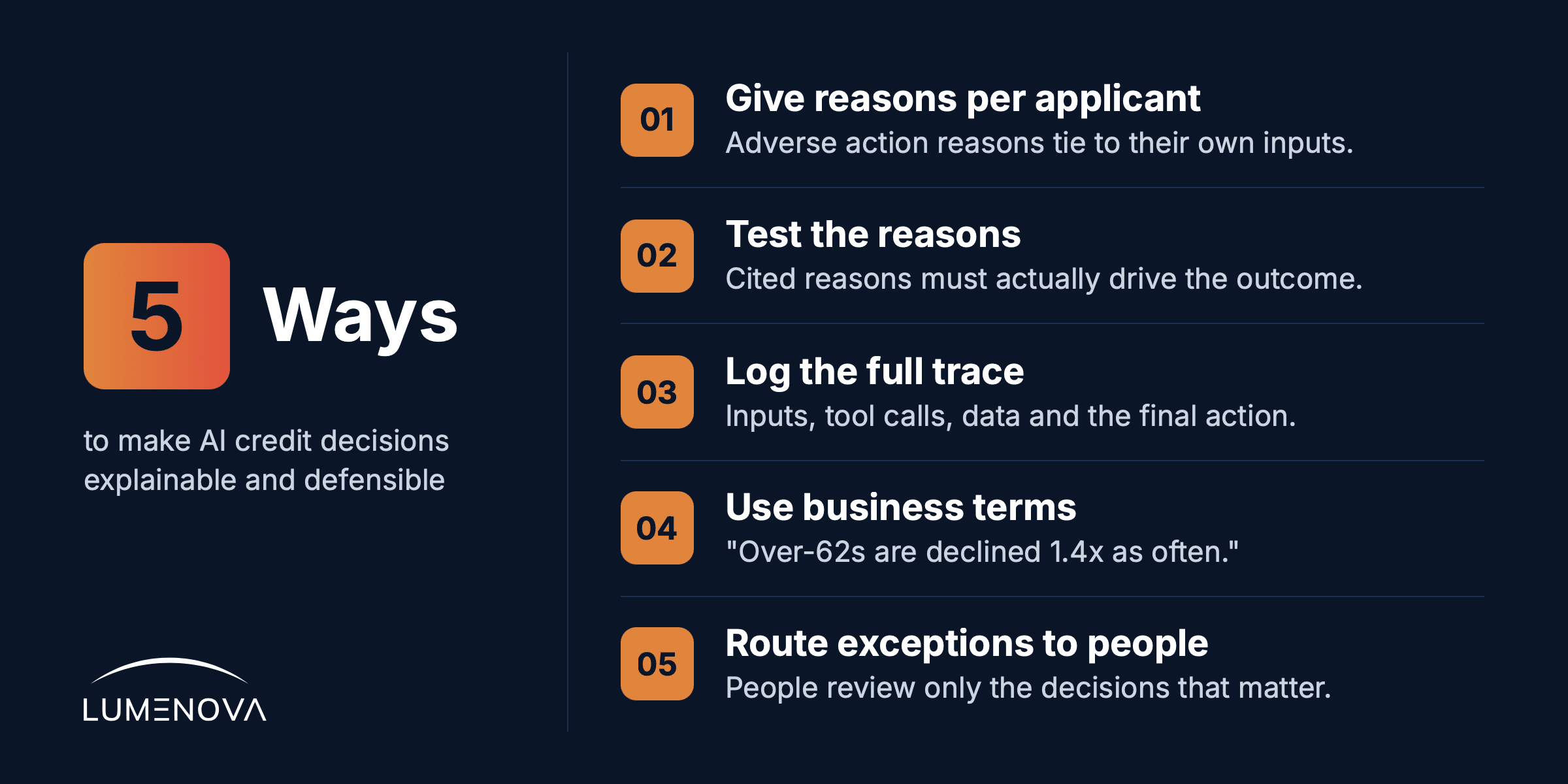
The five practices below turn explainability from a model property into something compliance teams, risk committees and declined applicants can each act on.
Strategies Used to Improve Fairness in AI Systems
Fairness in machine learning improves most when the fix matches the stage where bias enters, and when legal, compliance and technical teams agree on the metric before the model is built.
The main strategies are:
- Pre-processing: fix the data by reweighting under-represented groups, repairing biased labels or removing proxy features.
- In-processing: constrain the model with fairness penalties or adversarial debiasing during training.
- Post-processing: recalibrate scores or revisit cut-offs, with legal review first, since group-specific thresholds can themselves be disparate treatment.
- Operational controls: pre-deployment gates, subgroup monitoring and defined retest triggers.
AI Fairness Tools and Frameworks
Teams rarely start from scratch. Open-source libraries such as Fairlearn, IBM AI Fairness 360 and Aequitas compute bias metrics, SHAP and LIME produce feature attributions, and frameworks such as the NIST AI Risk Management Framework, ISO/IEC 42001 and the NAIC AI Model Bulletin give the program its structure.
These tools compute numbers; they do not decide which metric governs, keep versioned evidence, route approvals or alert anyone when a subgroup drifts. Most fairness failures in regulated firms are coordination failures, which is why technical, legal and compliance teams need one shared metric set and one record that everyone reads.
How Lumenova AI Turns Fairness Testing into Durable Evidence
Lumenova AI helps banks, lenders and carriers move from asserting that a model is unbiased to holding evidence a validator, examiner or plaintiff’s expert would accept. The platform maps directly to the protocol above:
- Pre-deployment evaluations: deep-dive fairness and bias assessments across applicant and policyholder segments before a model, prompt or vendor update goes live.
- AI security for agentic workflows: red-team underwriting and lending agents for prompt injection, data exfiltration and tool misuse, then turn each finding into a policy that blocks the attack at runtime.
- Continuous observability: alerts on subgroup drift, tied to your retest triggers.
- Guardrails for agentic AI: human oversight focused on the decisions that need it.
- Centralized governance workflow: dated, versioned evidence that serves model risk and fair lending review at once.
Conclusion
The 2026 changes shifted who enforces fairness in AI, not whether it must be shown. Insurers face more state scrutiny, and agentic systems are moving faster than any manual review process. The institutions that manage AI bias in credit decisions well will be those that can show what was tested, on which model version, with which data, and who signed off.
Book a demo with our team to see how Lumenova AI produces that evidence across your credit, underwriting and agentic AI portfolio.
Frequently Asked Questions
Disparate treatment is treating applicants differently because of a protected characteristic, including through a deliberately chosen proxy. Disparate impact is a neutral practice that disproportionately harms a protected group, whether or not anyone intended it.
No. Models can rebuild protected characteristics from correlated inputs, so leaving them out does not remove bias. Lenders also need demographic data, reported or estimated, to measure whether outcomes differ at all.
It is a different model or variable set that meets the same business goal with smaller disparities between groups. Documenting the search for one, and why the final model was chosen, is often what makes a fairness review defensible.
Not necessarily. Comparing several candidate models often turns up one that is fairer with little or no loss in predictive power, and fixing a biased proxy can even improve accuracy for groups the model scored poorly.
It can. The Act covers AI systems placed on the EU market or whose output is used in the EU. Credit scoring for individuals is high-risk under it, with obligations applying from December 2, 2027.