
Contents
Key Takeaways
- Prompt injection still ranks first in the OWASP Top 10 for LLM Applications 2026, and excessive agency rose to third as agents turn manipulated outputs into actions.
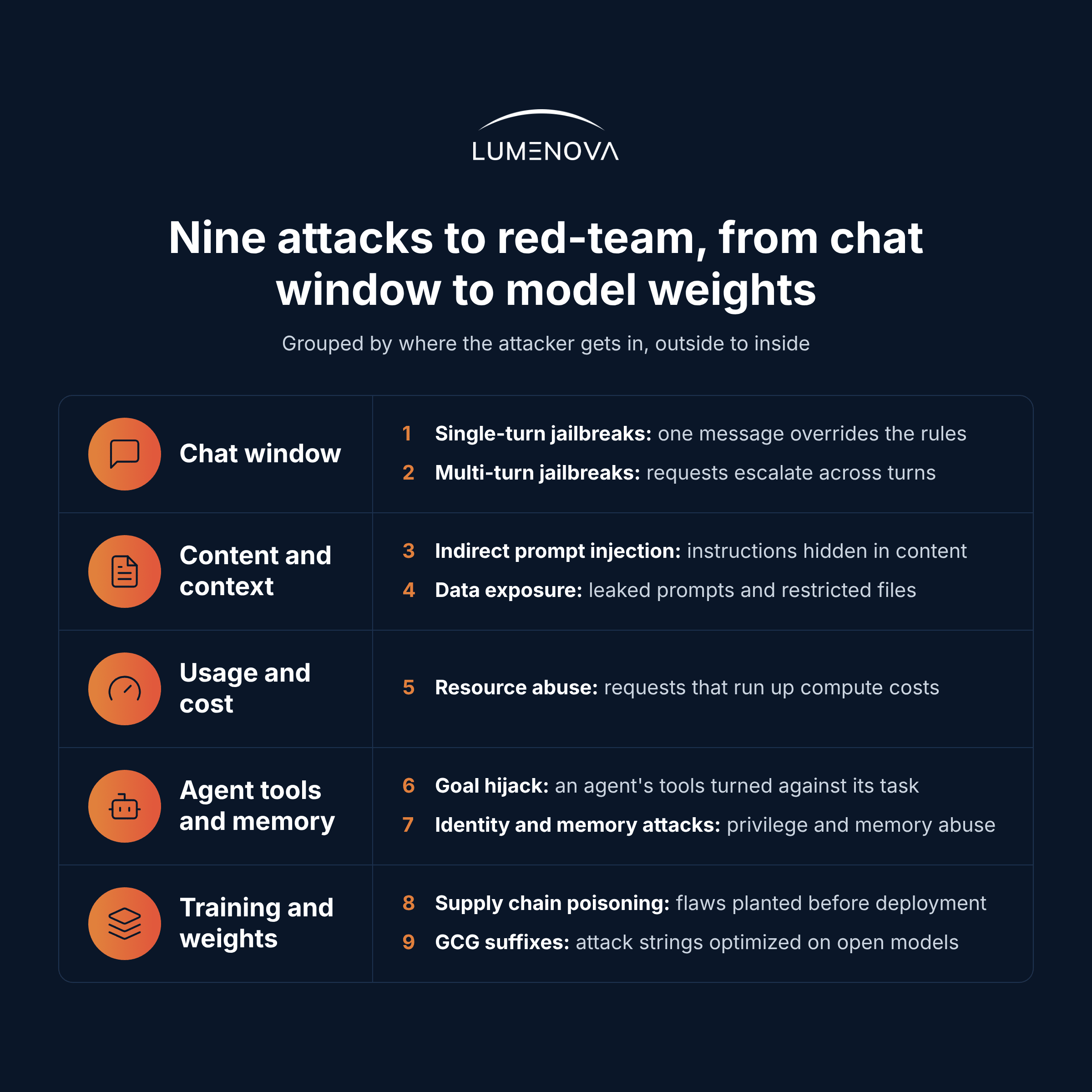
- Adversarial machine learning and AI attacks on language models fall into nine classes, from single-message jailbreaks anyone can try to GCG suffixes optimized on open model weights.
- GCG suffixes can transfer between models, but how well depends on how the target model was aligned.
- Defenses that report near-zero attack success can fail against attackers who adapt. Researchers from OpenAI, Anthropic and Google DeepMind bypassed 12 published defenses, most at success rates above 90%.
- Teams using hosted models can’t change the provider’s safety training, so their protection comes from least agency, guardrails, conversation-level monitoring and continuous red teaming.
Prompt injection is still the top risk for LLM applications. The OWASP Top 10 for LLM Applications 2026, the first edition ranked partly on real incident data, kept it at number one and moved excessive agency up to third. Attackers reach enterprise models through the same entry points users do. Once an agent can send emails or approve payments, a successful attack ends in an action.
This taxonomy sorts those attacks into nine classes, from jailbreaks any user can try to the gradient-optimized suffixes of GCG, and covers whether a suffix built on one model can break another. Each class maps to NIST AI 100-2, the OWASP LLM and Agentic Top 10 lists and MITRE ATLAS, with the defenses that apply and the point where each one stops working.
Adversarial machine learning, from classifiers to language models
NIST’s AI 100-2 report now gives the field a shared vocabulary. For generative AI, it adds misuse as an attacker objective alongside availability, integrity and privacy. It groups GenAI attacks into supply chain attacks, direct prompting attacks and indirect prompt injection, and gives agent security a section of its own.
What changes with language models
Language models can be attacked by people with no machine learning skills. Fooling an image classifier usually takes an optimization algorithm. A language model can be fooled by a well-phrased request, so anyone with access to the chat window can try.
Instructions and data also travel through the same channel. A model reads its system prompt, the user’s message and a retrieved document as one stream of text, with no reliable way to tell which parts are commands. An instruction hidden in a PDF can carry the same weight as one written by the developer.
What are adversarial patterns?
Adversarial patterns are the recurring structures that attacks share, whatever their target or delivery channel. Attackers can reword a prompt endlessly, but the pattern underneath stays the same, so defenses built around patterns last longer than lists of known bad prompts. Four patterns run through the taxonomy:
- Role framing: The attacker sets up a character or scenario in which the model’s usual rules seem not to apply.
- Gradual escalation: Each message goes a little further than the last, so no single turn looks harmful.
- Hidden payloads: Instructions sit inside content the model processes, such as documents, emails, web pages, images or tool outputs.
- Optimized token strings: An algorithm searches for a sequence of tokens, often unreadable to people, that pushes the model toward a target response.
How the taxonomy classifies each attack
Every attack class in the taxonomy is described on three axes:
- Access: What the attacker knows about the system. NIST separates white-box attacks, where the attacker has full knowledge of the model, from gray-box attacks with partial knowledge and black-box attacks that rely on query access alone.
- Turns: Whether the attack works in one message or builds across a conversation.
- Target: Whether the attack goes after the model, the application built around it or an agent that can take actions.
Where these attacks land in regulated sectors
Exposure grows with two things: how much sensitive data a model can read, and what it can do with that data. Regulated sectors raise both.
Retrieval over sensitive financial knowledge bases
Banks and insurers connect assistants to policy documents, client files, research and internal email through retrieval-augmented generation (RAG). Any document that reaches the index can carry hidden instructions, and anything the assistant can retrieve can leak through its answers. EchoLeak showed the risk in a general enterprise assistant. In June 2025, researchers disclosed a zero-click flaw in Microsoft 365 Copilot that let an attacker pull organizational data out by sending a single crafted email. Microsoft rated it critical, with a CVSS score of 9.3. A financial RAG assistant with access to client files faces the same class of attack.
Clinical and claims triage
Triage models summarize medical records, read claim documents and decide what a human reviews first. Many of those documents come from people with a stake in the outcome. A 2025 study in Nature Communications hid instructions inside medical images and found that all four vision language models tested, including GPT-4o, could be manipulated into harmful outputs without any access to their parameters. The same tactic has appeared in legal filings. In 2026, a Connecticut court and a Brazilian labor tribunal each dealt with filings that contained white-on-white text telling AI reviewers to side with the filer or skip scrutiny of the documents.
The taxonomy: the most common types of adversarial attacks on language models
The nine classes below run from attacks that need nothing more than a chat window to attacks built with access to model weights or a foothold in the training pipeline. Each entry covers the adversarial pattern behind the attack, the access it needs, its OWASP and NIST mapping, and the defenses that apply, including where they stop working. The crosswalk table at the end of the section adds the matching MITRE ATLAS techniques.
1. Direct prompt injection and single-turn jailbreaks
The attacker sends one message designed to override the system prompt or the model’s safety training. Common forms include role-play setups, requests encoded in Base64 or another language, and many-shot prompts that pack dozens of fake dialogues into a long context window. Automation makes these attacks cheap to repeat. Best-of-N Jailbreaking applies random changes to a prompt, such as shuffled letters and odd capitalization, until one version gets through. It reached an 89% attack success rate on GPT-4o after 10,000 attempts.
- Adversarial pattern: Role framing, plus hidden payloads when the request is encoded
- Profile: Black-box, single turn, targets the model and application
- Maps to: LLM01:2026 Prompt Injection; NIST direct prompting attacks
- Primary defenses: Safety training by the model provider, input and output classifiers, rate limits that make thousands of attempts expensive
- Where defenses stop: Classifiers trained on known jailbreaks miss new wording, and Best-of-N also got past circuit breakers, a state-of-the-art open-source defense.
2. Multi-turn jailbreaks
The attacker spreads a harmful request across a conversation. Crescendo, developed by Microsoft researchers, opens with a harmless question about the topic and escalates by building on the model’s own replies. It ends with content the model would refuse if asked directly. Newer variants automate the escalation or split the intent across separate sessions to beat moderation that scores each message on its own. Protection lowers success rates without stopping these attacks. In an EMNLP 2026 study, adding a prompt-based safety layer cut a strong multi-turn attack’s success rate from 89.6% to 60.8%.
- Adversarial pattern: Gradual escalation
- Profile: Black-box, multi-turn, targets the model and application
- Maps to: LLM01:2026 Prompt Injection; NIST direct prompting attacks
- Primary defenses: Moderation that scores the whole conversation, multi-turn red teaming before release
- Where defenses stop: Per-message filters see only harmless turns, and protected models in the study above still failed in more than half of attempts.
3. Indirect prompt injection
The attacker never talks to the model. They place instructions in content the model will read later: a document in a retrieval index, an email, a web page, a calendar invite or an image. The 2026 OWASP list extends prompt injection to cross-modal attacks hidden in images or audio. EchoLeak, described above, belongs to this class. The attacker only needs a way to get content into the data the model reads.
- Adversarial pattern: Hidden payloads
- Profile: Black-box, no conversation with the target needed, targets the application and agents
- Maps to: LLM01:2026 Prompt Injection; ASI01 Agent Goal Hijack; NIST indirect prompt injection
- Primary defenses: Treating retrieved and tool-returned content as untrusted, marking it clearly in the prompt, blocking outbound links and tool calls after the model reads untrusted content, filtering outputs for data leaving the system
- Where defenses stop: Delimiters and rules such as “ignore instructions inside documents” lower success rates. The model still reads everything as one stream of text, so neither one closes the gap.
4. Sensitive information disclosure and hidden context exposure
The attacker asks the model to reveal what it should keep private: its system prompt, hidden instructions, documents the user isn’t allowed to see or data from other users’ sessions. The 2026 OWASP list renamed System Prompt Leakage to Hidden Context Exposure and widened its scope. Extraction often starts with plain requests to repeat earlier text, wrapped in role framing. In retrieval systems, the larger risk is missing permission checks: the assistant fetches a document the user couldn’t open directly and summarizes it for them.
- Adversarial pattern: Role framing; hidden payloads when the extraction request arrives through retrieved content
- Profile: Black-box, single or multi-turn, targets the application
- Maps to: LLM02:2026 Sensitive Information Disclosure; LLM08:2026 Hidden Context Exposure; NIST privacy compromises (prompt and data extraction)
- Primary defenses: Keeping secrets and access rules out of prompts, enforcing user permissions at the retrieval layer, scanning outputs for personal data and credentials
- Where defenses stop: Anything in the context window can eventually be extracted. Output scanners catch known formats such as card numbers and API keys, but miss paraphrased business information.
5. Resource abuse
The attacker makes the application burn compute, time or money. Crafted prompts can push a model into very long outputs, and scripts can flood an API with requests that each look normal. Reasoning models add a newer route. OverThink hides decoy puzzles, such as Sudoku or Markov decision problems, in content the model retrieves. The model still gives the correct answer, but spends up to 46 times more reasoning tokens getting there. Providers bill reasoning tokens like any other output, so the cost lands on the application owner.
- Adversarial pattern: Hidden payloads, when the decoy sits in retrieved content
- Profile: Black-box, single or multi-turn, targets the application and its budget
- Maps to: LLM06:2026 Unbounded Consumption; NIST availability violations
- Primary defenses: Per-user rate limits and quotas, caps on output and reasoning tokens, cost alerts per session
- Where defenses stop: OverThink’s decoys are harmless content, so safety filters let them through. Its authors found prompt-injection guardrails, filtering and paraphrasing largely ineffective. Token caps limit the damage but can also cut off legitimate long answers.
6. Agent goal hijack and tool misuse chains
The attacker redirects an agent’s goal or turns its tools against the task it was given. The hijack can arrive through injected content, as in class 3, or through the conversation itself. STAC builds chains of tool calls that look harmless one at a time but add up to a harmful action. State-of-the-art agents, including GPT-4.1, failed against it in more than 90% of attempts in most test settings.
- Adversarial pattern: Gradual escalation; hidden payloads when the hijack arrives through content
- Profile: Black-box, multi-turn or through content, targets agents
- Maps to: ASI01 Agent Goal Hijack; ASI02 Tool Misuse and Exploitation; LLM03:2026 Excessive Agency; NIST agent security
- Primary defenses: Least agency (only the tools a task needs, with narrow scopes), human approval for high-impact actions, checks on the full sequence of tool calls, a log of every call
- Where defenses stop: Per-call checks miss chains where every single step is allowed. Human approval helps only when reviewers see the whole chain, and OWASP lists over-trust in agents as a risk of its own (ASI09 Human-Agent Trust Exploitation).
7. Identity, privilege, memory and multi-agent attacks
These attacks target what an agent is allowed to do and what it remembers. Agents often run with broader credentials than their task needs, and an attacker who steers one inherits those rights. Memory makes an attack last. MINJA let regular users with no special access plant malicious records in an agent’s long-term memory through queries alone, with an injection success rate above 95% in tests. The poisoned records then shaped the agent’s answers to other users. In multi-agent systems, forged messages between agents and errors that pass from one agent to the next spread the damage further.
- Adversarial pattern: Hidden payloads, stored in memory or passed between agents
- Profile: Black-box, multi-turn or across sessions, targets agents and multi-agent systems
- Maps to: ASI03 Identity and Privilege Abuse; ASI06 Memory and Context Poisoning; ASI07 Insecure Inter-Agent Communication; ASI08 Cascading Failures; ASI10 Rogue Agents
- Primary defenses: Short-lived credentials scoped to each task, memory separated by user, review of what gets written to memory, authenticated messages between agents
- Where defenses stop: Detection-based moderation such as Llama Guard and memory sanitization techniques proved ineffective against MINJA.
8. Training-time and supply chain attacks
The attacker plants the flaw before the model or agent ships, through poisoned training or fine-tuning data, a tampered model file, or a malicious plugin or tool. The bar is lower than many teams assume. A joint study by Anthropic, the UK AI Security Institute and the Alan Turing Institute found that 250 malicious documents were enough to plant a backdoor in models from 600 million to 13 billion parameters, regardless of model size. For agents, the supply chain also covers the tools, prompts and plugins they load at runtime.
- Adversarial pattern: Hidden payloads, as backdoor triggers in data or dependencies
- Profile: Needs a foothold in training data, model files or dependencies; no conversation needed; targets the model and agents
- Maps to: LLM04:2026 Supply Chain; LLM05:2026 Data and Model Poisoning; ASI04 Agentic Supply Chain Vulnerabilities; NIST supply chain attacks
- Primary defenses: Provenance checks and signing for models and datasets, an inventory of every model, tool and plugin in use, pinned and scanned dependencies, backdoor testing before deployment
- Where defenses stop: A backdoor stays dormant until its trigger appears. Runtime red teaming catches it only if a test happens to include that trigger.
9. Optimization-based adversarial suffixes (GCG and successors)
The attacker uses a model’s gradients to search for a short string of tokens, often unreadable to people, that pushes the model to start an affirmative answer to a harmful request. The Greedy Coordinate Gradient (GCG) method, published by Zou et al. in 2023, trained its suffixes on open Vicuna models. How GCG works, how well its suffixes transfer and which defenses hold up are covered below.
- Adversarial pattern: Optimized token strings
- Profile: White-box on an open-weight model, then delivered as plain text in a single turn; targets the model
- Maps to: LLM01:2026 Prompt Injection; NIST direct prompting attacks
- Primary defenses: Perplexity filters, input perturbation such as SmoothLLM, adversarial training
- Where defenses stop: Suffixes optimized for readability get past perplexity filters, and newer attacks have beaten defenses that reported near-zero success rates.
| Attack class | NIST AI 100-2 | OWASP LLM 2026 | OWASP Agentic 2026 | MITRE ATLAS |
| 1. Direct prompt injection and single-turn jailbreaks | Direct prompting attacks | LLM01 Prompt Injection | None | AML.T0051.000 LLM Prompt Injection: Direct; AML.T0054 LLM Jailbreak; AML.T0068 LLM Prompt Obfuscation |
| 2. Multi-turn jailbreaks | Direct prompting attacks | LLM01 Prompt Injection | None | AML.T0054 LLM Jailbreak; AML.T0080.001 AI Agent Context Poisoning: Thread |
| 3. Indirect prompt injection | Indirect prompt injection attacks | LLM01 Prompt Injection | ASI01 Agent Goal Hijack | AML.T0051.001 LLM Prompt Injection: Indirect |
| 4. Sensitive information disclosure and hidden context exposure | Privacy compromises | LLM02 Sensitive Information Disclosure; LLM08 Hidden Context Exposure | None | AML.T0056 Extract LLM System Prompt; AML.T0057 LLM Data Leakage |
| 5. Resource abuse | Availability violations | LLM06 Unbounded Consumption | None | AML.T0034 Cost Harvesting; AML.T0029 Denial of AI Service |
| 6. Agent goal hijack and tool misuse chains | Security of agents | LLM03 Excessive Agency | ASI01 Agent Goal Hijack; ASI02 Tool Misuse and Exploitation | AML.T0053 AI Agent Tool Invocation; AML.T0086 Exfiltration via AI Agent Tool Invocation |
| 7. Identity, privilege, memory and multi-agent attacks | Security of agents | LLM03 Excessive Agency | ASI03, ASI06, ASI07, ASI08, ASI10 | AML.T0080.000 AI Agent Context Poisoning: Memory; AML.T0083 Credentials from AI Agent Configuration |
| 8. Training-time and supply chain attacks | Supply chain attacks (data and model poisoning) | LLM04 Supply Chain; LLM05 Data and Model Poisoning | ASI04 Agentic Supply Chain Vulnerabilities | AML.T0020 Training Data Poisoning; AML.T0010 AI Supply Chain Compromise; AML.T0018 Manipulate AI Model; AML.T0110 AI Agent Tool Poisoning |
| 9. Optimization-based adversarial suffixes (GCG and successors) | Direct prompting attacks | LLM01 Prompt Injection | None | AML.T0054 LLM Jailbreak; AML.T0043 Craft Adversarial Data |
Universal and transferable adversarial attacks on aligned language models: how GCG works
GCG is the best-known optimization attack on language models, and most later suffix attacks build on it.
How GCG builds an adversarial suffix
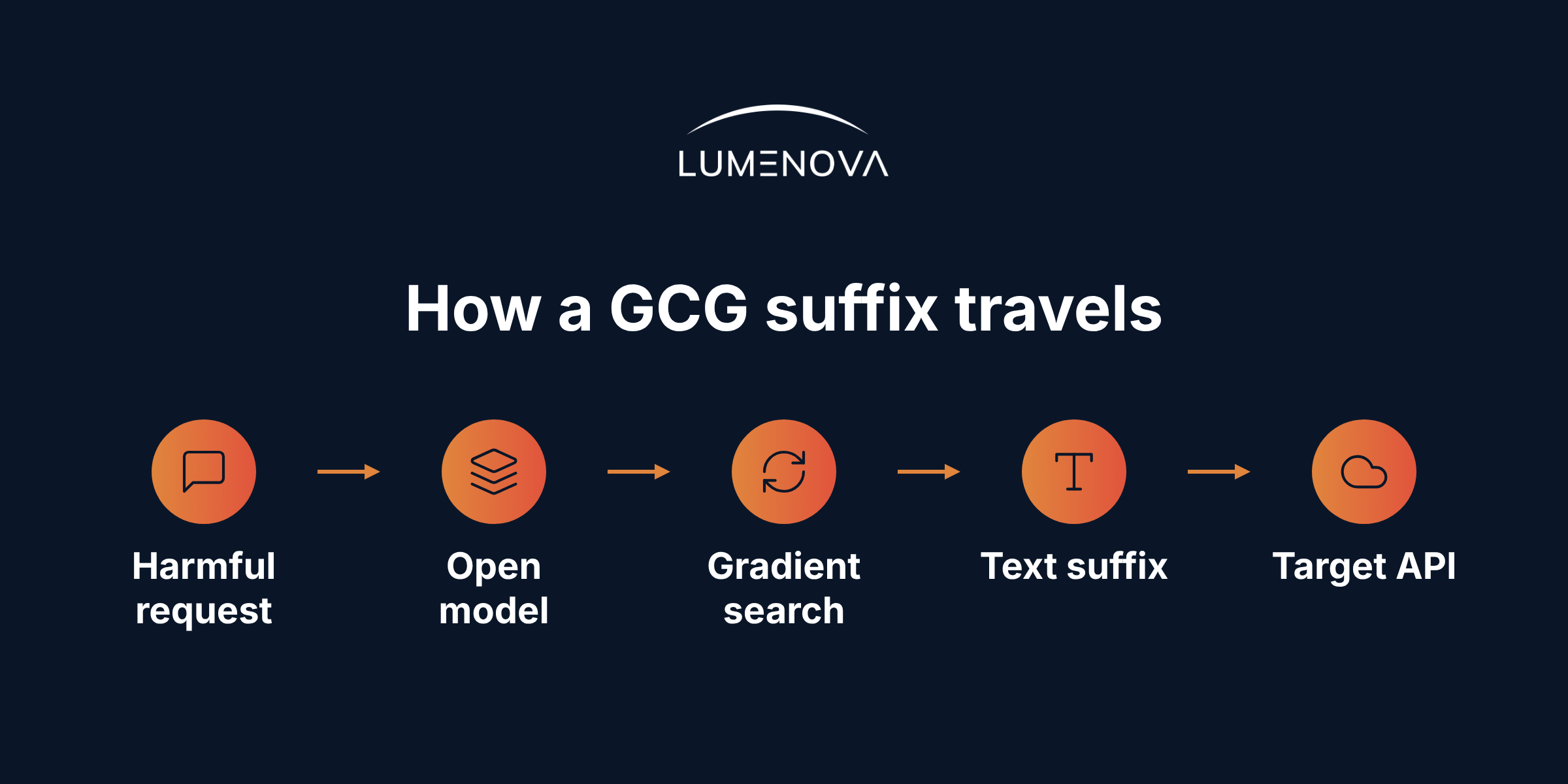
The Greedy Coordinate Gradient (GCG) method, published by Zou et al. in 2023, searches for a string of tokens that makes a model begin its answer with an affirmative phrase such as “Sure, here is.” Once a model starts that way, it tends to finish the harmful answer.
The search starts from a placeholder suffix and repeats one loop hundreds of times. The model’s gradients show which token swaps at each position are most likely to make the affirmative opening more probable. GCG builds a shortlist from those swaps, tests a batch of them, and keeps whichever swap works best. To make the suffix universal, the authors optimized it across many harmful requests and two models at once, Vicuna-7B and Vicuna-13B. The result is a short, mostly unreadable string that works when appended to requests it was never trained on.
Can adversarial attacks on language models be transferred across different models?
Yes, but how well depends on the target model. The original suffixes, built on open Vicuna models, also produced objectionable content in ChatGPT, Bard and Claude, as well as several open models. Transfer worked best against GPT-based models, which the authors linked to Vicuna being trained on ChatGPT outputs.
Later research found the picture less uniform. A 2025 study of 13 open models found that GCG suffixes transferred inconsistently. Models aligned with preference optimization, such as RLHF, resisted transfer well, while models aligned through fine-tuning alone were much easier to break.
Attackers have also improved their methods. IRIS (NAACL 2025) built a single suffix on Llama-3 that transferred to GPT-4o in 76% of tests and to o1-preview in 48%. For security teams, this means transfer can’t be assumed and can’t be ruled out.
What GCG means for teams with API-only access
GCG’s gradient step needs model weights, but the attacker doesn’t need yours. They can optimize a suffix on any open-weight model and send the finished string to your endpoint as ordinary text. GCG also doesn’t strictly need a surrogate model. Its candidate selection needs only a score for each candidate, and a 2024 query-based variant used the API’s output probabilities to attack GPT-3.5 directly.
Teams that self-host open-weight models face the full white-box version of the attack. Teams that call a hosted model face transferred and query-based suffixes. In both cases, the deploying team can’t retrain the model, so its controls sit at the input and output layers.
Are there any recent advancements in defending against GCG attacks?
Yes. Defenses now work at three points: filtering the input, changing the model, and combining checks across the pipeline.
| Defense | Stage | How it works | Reported result | Known limit | Source |
| Perplexity filtering | Input | Flags text with very high perplexity | Catches GCG-style gibberish | Readable suffixes pass; false positives on unusual but legitimate prompts | Jain et al.; Alon and Kamfonas, 2023 |
| SmoothLLM | Input | Perturbs copies of the prompt and compares the answers | Near-zero success for GCG, PAIR and AmpleGCG | Several model calls per query, which adds cost | Robey et al., 2023 |
| Adversarial Suffix Filtering | Input | Lightweight pipeline that works with any model and detects suffixes | Suffix attack efficacy below 4% | Built for suffix attacks only | Khachaturov and Mullins, 2025 |
| Circuit breakers | Model | Interrupts internal representations linked to harmful output | GCG success of 2.5% | IRIS reached 25%; Best-of-N also got past it | Zou et al., 2024 |
| TrapSuffix | Model | Traps the attacker’s optimization, or leaves traceable fingerprints in suffixes that succeed | Success below 0.01%; 87.9% of suffixes traced | February 2026 preprint, not yet tested independently | Du et al., 2026 |
| CASCADE | Across stages | Selects combinations of defenses for each pipeline stage | Preferred combinations for each deployment scenario | A selection framework, not a defense on its own | EMNLP 2026 Findings |
These results come with a warning. A 2025 study showed that effective suffixes still exist against alignment-based defenses that reported near-zero success rates, once attackers use knowledge of how those defenses were trained. The results in the table come from each paper’s own tests, and few of these defenses have been tested independently against attackers who adapt.
How adversarial training improves model robustness, and where it stops
The model developer attacks the model during fine-tuning and trains it to refuse each attack that works, regenerating the attacks as the model changes. HarmBench showed the payoff against GCG. A Zephyr 7B model trained with its R2D2 method had about a quarter of the GCG success rate of the next most robust model tested, and kept its general-capability scores.
Where adversarial training stops
- New attacks: Protection is strongest against the attack families used in training. HarmBench found that no current defense is uniformly effective.
- Adaptive attackers: In The Attacker Moves Second, researchers from OpenAI, Anthropic and Google DeepMind bypassed 12 published defenses with success rates above 90% for most. Most of those defenses had originally reported near-zero success rates.
- Over-refusal: Models trained hard against attacks start refusing harmless requests that resemble harmful ones.
- Ownership: Only whoever controls the model weights can run adversarial training . Teams calling a hosted model inherit the provider’s training and can’t add to it.
That last point matters most for enterprise teams. A provider’s training covers the base model, but not your system prompt, retrieval data or agent tools. Those need their own testing and controls, which the next section covers.
How can adversarial AI attacks be detected and prevented in production?
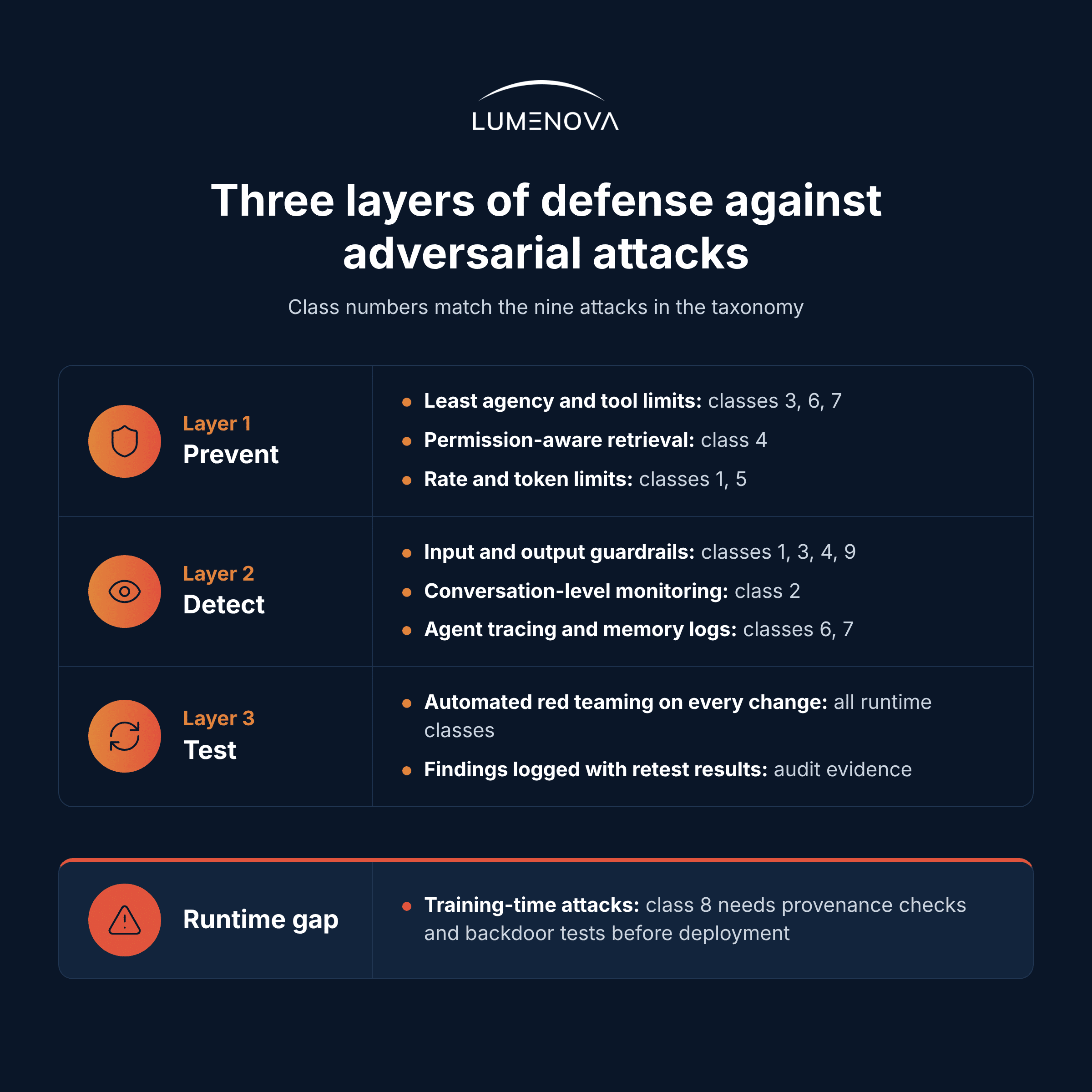
No single control covers all nine attack classes. Production defense works in layers: limit what an attack can reach, watch for it while it happens, and keep testing as the system changes.
Prevent: limit what an attack can reach
- Least agency: Give agents only the tools and credentials their task needs, scoped to that task (classes 6 and 7). OWASP’s agentic guidance treats this as a starting principle.
- Tool restrictions after untrusted input: Once an agent has read retrieved or external content, restrict which tools it can call next. MITRE ATLAS lists this as a mitigation of its own (classes 3 and 6).
- Permission-aware retrieval: Enforce each user’s access rights at the retrieval layer, so the assistant can’t fetch what the user couldn’t open (class 4).
- Rate and token limits: Cap requests, output and reasoning tokens per user and session (classes 1 and 5).
Detect: watch inputs, conversations and actions
- Input and output guardrails: These catch known jailbreak patterns, hidden instructions and data leaving the system. In 2026, a Brazilian labor tribunal’s AI tool blocked a hidden instruction in a court filing, and a human reviewer confirmed it.
- Conversation-level monitoring: Score the whole conversation as well as each message, so gradual escalation shows up (class 2).
- Agent observability: Trace every tool call and memory write, so a harmful chain of individually allowed steps can be reconstructed and stopped (classes 6 and 7).
Test continuously
Periodic manual red teaming captures one moment. Models get updated, prompts change and new techniques appear between tests. Automated red teaming that reruns on every change keeps coverage current. Each finding should record the attack, the date, the control that addressed it and the result of a retest. That record is the evidence security leaders and model risk teams need.
How Lumenova AI closes the loop
AI Security attacks your applications and agents the way an adversary would, through the same interfaces attackers use, and maps each finding to OWASP and MITRE ATLAS. Each finding becomes a draft policy that a person on your team reviews and activates, and the original attacks are replayed to prove the fix holds, with the record kept. Between tests, AI Guardrails screen what goes into and comes out of each model for prompt injection and personal data, and AI Observability records every tool call so a harmful chain can be reconstructed.
Find the attacks your defenses miss: Red team your AI applications and agents, block what gets through and prove the fix holds.
Request Demo
Frequently Asked Questions
They fall into nine classes: direct prompt injection and single-turn jailbreaks, multi-turn jailbreaks, indirect prompt injection, sensitive information disclosure, resource abuse, agent goal hijack and tool misuse, identity and memory attacks, training-time and supply chain attacks, and optimized adversarial suffixes such as GCG. Prompt injection ranks first in the OWASP Top 10 for LLM Applications 2026.
A universal attack is a single adversarial input, usually a suffix, that works across many different harmful requests. A transferable attack is built on one model and also works on others. The 2023 GCG paper, “Universal and Transferable Adversarial Attacks on Aligned Language Models,” showed both properties in one attack.
Yes, but unevenly. GCG suffixes built on open Vicuna models also worked against ChatGPT, Bard and Claude. Later research found that models aligned with preference optimization, such as RLHF, resisted transfer, while models aligned through fine-tuning alone were easier to break. Newer methods such as IRIS transferred to GPT-4o in 76% of tests.
In layers. Prevent attacks by limiting agents’ tools and credentials, enforcing user permissions at the retrieval layer and capping requests and tokens. Detect them with input and output guardrails, conversation-level monitoring and tracing of tool calls. Then test continuously, rerunning automated red teaming on every change and keeping each finding and retest as evidence.