
Contents
The 4 AI Risks Keeping Bank & Insurance CROs Awake:
- Algorithmic bias — skewed underwriting and lending decisions that expose institutions to discrimination claims and regulatory scrutiny.
- Security vulnerabilities — adversarial attacks and data poisoning that compromise fraud detection and put customer data at risk.
- Regulatory non-compliance — rapidly evolving rules, from the EU AI Act to sector-specific guidance, that can trigger fines and operational shutdowns.
- Model drift — silent performance degradation that erodes the accuracy of credit, pricing, and fraud models over time.
The use of artificial intelligence (AI) has exploded in recent years, and it’s been permeating virtually every industry. The increased presence of AI agents and algorithms is helping organizations to boost their productivity, make more informed decisions, and in some cases even gain an edge over their competitors. However, these benefits also come with associated AI risks, and some industries might experience greater risks of AI use than others.
SEE ALSO: AI in Finance: The Rise and Risks of AI Washing
Banks and insurance industries handle sensitive, critical areas of consumers’ lives. Without proper oversight, AI can introduce bias into financial decisions, become a target for cyber threats, and create regulatory challenges that put institutions at legal and reputational risk. In this article, we’ll discuss four critical AI risks in banking and insurance that banks and insurance companies must be aware of if they utilize AI in their operations.
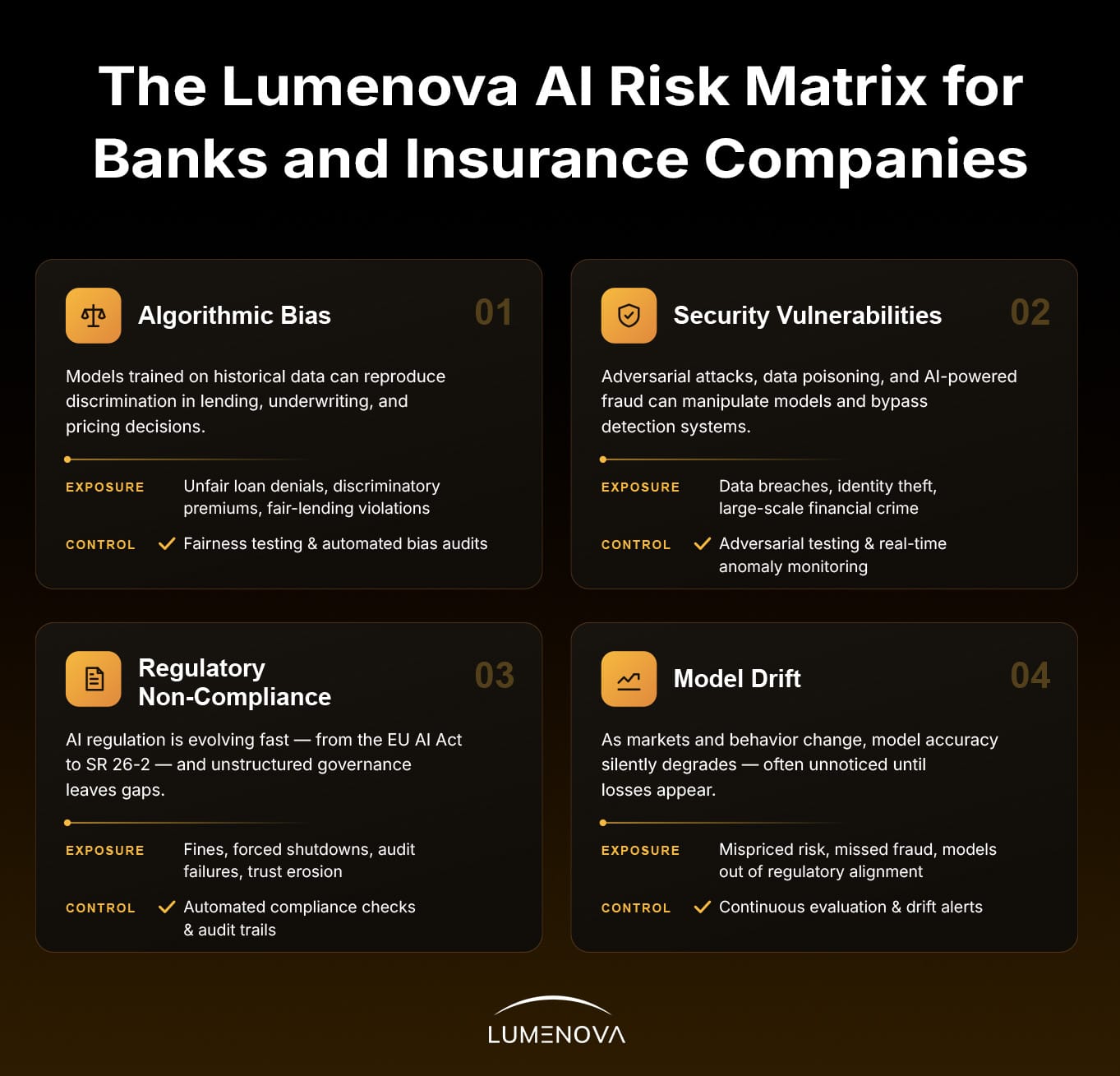
The matrix below maps all four risks, where they surface and the controls that contain them:
Mitigating Algorithmic Bias in AI Underwriting and Lending Models
AI models excel at using data to make informed decisions. If the historical data they are trained on, though, contains biases, then those biases are likely to be reinforced and even amplified. AI in the insurance and banking industries could be at risk of including historical discrimination, socioeconomic factors, and unbalanced datasets in training data. This could lead to unfair lending decisions, discriminatory insurance pricing, and other unfair actions.
Three forms of bias carry particularly high stakes in financial services:
- Proxy discrimination is when an AI model relies on seemingly neutral variables, such as ZIP code, shopping behavior, or device type, that correlate strongly with protected characteristics like race or gender, producing discriminatory outcomes without directly using protected data.
- Algorithmic redlining is the practice of an AI system systematically denying or limiting financial services, such as loans or favorable insurance terms, to residents of specific geographic areas, reproducing the historical practice of redlining in digital form.
- Credit scoring bias is a systematic skew in AI-generated credit scores that occurs when models learn from historical lending data shaped by past discrimination, causing certain groups to receive lower scores regardless of their actual creditworthiness.
Mitigation Strategies
Preventing AI bias and ensuring fair financial decision-making should be a top priority for any bank or insurance provider planning to use AI over the coming months and years. Doing so can help to avoid severe legal penalties and reputational damage. Financial institutions can implement the following strategies to protect themselves:
- Use diverse and representative datasets. Ensure training data for AI models reflects a wide range of demographics and socioeconomic backgrounds.
- Implement fairness audits and bias detection tools. Regularly test AI models for biased outcomes and adjust them accordingly.
- Establish transparent AI decision-making processes. Clearly document how AI-driven decisions are made, providing explanations for approvals and denials.
By proactively addressing AI bias, financial institutions can build trust, ensure compliance, and deliver fairer financial services. Embedding these checks in an AI governance workflow keeps fairness documentation consistent and regulator-ready.
Addressing Security Concerns of AI in Banking Systems
As the prevalence of cybercrime grows, security concerns around AI in banking systems are mounting and companies handling sensitive information have an increased responsibility to keep their customers’ data secure. AI models can be vulnerable to cyber attacks that put this security at risk. Adversarial attacks, data poisoning, and sophisticated fraud techniques have been prevalent strategies to derail the AI models of banks and insurance companies.
- Adversarial attacks represent manipulated inputs designed to trick an AI model into making incorrect decisions, such as approving fraudulent transactions.
- Data poisoning is the intentional corruption of a model’s training data so that it learns flawed patterns an attacker can later exploit.
Attackers can manipulate AI decision-making, bypass fraud detection systems, or even use AI-powered automation for large-scale financial crimes.
Mitigation Strategies
Without effective security and compliance safeguards, financial institutions using AI may be at risk for higher rates of fraud, data breaches that lead to customer identity theft, and regulatory consequences. Any one of these risks of AI in banking could lead to massive financial losses for a company as well. To protect themselves from exploitation, banks and insurance providers should incorporate the following strategies into their operations. An AI risk management platform supports this by centralizing threat monitoring and surfacing emerging vulnerabilities in real time.
- Conduct regular AI security assessments and adversarial testing. Continuously test AI models against simulated cyber threats to identify weaknesses.
- Implement robust encryption and multi-layered cybersecurity measures. These help to protect AI data pipelines, model training processes, and decision-making algorithms from tampering.
- Monitor AI models for anomalies in real time. AI models can not be a “set it and forget it” solution. Deploy AI-driven security monitoring systems to detect and respond to unusual behavior before attackers can cause damage.
Navigating AI Compliance and Regulatory Risk in Financial Services
Governments and regulatory bodies have begun identifying the risks of AI in banking, and have been taking action to protect consumers from these risks. As a result, AI regulations are evolving rapidly, and financial institutions must stay ahead of applicable legislation to avoid legal and operational risks. Without a structured AI governance framework, banks and insurers may struggle to meet transparency, fairness, and accountability requirements.
- AI governance framework is the set of policies, controls, and accountability structures that defines how an organization develops, deploys, and monitors AI systems.
A dedicated AI governance and regulatory compliance module keeps these requirements mapped to concrete controls as legislation evolves.
This challenge intensifies as financial institutions move from standalone models to AI agents that act autonomously across systems — a shift that exposes the limits of traditional model risk management. As Andrei Manea, Co-Founder and Chief Scientist at Lumenova AI, explains:
“You can validate every component of an agentic system to the letter and still deploy something unsafe. That’s because legacy model risk management frameworks govern models — static artifacts with defined inputs and outputs — whereas an agent’s behavior emerges dynamically from the interaction between models, tools, memory, retrieved context, and the environment on every request. The risk no longer resides in any individual component, but in the execution trajectory. Governing agents therefore require evaluating decisions, tool use, and end-to-end system behavior, not just validating underlying models.”
For banks and insurers, the takeaway is that governance programs must expand beyond one-time model validation to cover how AI systems actually behave in production.
Mitigation Strategies
Beyond regulatory penalties and fines, if a financial institution is found to be non-compliant with applicable legislation, they also risk operational disruptions. If an AI system is found to be non-compliant, in many cases a business must halt operations and scramble to address the issues, leading to frustrated customers and business losses. To ensure AI compliance and regulatory alignment, financial institutions should:
- Closely monitor AI policies that might apply to them. Watching for regulation changes in any location where a company has customers can help to prepare for policy changes and avoid surprises.
- Adopt an AI governance framework aligned with industry standards. Implement governance structures that incorporate evolving regulations.
- Maintain detailed audit trails for AI decisions. Keep comprehensive records of AI model decisions to demonstrate transparency and accountability in case of regulatory audits.
- Collaborate with compliance teams to ensure AI transparency. Foster cross-functional collaboration between AI engineers, compliance officers, and legal teams to continuously evaluate the regulatory adherence of AI models.
Managing AI Model Drift in Financial Risk Systems
AI models in banking and insurance do not operate in static environments. Market conditions shift, customer behavior evolves, and fraud tactics change. Model drift is the decline in a model’s predictive accuracy that occurs as real-world data diverges from its training data. It is especially dangerous in financial risk systems. A drifting credit scoring model may approve high-risk applicants or deny creditworthy ones, while a degraded fraud detection model can let new attack patterns slip through unnoticed.
Because drift accumulates gradually, it often goes undetected until it has already caused financial losses and a model that has drifted may also fall out of alignment with the fairness and transparency standards regulators expect financial institutions to uphold. Pairing drift detection with continuous AI risk management closes that gap before it reaches customers or regulators.
Mitigation Strategies
Unlike a one-time security audit or bias review, managing model drift is a continuous discipline. To keep AI models in financial risk systems accurate and compliant over time, banks and insurers should:
- Monitor model performance continuously. Track accuracy metrics, input data distributions, and output patterns in production to catch early signs of drift before they affect financial decisions.
- Set drift thresholds and automated alerts. Define acceptable levels of performance degradation and trigger reviews or retraining workflows the moment a model crosses them.
- Retrain and revalidate models regularly. Refresh models with current data and re-test them against accuracy and fairness benchmarks before returning them to production.
- Document model performance over time. Maintain historical performance records that demonstrate to auditors and regulators that models remain fit for purpose throughout their lifecycle.
How AI Risks Map to Financial Regulations
The table below traces each AI risk factor to the financial use cases where it surfaces, the regulations that govern it, and how the Lumenova Responsible AI platform mitigates it:
| AI Risk Factor | Financial Use Case | Relevant Regulation | Lumenova AI Mitigation |
| Algorithmic bias | Credit underwriting, loan approvals, insurance pricing | ECOA and fair lending laws, Colorado SB21-169, EU AI Act | Fairness testing and automated bias audits |
| Security vulnerabilities | Fraud detection, transaction monitoring, customer data processing | GLBA, DORA, NYDFS Part 500 | AI security assessments and real-time anomaly monitoring |
| Model drift | Credit scoring, risk and pricing models | SR 26-2 (model risk management), EU AI Act | Continuous model evaluation and drift alerts |
| Regulatory non-compliance | All AI-driven decisioning | EU AI Act, GDPR, ISO 42001, NIST AI RMF | Automated compliance checks and audit trails |
Controlling AI Risk in Banking with Governance Software
AI is transforming the banking and insurance industries, but as we’ve explored, hidden risks like bias, security vulnerabilities, model drift and regulatory challenges can undermine its benefits. Without proactive risk management, financial institutions face potential compliance violations, cyber threats, and reputational damage.
The Lumenova Responsible AI platform is designed to simplify AI governance, automate compliance, and enhance risk management, helping banks and insurers deploy controllable AI responsibly. Book a demo today to see how we can help you avoid these crucial AI risks.
Frequently Asked Questions
The top risks of AI in financial services include algorithmic bias, cybersecurity vulnerabilities, and regulatory compliance challenges. These risks can lead to unfair decision-making, data breaches, and legal penalties if not properly addressed through AI governance and monitoring systems.
Bias in AI can lead to discriminatory outcomes such as unfair loan denials or inaccurate insurance pricing. These actions can harm customers and expose institutions to legal action and reputational damage. Preventing bias requires diverse data, fairness audits, and explainable AI systems.
Yes. AI systems can be exploited through adversarial attacks, data poisoning, or manipulation of training data. These attacks can disrupt fraud detection, enable identity theft, and result in massive financial losses. Regular testing and real-time anomaly detection are essential for protection, especially as AI-powered cyber attacks intensify.
Financial institutions must comply with evolving AI regulations such as the EU AI Act and GDPR. Without proper oversight, they risk fines, operational shutdowns, and trust erosion. Implementing a robust AI governance framework helps ensure transparency and regulatory alignment.
AI governance platforms like Lumenova help banks and insurers manage risk by automating compliance checks, monitoring model behavior, conducting fairness assessments, and maintaining audit trails. These tools make it easier to detect issues early and meet legal and ethical standards.