July 16, 2026
Controlling AI Agent Infrastructure Costs Best Practices: What Every Team Lead Needs to Know Before Scaling Agents
Contents
Key Insights
- AI agent infrastructure costs are consumption-based, making them significantly less predictable than traditional software licensing.
- The biggest cost drivers include inefficient agent loops, oversized models, verbose prompts, excessive tool usage, and always-on or multi-agent workflows.
- Controlling infrastructure costs goes beyond technical optimization; it depends on governance, visibility, and continuous oversight.
- Team leads should evaluate AI agent ROI, balancing infrastructure costs against business outcomes such as productivity gains, improved accuracy, and customer satisfaction.
- Building governance into AI deployments from the start helps organizations optimize costs, improve operational efficiency, and scale AI with greater confidence.
Why AI Agent Costs Are Different from Traditional Software
Most business software follows a predictable pricing model. Organizations typically pay a monthly or annual subscription based on the number of users, making it relatively easy to forecast future expenses.
AI agents work differently.
Instead of paying primarily for access, organizations pay for usage. Every interaction between an agent and a large language model (LLM), every API request, every database query, and every reasoning step contributes to the overall infrastructure cost.
The more autonomous an agent becomes, the more opportunities it has to generate costs without direct human involvement.
| Traditional SaaS | AI Agents |
| Fixed subscription pricing | Consumption-based pricing |
| Predictable monthly costs | Variable costs based on usage |
| Human-initiated actions | Autonomous execution |
| Easy budgeting | Require continuous monitoring |
This shift means organizations must manage AI infrastructure much like cloud infrastructure: through ongoing monitoring, optimization, and governance rather than relying solely on fixed budgets.
Where AI Agent Infrastructure Costs Come From
Understanding where costs originate is the first step toward controlling them.
Large Language Model (LLM) Inference
Every time an AI agent sends a prompt to a language model, the organization incurs a cost. More requests mean higher spending.
These expenses become especially noticeable when agents execute hundreds or thousands of tasks every day.
Token Consumption
LLMs charge based on tokens (the units of text processed during a request).
Long prompts, extensive conversation history, and detailed responses all increase token usage. Even seemingly minor prompt changes can significantly affect monthly costs at scale.
API and Tool Calls
AI agents rarely work in isolation. They interact with business applications such as CRMs, databases, ticketing systems, document repositories, search engines, and communication platforms.
Each of these integrations may involve additional API requests, licensing fees, or cloud resource consumption.
Compute Resources
Depending on how agents are deployed, organizations may also pay for:
- Virtual machines
- Containers
- Serverless functions
- GPU resources
- Cloud infrastructure
As workloads increase, compute costs often grow alongside model usage.
Memory and Storage
Many enterprise agents maintain conversation history, store embeddings, log activity, or retrieve information from vector databases.
These storage requirements accumulate over time, particularly for organizations running hundreds of concurrent agents.
Agent Orchestration
Modern AI systems frequently involve multiple specialized agents collaborating on complex tasks.
Planning, delegation, retries, scheduling, and communication between agents all consume additional computational resources that contribute to overall infrastructure costs.
Why AI Agent Costs Suddenly Spike
Many organizations are surprised when AI expenses rise much faster than expected. In most cases, the increase isn’t caused by a single large change but by multiple small inefficiencies that compound over time, as shown in the table below:
| Cost Driver | Why It Increases Costs | How to Reduce It |
| Inefficient Agent Loops | Agents repeatedly retry tasks, revisit the same reasoning, or get stuck in execution loops, increasing API calls and token usage. | Set execution limits, monitor retries, and implement guardrails. |
| Oversized Models | Using premium LLMs for simple tasks drives up inference costs unnecessarily. | Match the model to the complexity of the task. |
| Verbose Prompts | Long prompts and excessive context increase token consumption with every request. | Manage prompts and include only the necessary context. |
| Excessive Tool Usage | Agents make unnecessary API calls or repeatedly query external systems. | Eliminate redundant tool calls and cache frequently used results. |
| Always-On Agents | Agents continue running or polling for updates even when there’s no meaningful work to perform. | Schedule agents intelligently and trigger them only when needed. |
| Multi-Agent Workflows | Multiple agents communicating with each other generate additional reasoning steps, API calls, and token usage. | Use multi-agent architectures only where they provide clear business value, and monitor inter-agent communication. |
AI Agent Infrastructure Cost Control Best Practices
Effective cost control isn’t about restricting innovation. It’s about ensuring AI resources are used intentionally and efficiently. As AI deployments grow, the following best practices can help organizations optimize infrastructure spending without limiting innovation:
1. Define the Business Objective Before Deploying an Agent
Not every business problem requires an autonomous AI agent.
In many cases, traditional automation or rule-based workflows provide similar outcomes at significantly lower cost.
Before deployment, ask:
- Does this task require reasoning?
- Does it require autonomy?
- Would simpler automation achieve the same result?
2. Match the Model to the Task
Choosing the right model has a major impact on infrastructure costs.
Reserve premium reasoning models for complex decision-making while using smaller, faster models for routine tasks.
This approach often reduces expenses without sacrificing performance.
3. Establish Budgets and Spending Alerts
Organizations routinely monitor cloud infrastructure spending. AI infrastructure deserves the same discipline.
Set:
- Department budgets
- Usage thresholds
- Spending alerts
- Monthly reviews
Early visibility prevents unexpected budget overruns.
4. Monitor Agent Behavior Continuously
Cost optimization requires understanding how agents behave—not just how much they cost.
Track metrics such as:
- Prompt volume
- Token usage
- Retry frequency
- Tool utilization
- Workflow completion rates
- Failed executions
AI observability makes it easier to identify inefficient workflows before they become expensive.
5. Create Agent Usage Policies
Governance policies define how agents should operate within the organization.
These policies may include:
- Maximum execution limits
- Approved tools
- Human approval requirements
- Escalation rules
- Access permissions
Clear AI guardrails reduce unnecessary computation while improving operational consistency.
6. Measure Cost Against Business Value
Infrastructure spending should always be evaluated alongside business outcomes.
Useful metrics include:
- Cost per completed workflow
- Cost per successful task
- Cost per customer interaction
- Time saved
- Productivity improvements
These measurements provide a more accurate picture of AI return on investment.
7. Audit AI Agents Regularly
AI deployments evolve quickly.
Regular reviews help identify:
- Unused agents
- Duplicate workflows
- Inefficient prompts
- Outdated integrations
- Opportunities to simplify automation
For organizations subject to the EU AI Act, regular monitoring and documentation can also contribute to meeting lifecycle governance and compliance obligations. Continuous optimization keeps AI infrastructure aligned with both business objectives and evolving regulatory expectations.
Implementing these best practices provides a strong foundation for cost-efficient AI operations. The next step is ensuring your engineering team or AI vendor can demonstrate how these practices are being applied in your environment.
Questions Every Team Lead Should Ask Before Scaling AI Agents
Team leads don’t need to understand every technical implementation detail, but they should ask questions that improve visibility into operational efficiency.
Start the conversation with your engineering team or AI vendor by addressing:
- What is the average cost per completed workflow?
- Which agents generate the highest infrastructure costs?
- Are we using the most appropriate language model for each task, or could a smaller model deliver similar results?
- Could this task be run using an open-source model hosted on our own infrastructure? If so, how does the estimated hosting cost compare with the ongoing token costs of using a commercial API?
- Are repeated outputs being cached, or are we paying to generate the same responses repeatedly?
- How often do agents retry failed operations or enter unnecessary reasoning loops?
- What happens to infrastructure costs if we double the number of users, workflows, or autonomous agents?
- Which agents operate without human oversight, and what safeguards are in place to prevent runaway execution?
- How quickly can we detect abnormal spending patterns or unexpected spikes in usage?
These conversations encourage greater transparency and help establish accountability before costs become difficult to manage.
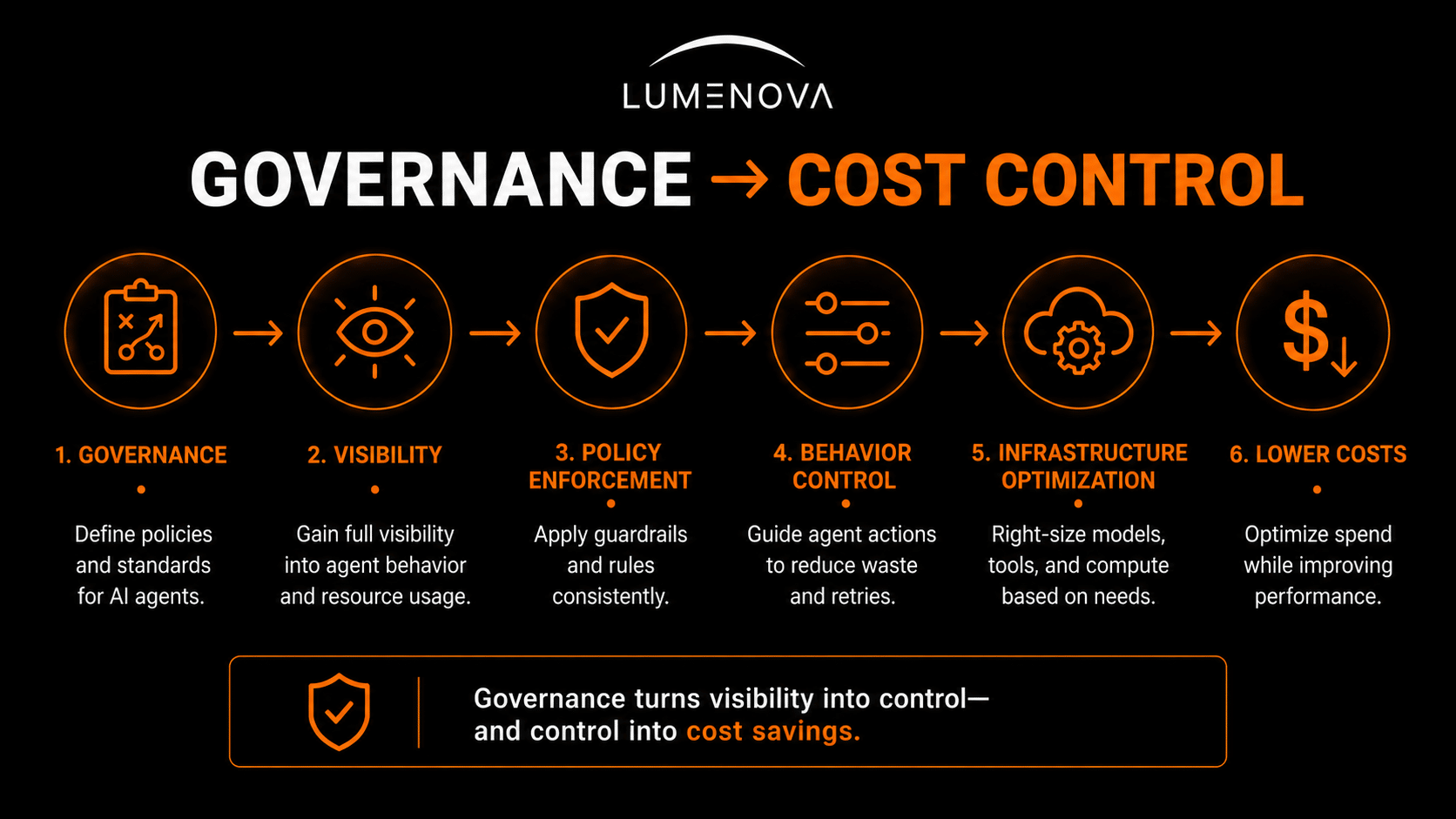
The Connection Between Governance and Cost Control
Many organizations think of AI governance primarily as a compliance requirement. In reality, effective governance also improves operational efficiency.
When organizations gain visibility into agent behavior, enforce policies consistently, and monitor workflows continuously, they reduce many of the inefficiencies that drive infrastructure costs.
Good governance helps organizations:
- Detect runaway agent behavior early
- Reduce redundant reasoning cycles
- Eliminate unnecessary tool calls
- Improve model selection
- Standardize deployment practices
- Increase visibility into resource consumption
Recent industry examples illustrate why this matters.
Usage-Based Pricing Exposed the True Cost of AI Agents
In 2025, AI coding platform Cursor transitioned from a more predictable subscription model to usage-based pricing after increasingly capable AI models made flat-rate pricing difficult to sustain. The rollout led to confusion, unexpected charges for some users, and public refunds. More importantly, it highlighted a broader industry trend: as AI agents perform longer, more autonomous tasks, infrastructure costs become significantly less predictable.
- Key takeaway: Agentic workflows don’t scale linearly. A single autonomous coding task may involve hundreds of model calls, making observability and cost controls essential.
Autonomous Agents Can Consume Infrastructure at Scale
Another example came from the open-source AI project OpenClaw. In 2026, creator Peter Steinberger revealed that the project had consumed more than $1.3 million worth of OpenAI API tokens in just 30 days, driven by approximately 100 autonomous coding agents performing millions of requests. OpenAI covered the bill as part of its support for the research project, but the example demonstrates how quickly autonomous agents can generate infrastructure costs when operating at scale.
- Key takeaway: Most organizations won’t approach that level of usage, but the underlying lesson is universal: autonomous execution without visibility can lead to exponential cost growth.
Governance Enables Smarter AI Spending
The industry is also shifting toward model routing, which is automatically selecting the most appropriate model for each task instead of defaulting to the most powerful (and most expensive) option. This approach reduces infrastructure costs while maintaining performance, demonstrating that effective governance isn’t about limiting AI adoption, but using AI resources intentionally.
This is where AI governance platforms like Lumenova AI provide value. By centralizing AI agent observability, policy enforcement, and continuous monitoring, organizations can identify inefficient agent behavior, enforce cost-conscious deployment policies, and maintain control over infrastructure spending as AI adoption grows.
More specifically, Lumenova AI helps organizations reduce unnecessary AI infrastructure costs by enabling:
- Complete visibility into agent activity through centralized monitoring and observability.
- Continuous monitoring to identify abnormal token usage, API calls, and infrastructure consumption before costs escalate.
- Policy-based guardrails that limit unnecessary agent actions, excessive retries, and unauthorized tool usage.
- Model governance to ensure each workload uses the most cost-effective model for the task.
- Agent inventory and lifecycle management to identify redundant, underutilized, or outdated agents that continue consuming resources.
- Risk and cost insights that connect agent behavior with operational impact, helping teams optimize both performance and spend.
- Enterprise-wide governance that gives engineering, security, and business leaders a shared view of AI operations and infrastructure usage.
- Audit trails and reporting that make it easier to understand where AI spending originates and demonstrate accountability to stakeholders.
Conclusion
Controlling AI infrastructure costs isn’t about spending less, but spending with intention.
The most successful organizations don’t evaluate AI agents based solely on token usage or monthly infrastructure bills. Instead, they measure return on investment (ROI) by balancing operational costs against the business value each agent delivers.
As AI initiatives move from pilot projects to enterprise-scale deployments, team leads should establish an ROI baseline early. By analyzing infrastructure costs during development and pilot testing, organizations can estimate how token usage, compute requirements, and API calls will scale as adoption grows. This makes it possible to project the cost per workflow, cost per user, or cost per successful task before expanding AI across the business.
Lumenova AI helps teams measure the ROI of AI systems, monitor agent behavior through observability, and apply governance guardrails that reduce risk and unnecessary spending even during proof-of-concept stages. And when organizations encounter roadblocks on their AI journey, our Forward Deploy Team works alongside them to implement practical solutions and keep deployments on track.
Ready to maximize AI ROI while keeping infrastructure costs under control? Book a discovery call with Lumenova AI to see how AI governance can help you scale with confidence.
Frequently Asked Questions
Start with a pilot or proof of concept and measure token usage, API calls, compute resources, and workflow execution costs. You can then extrapolate these metrics to estimate costs at higher usage levels and calculate expected ROI before scaling.
It depends on your workload. Commercial APIs often offer lower upfront costs and easier management, while self-hosting an open-source model may become more cost-effective for high-volume, predictable workloads. Comparing hosting costs against ongoing token consumption can help determine the better option.
Beyond infrastructure costs, organizations should monitor metrics such as cost per completed task, time saved, productivity improvements, response quality, customer satisfaction, and workflow completion rates to evaluate overall business value.
Governance should begin during the proof-of-concept stage – not after production deployment. Establishing observability, guardrails, and monitoring early helps identify risks, optimize costs, and avoid expensive redesigns as AI initiatives scale.
There is no universal schedule, but organizations should review AI agents regularly, particularly after significant model updates, workflow changes, or increases in usage. Periodic audits help identify optimization opportunities, retire unused agents, and ensure AI systems continue to align with business and governance objectives.