August 11, 2026
How to Account for Agentic AI in Your AI Governance Strategy
Contents
Key Takeaways
- Agents act, models recommend. Governance built for outputs and human review does not cover a system that plans, calls tools, and executes on its own.
- NIST AI RMF and ISO/IEC 42001 still apply. What changes is the unit you govern: the agent and its permissions, not just the model.
- Start with an agent registry. Permissions, oversight, audit logging, and ownership all need a defined agent to attach to.
- Four existing controls break under agentic AI. Permissions, oversight cadence, audit logging, and ownership were all written for a model that recommends, not one that acts.
- An agentic AI control plane closes the gap. It enforces policy-as-code, tracing, and remediation while the agent runs, not only before or after.
- Nine concrete changes make up a working checklist, spanning governance, engineering, and business decisions.
Check the date on your AI governance strategy. If it precedes agents that can act on your systems, it governs a narrower problem than you have. That strategy was built for models that produce outputs: a risk score, a recommendation, with a person deciding what happens next. The person was the control.
Agentic AI removes that person. An agent plans, calls tools, and executes. It pulls the policy record, updates the claim status, emails the claimant, then hands the file to another agent to close. That is not a suggestion awaiting sign-off. It is an action already taken.
The NIST AI RMF and ISO/IEC 42001 still give you the right foundation. Neither needs replacing. What changes is what you govern: not the model, but the agent and what it is permitted to do.
This guide closes that gap: five places your existing framework comes up short, and what to add at each one.
Start With an Agent Registry
You cannot govern what you have not counted. Most enterprises that go looking find agents already running, and find them in places nobody registered.
Where Agents Are Already Taking Action
Your model inventory captures what you bought or built. Agents rarely arrive that way. They arrive when a vendor ships an agentic feature into a platform you already license, and someone in operations switches it on. A claims system adds automated triage in a quarterly release. The CRM gains an agent that drafts and sends follow-ups. A development team adopts a coding agent with write access to production repositories.
Four places to look first:
- Vendor platforms. Read the release notes for agentic features enabled by default in tools already in production.
- Business-unit pilots. Agents built or configured outside the formal model approval path.
- Developer tooling. Coding agents with repository write access and CI/CD permissions.
- Upgraded automation. Existing RPA workflows that now have a planning layer sitting on top of them.
For each agent, record what it can do rather than what it is:
- Owner, business function, and use case.
- Tools and APIs it can call.
- Systems it can write to, not only read from.
- Data categories it touches.
- Whether it can invoke other agents.
- Autonomy level, and where a human checkpoint exists, if one does.
That last group of fields is what separates an agent registry from a model inventory. Two agents running on the same underlying model can carry entirely different risks, depending on what you let them touch.
Classify With Risk Tiers and Value Tiers
Set the risk tier by the consequence of a wrong action, not by the sophistication of the model. Three questions do most of the work:
- Can the agent write, or only read?
- Is the action reversible, and how quickly?
- Does the action touch a regulated decision, customer funds, or personal data?
An agent that summarizes internal policy documents and an agent that adjusts claim reserves may run on identical infrastructure. Only one of them needs a human in the loop. Then tier the same agents by business value. This is the step governance teams skip, and skipping it is expensive. Without a value tier, every conversation with the business reads as a brake. With one, you can say which agents earn the oversight budget and which ones are not worth the controls they require.
Define value plainly: hours saved, cost avoided, or revenue influenced. Plotted against risk, every agent lands in one of four positions.
| Low business value | High business value | |
|---|---|---|
| High risk | Constrain scope, or make the case to the business owner for decommissioning. Governance flags it, the owner decides. | Heaviest controls. Real-time guardrails, defined escalation, named owner. |
| Low risk | Register, monitor lightly, and re-check when scope changes. | The safest place to expand autonomy. Use it to prove out your registry and tiering process before applying either to higher-risk agents. |
Tiers are not annual. An agent’s risk tier changes the moment its scope does, and scope changes without a change request: a vendor enables a new tool, or one agent borrows a capability from another.
The registry is the first of the five places to look, and it feeds the other four. Permissions, oversight cadence, audit logging, and ownership all need a defined unit to attach to. Without the registry, you are writing policy for agents you cannot name.
Four Places Your Existing Strategy Likely Falls Short
Building the registry is the first of the five changes, and the only one that starts from a blank page. The next four are controls you already run. They were written for a model that recommends, and each breaks in a specific way once the model acts.
1. Permissions — does your policy define what an agent can do, not just generate?
Most AI policies govern output. Acceptable use, prohibited content, disclosure requirements, review thresholds. Read yours again with an agent in mind, and you will find it says almost nothing about action. It restricts what a model may say, not what it may do.
Permissions are not a content question. They are an access question, and the answer usually lives in your identity and access management layer rather than in your AI policy. The agent inherits credentials from a service account that was scoped for an integration, not for an autonomous actor deciding when to use it.
What to add:
- Define permitted actions per agent use case: read, write, transact, communicate externally, invoke other agents.
- Set the ceiling in the identity layer, not the prompt. A system prompt telling an agent not to issue refunds is a request. A credential without refund scope is a control.
- Require approval for scope expansion, including scope a vendor adds on your behalf.
2. Oversight cadence — built for periodic review, not real-time action
Model governance runs on a cycle. Quarterly validation, annual review, a risk committee that meets monthly. That works when the model produces a recommendation and a person decides, because the review catches the problem before it reaches a customer.
An agent in production does not wait for the committee. By the time a quarterly review finds faulty logic, the agent has applied it thousands of times. Detection lag becomes exposure.
What to add:
- Keep periodic review for the model. Add continuous checks at runtime
- Set thresholds that escalate mid-session rather than at review time.
- Name an owner for the kill switch, and test it rather than document it.
3. Audit logging — captures prompts/outputs, not multi-step action chains
Your logging probably captures the exchange: input, output, timestamp, user. That is what you need to reconstruct a conversation. It is not what you need to reconstruct a decision.
When a regulator asks why a claim was denied, the prompt and the response do not answer it. The answer sits in the chain: which tools the agent called, in what order, what each returned, which branch it took, what it passed to the next agent, and where a human checkpoint was or was not.
What to add:
- Log tool calls, parameters, and returns, not only prompt and completion.
- Treat agent-to-agent handoffs as first-class events.
- Retain action logs to the same standard as the underlying business record, since they are evidence for the same decision.
- Make the log queryable by decision, not by session.
4. Ownership — who signs off when no human approved the specific action
Model governance assigns an owner to a model. That holds when harm traces back to an output someone approved. Agents break the chain, because the action was not approved by anyone. It got blanket permission.
Naming a model owner does not answer the question a regulator or a customer will ask, which is who is accountable for this specific action.
What to add:
- Assign accountability per agent use case, not per model. One model behind six agents is six accountability lines.
- Separate the accountable executive for actions from the technical owner of the agent.
- Define in advance who can suspend an agent and who reviews afterward.
- Where an agent acts on a regulated decision, map ownership to the existing regulatory accountability rather than building a parallel AI structure.
Adding the Agentic AI Control Plane
The four gaps share a root cause. Each control assumes a person sits between the decision and the action, with time to review. Closing them one at a time, with more policy documents and more review meetings, adds process without adding speed. What closes them together is a layer that enforces policy at the moment the agent acts.
An agentic AI control plane is an automated governance layer that turns written policy into executable controls and applies them in real time, while the agent runs.
Why Runtime Enforcement, Not Only Pre-Release Testing
Pre-deployment testing is not obsolete, and nothing here replaces it. Agent code can be reviewed. Guardrails against prompt injection can be tested, and increasingly tested while the agent runs rather than only before release. Keep all of it.
What pre-release testing cannot cover is capability the agent acquires after deployment. An agent that pulls code from a public repository, or delegates a step to an external agent, introduces something into your environment that nobody reviewed. There was no change request, no security assessment, no procurement record. The normal IT checks were not bypassed. They were never triggered, because nothing that looks like a change was made.
That is the argument for enforcing at runtime. You cannot pre-approve what the agent has not acquired yet.
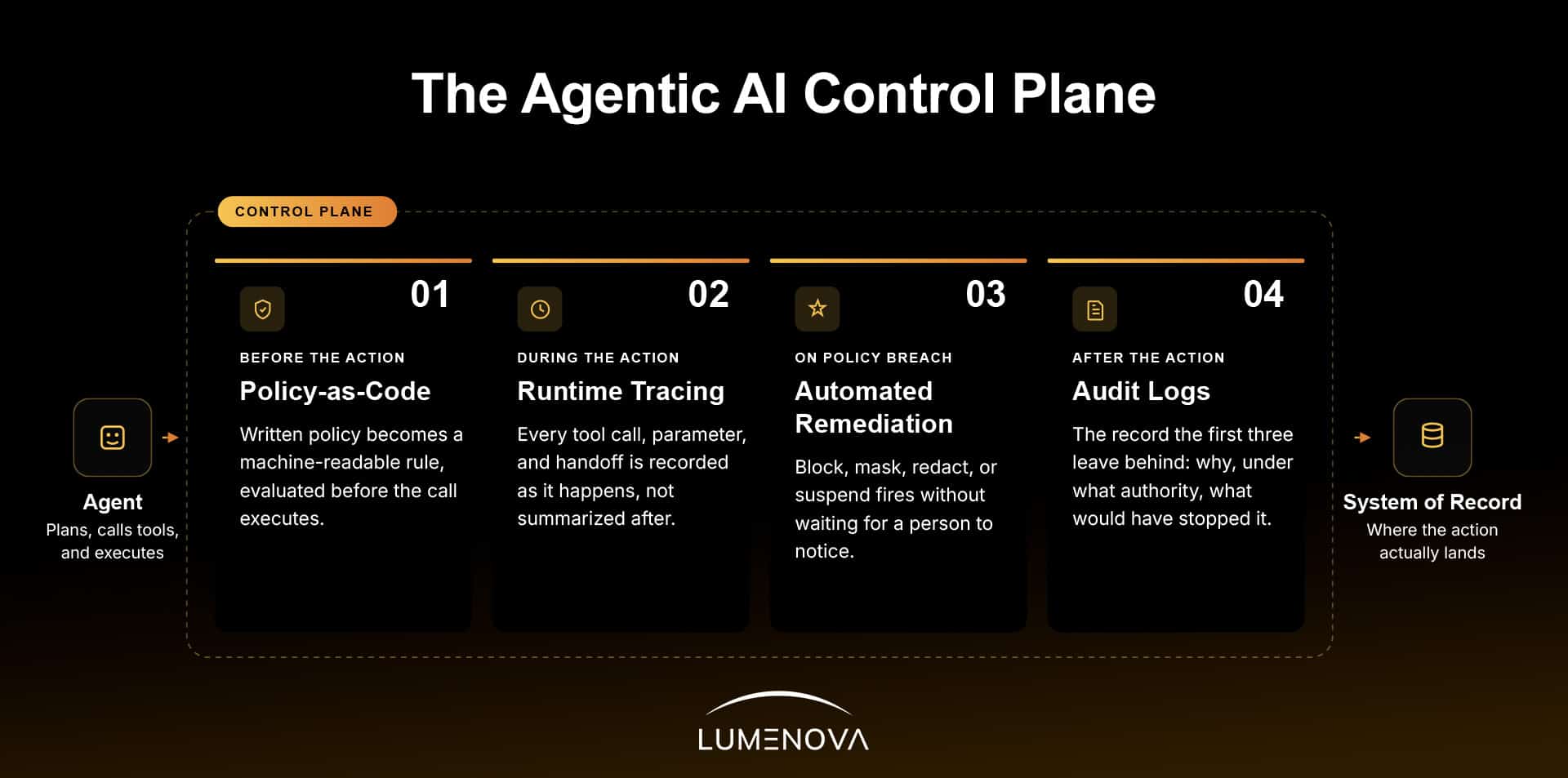
The four components are not a menu to choose from. They are points along a single agent action: one gates it, one records it, one responds when it breaks policy, and the last is the evidence the other three leave behind.
Policy-as-Code
Your written policies become machine-readable rules, evaluated before an action executes rather than after. This is the permission gap answered in practice: the difference between a policy stating that agents may not initiate payments and a control that refuses the call.
Runtime Tracing
Every step in the chain is recorded as it happens. The tool called, the parameters passed, what came back, the branch taken, the handoff to the next agent. This is what turns a session log into a reconstruction of a decision.
Automated Remediation
When an action breaches policy, the response fires without waiting for a person: block the call, roll back the step, escalate to a named owner, or suspend the agent. Detection without response is monitoring. The point of the control plane is that detection and response are the same event.
Audit Logs for Post-Session Analysis
The first three components generate the record. What matters is that the record is structured for the questions asked later: why this decision, under what authority, and what would have stopped it.
A Practical Checklist for Updating Your Strategy
The sections above explained what breaks and why. This is the working version. Each row pairs a change to your framework with the condition that proves it landed, because most of these items can be marked complete in a document while remaining false in production.
| Change | Done when |
| Build the agent registry | Every agent in production has an owner, a permitted-action list, and a risk-and-value tier. |
| Define permitted actions per use case | Your policy names actions, not just content, and the limit is enforced by credentials rather than by a prompt. |
| Integrate escalation by risk and autonomy level | Each tier has a named escalation path that fires mid-session, not at the next review. |
| Add real-time guardrails at the action layer | A policy breach stops the action rather than appearing in a report afterwards. |
| Extend audit requirements to agent action logs | Action logs are retained to the same standard as the business record they support. |
| Ensure tracing covers every agent action | You can reconstruct a decision end to end, including agent-to-agent handoffs. |
| Assign accountability per agent use case | Every use case names an accountable executive and a technical owner. One model behind six agents produces six lines, not one. |
| Implement policy-as-code | Policies exist as rules the system evaluates, not only as documents people read. |
| Extend risk assessments to acquired capability | Your assessment covers code and capability the agent picks up at runtime, from public repositories or external agents, not only misuse of the tools you granted it. |
These do not all belong to the same team. The registry and the accountability lines are governance work. The identity ceiling and policy-as-code are engineering work. Deciding which agents are worth the controls is a business decision. Assign the rows before you assign the deadline.
How Lumenova AI Helps
Beacon is where this checklist becomes operational: an inventory of every agent, policy agents are actually held to, real-time guardrails, and the tracing and audit trail to back it all up. Mapped against the checklist above:
Closing the Registry Gap
Covers: build the agent registry, assign accountability per agent use case. Agents gives every AI agent in your projects a home, with Agent Insights reviewing runs across reliability, quality, performance, and safety, and a fleet view ranking which agents need attention first. Access and Single Sign-On maps roles and teams to fine-grained permissions, so each agent traces back to the group actually accountable for it.
Enforcing Permissions
Covers: define permitted actions per use case, implement policy-as-code. Agentic Governance sets and enforces what an agent is allowed to do, authored in plain language, versioned, and backed by a full audit trail. Safe Promotion moves that policy from staging to production through a reviewed, approval-gated workflow, so no change reaches a live agent unsigned.
Continuous Oversight
Covers: escalation by risk and autonomy level, real-time guardrails, extend risk assessments to acquired capability. Guardrails check every input and output in real time: PII detection and masking, prompt-injection defense, language restriction, and profanity and topic filters, with trust scoring, all logged and testable. System Probe stress-tests and red-teams model behavior to surface weaknesses before a customer does, directly addressing capability an agent might acquire outside your normal review. Alerts route to email, Slack, Microsoft Teams, and ServiceNow, though tying that routing to specific risk or autonomy tiers is still a gap to close on your side.
Evidence, Not Just Logs
Covers: extend audit requirements, ensure tracing covers every agent action. Observability traces every prompt, tool call, and retrieval an agent makes, down to the individual step, built on open standards. Enterprise Security and Retention keeps that history in encrypted, audit-ready storage for as long as compliance requires, without the cost of retention becoming the reason it gets cut short.
Where to Start
None of this requires rebuilding your framework from scratch. The NIST AI RMF and ISO/IEC 42001 still hold. What changes is the unit you govern, and the five places in this guide are where that change shows up first.
The place to start is finding out where you actually stand. Lumenova’s AI governance assessments will show you which of the five gaps are open in your organization today, before an agent finds them for you.
Frequently Asked Questions
Agentic AI governance is the set of policies, permissions, and controls that manage AI agents that plan, call tools, and take action on systems, not just models that generate content or a recommendation for a person to review
A model produces an output for a person to review before anything happens. An agent executes the action itself, so governance has to define what the agent is permitted to do and enforce that in real time, rather than only reviewing what it produced.
An agentic AI control plane is an automated governance layer that turns written policy into machine-enforceable rules, applied while an agent runs rather than only reviewed before or after deployment.
Accountability should be assigned per agent use case, with an accountable executive for the action’s business outcome kept separate from the technical owner of the agent, rather than relying on a single model owner to cover every agent that model powers.
Build the agent registry first. It is the only one of the five changes that starts from a blank page, and it gives permissions, oversight, audit logging, and ownership a defined unit to attach to.