August 6, 2026
Securing Autonomy: A Buyer’s Guide to Mitigating AI Security Risks in Agentic Systems
Contents
Key Takeaways
- Agentic AI expands the enterprise attack surface by autonomously interacting with enterprise systems and tools.
- Traditional governance doesn’t scale for autonomous agents operating at machine speed.
- Continuous policy enforcement is essential to prevent unauthorized actions before they occur.
- Real-time observability and auditability provide the visibility needed to support secure, compliant AI operations and investigate algorithmic failures when they occur.
- Centralized governance enables consistent control across agents, models, and environments.
- Choose platforms built for autonomy, not just AI monitoring.
Agentic AI is changing the way enterprises operate. Unlike traditional AI systems that generate recommendations, agentic AI can reason, plan, and execute actions autonomously. It can retrieve sensitive data, call APIs, trigger transactions, and interact with enterprise systems, all with minimal human intervention.
That autonomy is what makes agentic AI so powerful and what makes it a fundamentally different cybersecurity challenge.
The challenge is becoming increasingly urgent. Gartner found that 75% of organizations are already piloting, deploying, or using AI agents, yet only 13% believe they have the right governance structures in place to manage them, and 74% view AI agents as a new attack vector for their organization.
As organizations deploy AI agents across banking, healthcare, insurance, software development, manufacturing, telecommunications, and other sensitive environments, traditional governance models begin to break down. Security teams can no longer rely on periodic reviews or manual approvals when autonomous systems are making decisions at machine speed.
Enterprises need governance designed for autonomous systems, not retrofitted from traditional ML security processes.
This guide explores why agentic AI introduces new cybersecurity risks, why conventional governance doesn’t scale, and what to look for in an enterprise AI governance platform.
What Makes Agentic AI a Distinct Security Risk
Traditional AI typically generates information for a person to review before taking action.
Agentic AI goes a step further. It can independently determine what to do, how to do it, and which enterprise systems to use to accomplish an objective.
There are three characteristics that make agentic AI a unique security challenge:
1. Autonomy
AI agents can:
- Plan multi-step workflows
- Make decisions without waiting for human approval
- Adapt based on new information
- Continue executing toward an objective
2. Tool Access
Modern agents routinely interact with:
- Enterprise databases
- APIs
- CRM and ERP platforms
- Cloud infrastructure
- Financial systems
- Internal knowledge bases
- Third-party SaaS applications
These integrations enable productivity, but they also expand the enterprise attack surface.
3. Machine-Speed Execution
Unlike human employees, AI agents can execute hundreds or thousands of actions in minutes.
That speed means governance must keep pace.
- Policies must be enforced in real time, not after the fact.
- Risk can escalate quickly as agents chain actions across systems.
- Security controls must scale with agent activity, not human reviewers.
Together, autonomy, tool access, and machine-speed execution create a security model that traditional governance was never designed to manage.
What Can Go Wrong in Sensitive Environments?
As organizations give AI agents access to critical systems, even seemingly small mistakes can have significant business consequences.
| Environment | Potential Failure Mode |
| Banking & Financial Services | Agent initiates an unauthorized payment, loan approval, or trading action. |
| Insurance | Agent incorrectly approves or denies claims, exposing the organization to financial, regulatory, or legal risk. |
| Healthcare | Agent retrieves or shares protected patient data (PHI) outside approved workflows or makes inappropriate treatment recommendations. |
| Customer Support | Agent exposes confidential customer information or performs unauthorized account actions. |
| HR & Recruitment | Agent exposes employee or candidate data, makes biased hiring decisions, or accesses confidential personnel records without authorization. |
| Consumer Goods & Retail | Agent manipulates pricing, inventory, or customer data, resulting in financial loss or reputational damage. |
| Technology & Software Development | Agent deploys unapproved code, modifies cloud infrastructure, or exposes source code and secrets. |
| Telecommunications | Agent changes network configurations, provisions services incorrectly, or exposes customer account information. |
| Manufacturing | Agent modifies production workflows or equipment configurations based on incorrect reasoning. |
| Utilities & Critical Infrastructure | Agent issues unauthorized commands affecting operational technology (OT) systems, energy distribution, or critical infrastructure operations. |
These aren’t simply software bugs. They’re examples of autonomous systems making operational decisions with real-world consequences.
Why Does Agentic AI Require a Different Approach to Cybersecurity?
These risks differ from traditional cybersecurity threats because they are driven not only by malicious actors, but also by the characteristics of autonomous AI itself.
Agentic systems are inherently non-deterministic. They can produce behaviors that were never explicitly programmed, interact with tools in unexpected ways, and make decisions faster than any human review process can realistically evaluate. Rather than protecting a static application, organizations must govern software capable of making independent operational decisions in real time.
This shift demands a new approach to enterprise security.
SEE ALSO: OWASP Top 10 for Agentic Applications and NIST vs. Real-World Incident Records
Why Traditional AI Governance Doesn’t Scale
Most enterprise AI governance was designed for a very different world.
Traditional governance assumes:
- Humans approve important decisions.
- AI produces recommendations rather than actions.
- Reviews occur periodically.
- Risk is assessed before deployment rather than continuously during execution.
Agentic AI breaks these assumptions.
A human approval process may work for occasional, high-impact decisions. It does not scale when hundreds of autonomous agents perform thousands of actions every hour.
Organizations typically face two undesirable options:
Option 1: Review everything manually.
- Innovation slows dramatically as human reviewers become bottlenecks.
Option 2: Reduce oversight.
- Approvals become routine, exceptions are overlooked, and governance becomes little more than a compliance exercise.
Neither approach provides meaningful security.
This creates a governance gap.
Many enterprises have documented AI policies. Far fewer have the ability to enforce those policies continuously as autonomous systems make decisions in real time.
Security and risk leaders are left choosing between innovation velocity and operational control, which is a false tradeoff.
How Organizations Can Mitigate Agentic AI Security Risk
Traditional governance wasn’t designed for autonomous systems operating at machine speed. As organizations deploy more AI agents across critical business functions, they need governance that is continuous, automated, and built directly into runtime operations.
An effective agentic AI governance framework should include four core capabilities.
1. Automated Guardrails as Continuous Controls
Periodic audits and one-time approvals cannot keep pace with autonomous agents executing thousands of actions across enterprise systems.
Instead, organizations need runtime guardrails that evaluate every action before it is executed.
Effective AI agent guardrails should:
- Block unauthorized queries before sensitive data is retrieved.
- Prevent unauthorized API calls or tool execution.
- Enforce least-privilege access based on organizational policy.
- Apply business rules consistently across every agent interaction.
- Scale automatically as the number of agents and actions increases.
The objective is to shift governance from reactive oversight to continuous policy enforcement. Rather than reviewing incidents after they occur, organizations prevent policy violations before they impact the business.
2. Real-Time Observability
Organizations cannot govern autonomous systems they cannot see.
Traditional monitoring often focuses on prompts or outputs. Effective agentic AI governance requires visibility into the entire execution lifecycle.
Security and risk teams should be able to answer questions such as:
- What is the agent doing right now?
- Which tools and enterprise systems is it accessing?
- Which APIs has it invoked?
- What sequence of decisions led to a particular action?
- Which governance policies were evaluated?
- Is the agent behaving as expected?
This level of observability enables organizations to detect unexpected, anomalous, or potentially risky behavior as it happens, not hours or days later during an investigation.
3. Auditability by Design
As agentic AI becomes embedded in regulated industries, auditability can no longer be an afterthought.
Every meaningful agent action should be automatically:
- Logged
- Timestamped
- Traceable
- Searchable
- Linked to the policies that governed the decision
Comprehensive audit trails support:
- SOX compliance
- HIPAA compliance
- SEC reporting requirements
- Internal audits
- Incident response
- Forensic investigations
Auditability also requires a complete inventory of AI systems, agents, and use cases. Maintaining a centralized AI inventory gives organizations visibility into what is deployed, who owns it, where it operates, and which governance policies apply. Combined with runtime logs and decision traces, this creates a complete record for compliance reporting, risk assessments, and investigations.
When organizations can reconstruct exactly what an agent did, why it made that decision, and which policies were enforced, they significantly reduce both compliance risk and investigation time.
4. Centralized Governance
Most enterprises will deploy multiple AI agents across different business units, applications, and AI models.
Managing governance independently for every deployment leads to inconsistent policies, duplicated effort, and fragmented oversight.
Instead, organizations should establish a centralized governance layer that applies consistent controls across:
- All AI agents
- Multiple LLM providers
- Different agent frameworks
- Cloud and on-premises environments
- Business units and development teams
A centralized approach enables security, compliance, and risk teams to manage governance from a single control plane while allowing individual business units to continue innovating.
Rather than balancing innovation against security, centralized governance allows organizations to achieve both at enterprise scale.
What Agentic AI Governance Looks Like in Practice
Effective governance platforms don’t just monitor AI; they continuously govern autonomous systems while they operate.
Lumenova AI was designed to help organizations operationalize governance across the entire lifecycle of agentic AI deployments.
Rather than relying on manual approvals or retrospective audits, Lumenova AI enables organizations to enforce policies in real time while providing the visibility and evidence required for enterprise security and compliance.
Key capabilities include:
- Policy-as-code that translates governance requirements into enforceable runtime controls.
- Real-time policy enforcement to prevent unauthorized actions before they occur.
- Agent tracing and observability that provide visibility into decision-making, tool usage, and execution paths.
- Comprehensive audit trails that support compliance, heed any possible investigations, and enable reporting.
- Centralized governance across models, agents, frameworks, and deployment environments.
Rather than forcing organizations to choose between innovation and control, these capabilities enable responsible adoption of autonomous AI while maintaining strong security and governance standards.
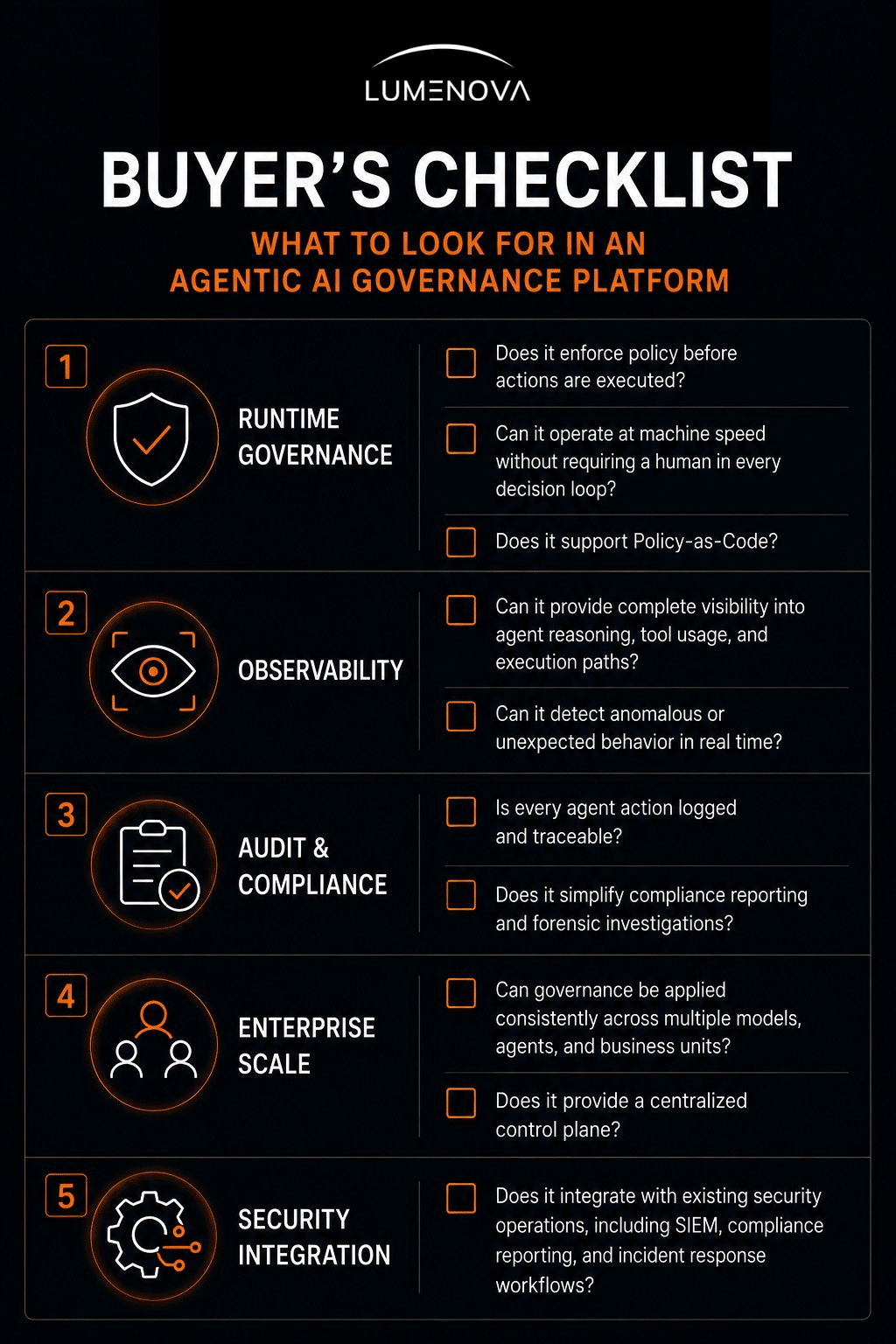
Buyer’s Checklist: What to Look for in an Agentic AI Governance Platform
While agentic AI adoption accelerates, organizations should evaluate governance platforms using security-first criteria.
The checklist below highlights the core capabilities organizations should evaluate accordingly to ensure AI agents operate securely, transparently, and at enterprise scale.
Runtime Governance
- Does it enforce policy before actions are executed?
- Can it operate at machine speed without requiring a human in every decision loop?
- Does it support Policy-as-Code?
Observability
- Can it provide complete visibility into agent reasoning, tool usage, and execution paths?
- Can it detect anomalous or unexpected behavior in real time?
Audit & Compliance
- Is every agent action logged and traceable?
- Does it simplify compliance reporting and forensic investigations?
Enterprise Scale
- Can governance be applied consistently across multiple models, agents, and business units?
- Does it provide a centralized control plane?
Security Integration
- Does it integrate with existing security operations, including SIEM, compliance reporting, and incident response workflows?
Organizations that answer “yes” to these questions will be significantly better positioned to deploy agentic AI securely and responsibly.
Conclusion
Agentic AI represents a significant shift in enterprise computing. Autonomous systems can improve productivity, accelerate decision-making, and automate increasingly sophisticated workflows.
But autonomy also introduces a new class of cybersecurity risk.
Organizations need governance that is embedded directly into runtime operations through automated guardrails, real-time observability, comprehensive auditability, and centralized policy enforcement.
Lumenova AI helps enterprises operationalize that foundation, enabling organizations to deploy agentic AI confidently with continuous policy enforcement, end-to-end observability, and enterprise-grade governance built specifically for autonomous systems.
Ready to secure your agentic AI deployments?
Book a discovery call with Lumenova AI to learn how to automate AI governance, enforce runtime guardrails, gain end-to-end visibility into autonomous agents, and scale AI securely across your enterprise.
Frequently Asked Questions
Yes. Depending on the use case, agentic AI can execute tasks autonomously. Organizations should define policies that determine when agents can act independently and when human approval is required.
By combining AI autonomy with continuous governance. Runtime policies, least-privilege access, real-time monitoring, and audit trails allow agents to operate safely without slowing innovation.
Not entirely. Traditional security tools protect infrastructure, but agentic AI also requires runtime policy enforcement, observability, and governance controls designed for autonomous systems.
Validate agent behavior through pre-deployment evaluations, define governance policies and permissions, and implement continuous monitoring before granting agents access to enterprise systems.