November 5, 2026
Red Team, Blue Team, Purple Team for AI Systems: What Each Actually Does, and Why Red Teaming Alone Is Not a Control
Contents
Key Takeaways
- Three functions, three jobs. Red teaming tests and finds [2.1]where an AI system can fail. Blue teaming identifies, contains and remediates failures in production. Purple teaming turns each finding into a lasting control.
- Red teaming alone leaves the risk open. It describes the system on the day it was tested. Detections, guardrails and regression tests keep working after every model, prompt or tool change. Guardrails and other controls catch the failures a team anticipated. Red team retests after system changes and post-session evaluations in production surface new ones, and purple teaming turns findings from both into the controls that are still missing.
- Each function needs an owner and evidence. NIST AI RMF, ISO/IEC 42001 and the EU AI Act all ask for testing and monitoring, and each function should map to a named owner and an audit artifact.
- Start with the team you have. Many organizations can extend their security function with AI-specific detection tools and methods instead of building two new teams.
In cybersecurity, red, blue and purple teams split the work: the red team attacks to find weaknesses, the blue team detects and contains real attacks, and the purple team turns each red team and blue team finding into something the blue team can catch. In AI security,the red side has been built out far more than the blue side. Blue team AI security has no settled definition, and in many organizations no owner.
This gap matters because red teaming is point-in-time and LLM systems do not stay still. Models are updated, prompts rewritten and agents given new tools, and each change can reopen a weakness not tested last quarter. A finding becomes a control only once it is turned into a detection, a guardrail or a regression test.
This article defines all three functions and how they differ, details the work an AI blue team does in production, and follows one finding through the purple team loop, from report to regression test. It also names the owner, evidence and framework requirement behind each function, and gives a realistic first step for organizations that have neither team.
AI systems follow two kinds of rules. Security guardrails protect systems and data from misuse and alteration, and security architecture usually defines them. Business and application rules define what a specific application may do for its users. These rules often come with conditions and prerequisites, so application owners usually write them as policy as code, working with business and governance stakeholders. In this article, “guardrail” refers to the runtime check that enforces either kind of rule, and “control” covers guardrails, policy rules, detections and regression tests.
What Is AI Red Teaming?
AI red teaming is adversarial testing of an AI system to find where it can be made to fail, leak data or act outside its intended scope, before a real attacker or user does.
For LLM applications and AI agents, red teams typically test for:
- direct prompt injection and jailbreaks
- indirect prompt injection, where instructions are hidden in documents, web pages or emails the system retrieves
- sensitive data disclosure, including system prompt leakage
- tool misuse and privilege abuse by manipulated agents
- harmful or policy-breaking output
Test plans often draw on public catalogs of known AI risks and attack techniques, such as the OWASP Top 10 for LLM Applications and MITRE ATLAS. Testing can be manual or automated, and some automated testing is agent-based: a testing agent can read the target system’s documentation, then send live requests the way a real user or attacker would. The output is a findings report, covering what failed, how to reproduce it and how severe it is.
That report describes the system at the moment it was tested. It does not stop the same attack from working next week. That is where the blue team’s work begins.
What Is Blue Teaming in AI?
AI blue teaming is the defensive discipline that detects, contains and remediates failures in AI systems once they are in production. It covers LLM applications, retrieval-augmented systems and AI agents, and it runs continuously for as long as the system is live.
Blue team AI security builds on the same foundations as a traditional security operations function: monitoring, detection rules, escalation and incident response. Four things change when the system being defended is an LLM application or agent:
- The evidence is a trace. Investigations start from the record of a single interaction: the prompt, the retrieved context, each tool call and the final output. Network and endpoint logs rarely show what the model was told or why it acted.
- Attacks arrive in natural language. A malicious instruction can look like an ordinary request, so signature-based detection catches little of it.
- Behavior varies. The same input can produce different outputs, so one clean result says little about the next one.
- The attacker may never touch the system. Instructions planted in a document, web page or email can reach the model through retrieval.
Defensive AI can mean two things: protecting AI systems, or using AI to protect other systems. This article uses the first meaning.
How Is AI Blue Teaming Different From Red Teaming?
Blue Teaming and Purple Teaming are relatively new terms in AI security. They describe the separate functions needed to keep LLM applications and agents safe once they run in production. The need is sharper for agents because they take actions: a manipulated agent can cause immediate harm while a manipulating chatbot mostly returns less reliable information. Purple Teaming connects the other two, and the table below compares all three.
| Aspect | Red teaming | Blue teaming | Purple teaming |
| Objective | Find weaknesses before attackers or users do | Detect, contain and remediate failures in production | Turn each finding into a lasting control |
| Core question | Where can this system be made to fail? | Is something going wrong right now? | Will we catch this attack next time? |
| Cadence | Point-in-time, in scheduled exercises and pre-release testing | Continuous, for as long as the system is live | After every confirmed finding, and after every model, prompt or tool change |
| Primary outputs | Findings with reproduction steps and severity ratings | Detections, tuned guardrails, escalation paths and incident records | Verified fixes and regression tests |
| How success is measured | Serious weaknesses found before attackers find them | Time to detect and contain, with a manageable false positive rate | Share of findings closed by controls verified with realtime evaluations and trace logs |
The clearest differences are timing and output. Red teaming usually runs before or between releases and produces findings. Blue teaming runs continuously in production and produces detections, guardrails and incident responses. Purple teaming is the working loop between the two: it takes a finding and returns a control that has been tested against the original attack. The two functions depend on each other. Without a blue team, red team findings often sit in a report with no owner. Without a red team, the blue team mostly learns about new attacks after they reach production.
What Does an AI Blue Team Do?
An AI Blue team does five jobs: it builds detections, tunes guardrails, owns escalation, runs incident response, and maintains the evaluation suite. It is the operational side of AI security and working within a clear split of duties. The Purple team analyses failure data and defines the controls and design requirements a system needs. Application developers then build and implement them. The Blue team regression tests each fix against the failures it addresses, moves it to production and monitors the production runs. When something abnormal shows up, it reports it to the Purple team so a new fix can be defined.
The Blue team also designs the evaluations and test causes used for validation testing. The Purple team then reviews production traces, evaluation results, and system logs to confirm that each fix works. This keeps the team that ships a fix separate from the team that confirms it.
1. Building Detections for Prompt Injection, Exfiltration and Anomalous Tool Use
Security detection engineering for AI applies an existing discipline to a new data source: the traces an LLM system produces. A detection is a rule or model that flags a pattern in those traces, such as an instruction hidden in a retrieved document or a tool call to an unfamiliar destination. Teams that already map alerts to MITRE ATT&CK can map AI detections to MITRE ATLAS, which uses the same structure of tactics and techniques.
| Threat | Signal in the trace | Typical response | Reference |
| Direct prompt injection | User input that tells the model to ignore its instructions or change its role | Block at the input guardrail; alert on repeated attempts | OWASP LLM01 |
| Indirect prompt injection | Instruction-like text in a retrieved document, page or email, followed by a change in the agent’s plan | Isolate the source; block the resulting action | OWASP LLM01, ASI01 |
| Data exfiltration | Personal data, credentials or internal records in an output or in tool-call parameters | Redact or block; review the session | OWASP LLM02 |
| Anomalous tool use | A tool the task does not need, an unusual call sequence, a spike in volume or a new destination | Require approval; rate-limit or revoke the permission | OWASP LLM03, ASI02 |
| Hidden context leakage | System prompt text, hidden instructions, keys or tokens in an output | Block the output; rotate exposed credentials | OWASP LLM08 |
References are entries in the OWASP Top 10 for LLM Applications 2026 (LLM) and the OWASP Top 10 for Agentic Applications 2026 (ASI).
2. Tuning AI Guardrails and Thresholds
An AI guardrail is a control that checks inputs, outputs or tool calls in real time and blocks, rewrites or flags anything that breaks a policy. That policy can be a security rule or a business rule written as policy as code. Every guardrail trades false positives against false negatives. Set it too tight and it blocks legitimate users; set it too loose and attacks pass. The blue team sets thresholds per use case, since a customer-facing agent with refund permissions needs a stricter setting than an internal summarizer. Each change goes into a configuration log, which later serves as evidence.
3. Owning the Escalation Path When a Guardrail Fires
When a guardrail fires, someone has to decide what happens next. That decision belongs to the owner of the rule: security architecture for most security guardrails, and the application owner for business rules. For each rule, the owner chooses one of three outcomes in advance: block the request, flag it for later review, or pause the action until a person approves it. The blue team then runs the escalation path. It monitors alerts, notifies the right people within agreed response times and reports anything unusual to the purple team. Without that path, alerts pile up and nobody acts on them.
4. AI Incident Response for AI Agents
In AI incident response, the trace is the primary evidence. It shows the prompt, the retrieved context, each tool call with its parameters, the output, and the model and prompt versions in use. Some platforms, including Lumenova AI, also keep session evaluation logs. These analyze every trace in a session automatically and highlight failures and poor practices for review. Containment options are specific to AI systems:
- revoke the agent’s tool permissions
- disable the agent
- roll back to an earlier model or prompt version
- quarantine a poisoned retrieval source
After containment comes root cause analysis and, where regulation requires it, incident reporting. Recent agentic AI security incidents show how quickly an agent’s mistake becomes an executed action.
5. Feeding Every Confirmed Finding Back Into the Evaluation Suite
Every confirmed attack, whether the red team found it or the blue team caught it in production, becomes a test case in the evaluation suite. The blue team keeps that suite up to date, including its test cases, scenarios and automated evaluation prompts. The suite runs before each release and after every model, prompt or tool change, so a fixed weakness cannot quietly return. This is continuous defensive testing: the system is checked against every attack it has already faced, every time it changes.
What Is Purple Teaming for AI Systems?
Purple teaming for AI systems is the shared process that starts with a confirmed red team finding and ends when a tested control is in place.
It is usually a working practice the two teams share, without a dedicated team of its own. It runs as a loop:
- The red team confirms a finding and records how to reproduce it.
- The blue team reproduces the attack and locates it in the trace.
- The blue team builds a detection, a guardrail, or both.
- The original attack is replayed to confirm it is now blocked.
- The attack and its variants become regression tests in the evaluation suite.
- The tests re-run after every model, prompt, tool or data change.
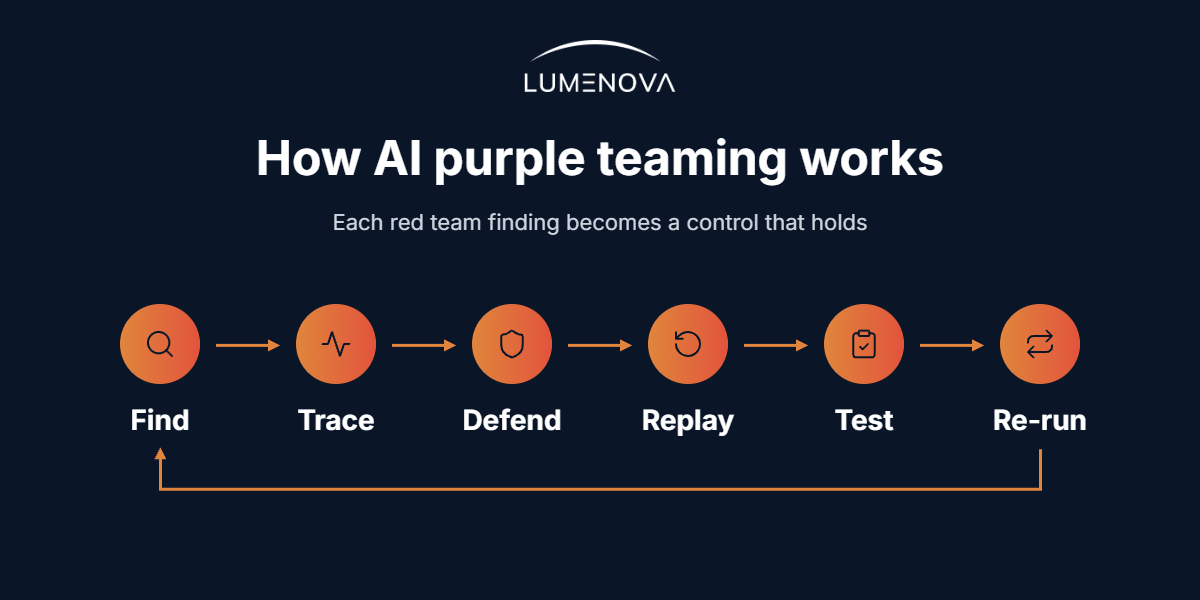
The loop is the core of continuous defensive testing. A finding closes when step 4 passes, and it stays closed for as long as step 6 keeps running.
Example Scenario: One Finding, Followed to a Control
In a hypothetical test, a red team plants hidden instructions in a knowledge base article. When a customer support agent retrieves the article, it follows the instructions and emails customer records to an outside address.
The blue team responds with:
- a detection for retrieved instructions followed by an outbound tool call carrying record data
- a guardrail limiting the email tool to approved domains
- an escalation path and an incident runbook
The original attack is replayed and blocked. It then joins the evaluation suite, with variants, and runs on every release. Each step leaves evidence: the finding, the detection rule, the configuration change, the replay result and the test history.
Why Red Teaming Alone Is Not a Control
An LLM-based assistant tested in January is a different system by April. Its model has been upgraded, its prompts rewritten and new tools connected. The January findings describe a system that no longer exists, and nobody can say which of them are open again.
That is the limit of red teaming on its own. In security and audit terms, a control prevents, detects or corrects a failure and leaves evidence that it did. A report can show where a control is needed, but it cannot act as one.
A finding becomes a control only once it is turned into a detection, a guardrail or a regression test. Until then, the organization knows about the risk and is still exposed to it.
An annual red team exercise shows how the system held up once. Detection, guardrails and regression tests show how it holds up every day after that.
Red, Blue and Purple Across the AI Stack
Each function has a different job at each layer of an AI system, from the model to the response a user sees.
| Layer | Red teaming tests | Blue teaming owns | Purple teaming keeps |
| Model | Jailbreaks and unsafe behavior, especially after a model update | Behavior monitoring across model versions, and the rollback path | Every successful jailbreak as a test case |
| System prompt and context | Attempts to extract or override hidden instructions | The prompt change log and alerts on leaked prompt text | Extraction attempts, re-run after every prompt change |
| Retrieval | Instructions planted in documents the system retrieves | The list of approved sources and the power to quarantine one | Poisoned documents in the test set |
| Tools and agent permissions | Calls to tools the agent should not use, or with the wrong parameters | Permission settings for each tool, kept to least privilege | Tool misuse cases, replayed after any permission change |
| Outputs | Harmful, false or data-leaking responses | Output guardrail thresholds and the escalation when they fire | Known bad outputs, re-tested on every release |
The Framework Requirements Behind Each Function
The NIST AI RMF, ISO/IEC 42001 and the EU AI Act all ask for testing, monitoring and improvement. Mapping the three functions to those requirements gives each one an owner and evidence an auditor can check.
| Function | NIST AI RMF | ISO/IEC 42001 | EU AI Act |
| AI Red Teaming | MEASURE 2.7: security and resilience evaluated and documented | A.6.2.4: verification and validation | Art. 9 (testing) and Art. 15 (robustness and cybersecurity); Art. 55 adversarial testing for general-purpose models with systemic risk |
| AI Blue Teaming | MEASURE 2.4 and MANAGE 4.1: production monitoring and incident response; MANAGE 2.4: disengage or deactivate; MANAGE 4.3: incident communication | A.6.2.6: operation and monitoring; A.6.2.8: event logs; A.8.4: communication of incidents | Art. 12 (logging), Art. 26 (deployer monitoring and log retention), Art. 72 (post-market monitoring), Art. 73 (serious incident reporting) |
| Purple Teaming | MEASURE 3.1: tracking emerging risks; MANAGE 2.3: responding to previously unknown risks | Clause 10: continual improvement and corrective action | Art. 72: findings fed back into post-market monitoring |
NIST AI 600-1, the Generative AI Profile of the AI RMF, applies the framework to generative AI and lists pre-deployment testing and incident disclosure among its primary considerations.
Timing matters for EU deployments. The Digital Omnibus (Regulation (EU) 2026/1744) moved high-risk obligations, including post-market monitoring and incident reporting, to 2 December 2027 for Annex III systems and 2 August 2028 for Annex I systems. Obligations for general-purpose models with systemic risk, including adversarial testing, already apply. Organizations aligning with ISO 42001 can reuse much of the same evidence for EU AI Act compliance, though the two do not map one to one.
Where to Start if You Have Neither an AI Red Team nor an AI Blue Team
Most enterprises have neither, and building two new teams is rarely the right first move. The faster route is to extend the security function you already have. The people who write detections and handle incidents today can cover AI systems once they can see AI traces and know what to look for.
A realistic starting sequence:
- Inventory your AI systems [LINK: AI Inventory glossary, URL pending]. List every LLM application and agent, the data it can reach and the tools it can call, then rank them by risk.
- Route traces to your security team. Send AI traces to the place analysts already work, so AI activity sits next to other security events.
- Write the first detections. Start with prompt injection, data exfiltration and anomalous tool use. This is security detection engineering applied to a new data source.
- Name an owner and an escalation path. One person owns the guardrail settings, and every alert has a defined route.
- Test the riskiest system and keep the results. Run one scoped red team exercise on the highest-risk system, and turn each confirmed finding into a regression test.
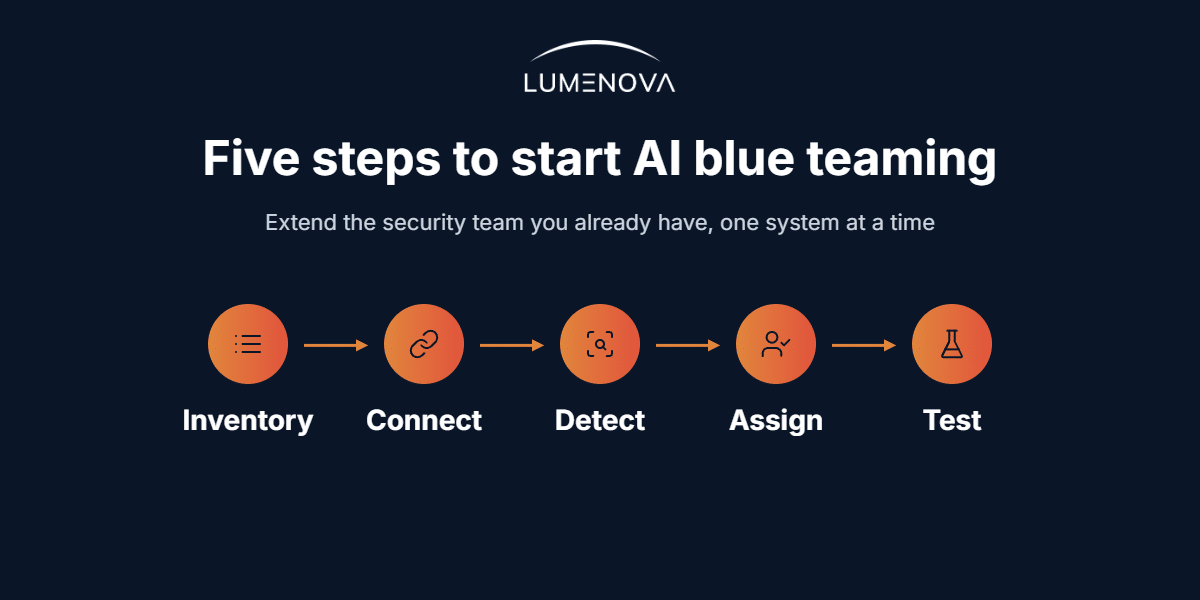
From there, blue team AI security grows one system at a time.
How Lumenova AI Turns Red Team Findings Into Controls
Lumenova AI covers all three functions in one platform, so each finding, the control that answers it and the proof that the control works sit in one record.
- Red teaming: a testing agent reads the system’s documentation, then sends live requests the way a real user or attacker would. It probes any agent’s endpoint, including vendor and no-code agents, with templates built on OWASP and MITRE ATLAS and no code access needed.
- Guardrails and real-time controls: these form the enforcement layer the blue team owns. The evidence from a finding can be drafted into a policy, which a person reviews and activates.
- Observability and traces: every LLM call, tool call and retrieval step becomes an OpenTelemetry trace, which can also flow to tools such as Datadog or Splunk.
- Evaluations: each confirmed finding becomes a reusable regression check. A finding counts as verified only when the replayed attack fails.
Turn red team findings into controls that hold
Request Demo
Frequently Asked Questions
Before its first release, after any major change to the model, prompts, tools or data, and on a schedule that matches the system’s risk. Between exercises, saved regression tests re-run automatically after every change.
Not at the start. Many organizations extend their existing security operations function with AI-specific detections once analysts can see AI traces. A dedicated team makes sense as the number of AI systems and their risk grow.
Traces. A trace records the prompt, the retrieved context, each tool call with its parameters, the output, and the model and prompt versions in use. Network and endpoint logs rarely show what the model was told or why it acted.