July 28, 2026
Mid-2026 Enterprise AI Adoption News: Market Growth, Agentic Systems, and the Governance Gap
Contents
Key Takeaways
- Enterprise AI adoption is accelerating, but governance has become the biggest barrier to scaling AI initiatives.
- Financial services, banking, insurance, and healthcare are leading adoption due to high-value use cases and evolving regulatory requirements.
- The rapid rise of Agentic AI is exposing a governance gap, making automated oversight and continuous monitoring essential for enterprise-scale deployment.
- Organizations that modernize AI governance will be better positioned to deploy AI safely, accelerate innovation, and maintain compliance.
Enterprise AI Adoption: The Market Is Entering A New Growth Phase
The enterprise AI market continues to expand rapidly as organizations integrate AI into customer service, operations, cybersecurity, software development, finance, and healthcare workflows. According to McKinsey’s 2025 State of AI survey, 88% of organizations now regularly use AI in at least one business function, up from 78% the previous year. However, only about one-third report that they have begun scaling AI across the enterprise, highlighting the growing gap between experimentation and enterprise-wide deployment.
This finding is reinforced by McKinsey’s State of AI Trust in 2026, which found that only about 30% of organizations have reached higher maturity levels in AI strategy, governance, and agentic AI controls, despite continued improvements in overall AI trust maturity.
Industry analysts expect enterprise AI spending to accelerate significantly over the next five years. Gartner forecasts worldwide AI spending will reach $2.59 trillion in 2026, up 47% year over year, with continued growth driven by AI infrastructure, software, services, and agentic AI workloads.
Several trends are driving this momentum:
- Enterprise adoption of Agentic AI and autonomous workflows (Deloitte)
- Growing investment in AI governance platforms (Gartner)
- Expansion of outcome-focused AI workflow orchestration (Gartner)
- Increasing adoption of domain-specific Small Language Models (SLMs) (Gartner)
- Greater executive focus on measurable business outcomes and ROI (McKinsey)
The conversation has shifted from “Should we adopt AI?” to “How do we deploy AI safely across the enterprise?”
That distinction represents one of the biggest developments in enterprise AI adoption news throughout 2026.
How Is the Enterprise AI Market Expected to Grow in the Next Five Years?
The next five years are expected to reshape enterprise software entirely.
Enterprise AI investment continues to accelerate as organizations expand from departmental implementations to company-wide AI platforms. According to IDC, enterprise spending on Agentic AI is becoming increasingly business-led, with investment expected to nearly double at the highest budget tiers by 2027.
As enterprises scale AI, investment priorities increasingly include:
- AI governance
- Risk mitigation
- Compliance automation
- AI security risks
- Model monitoring
- Agentic AI infrastructure
- Workflow orchestration
Rather than purchasing isolated AI tools, enterprises are increasingly investing in integrated platforms capable of managing the complete AI lifecycle, from model development and validation to deployment, monitoring, auditing, and continuous improvement.
This evolution mirrors previous enterprise software transformations, where centralized platforms replaced fragmented point solutions.
As AI systems become business-critical, governance platforms are expected to become as essential as cybersecurity or identity management systems.
Which Industries Are Leading the Adoption of AI in Enterprises?
While AI adoption spans nearly every industry, heavily regulated sectors continue to lead enterprise deployment because the business value is substantial and operational efficiencies are significant.
Financial Services, Banking & Investment
Banks and financial institutions are using AI to transform operations through:
- Fraud detection
- Credit underwriting
- Risk assessment
- Regulatory reporting
- Customer support
- Portfolio management
Because financial institutions operate under extensive regulatory oversight, explainability, auditability, and continuous monitoring have become essential for production AI systems. As AI adoption accelerates, organizations are increasingly investing in governance platforms that help manage AI risk while supporting innovation.
Learn how Lumenova AI helps financial institutions deploy responsible AI through its Banking & Investment solutions.
Insurance
Insurance companies leverage AI for:
- Claims automation
- Underwriting
- Policy recommendations
- Fraud investigation
- Customer engagement
As insurers deploy more AI-driven decision systems, automated AI governance has become critical for maintaining regulatory compliance and reducing operational risk.
Explore how Lumenova AI supports responsible AI adoption in the insurance sector through its Insurance solutions.
Healthcare
Healthcare organizations continue expanding AI across:
- Clinical documentation
- Medical imaging
- Patient scheduling
- Administrative automation
- Diagnostic assistance
However, healthcare remains one of the most highly regulated industries, requiring extensive validation, privacy protections, bias assessments, and ongoing monitoring before production deployment.
The result is a strong demand for governance solutions that accelerate approvals without compromising safety.
Lumenova AI helps healthcare and life sciences organizations accelerate AI innovation while maintaining compliance through its Health & Life Sciences solutions.
AI Adoption in Enterprises: Why Are Companies Lagging?
Despite increased investment, many organizations remain stuck between experimentation and enterprise deployment. Several recurring challenges explain why AI adoption in enterprises often progresses more slowly than expected.
1. Slow Internal Reviews
Many organizations still rely on manual governance processes.
Every new AI application may require reviews from:
- Legal
- Compliance
- Information security
- Privacy
- Risk management
- Business stakeholders
As AI initiatives multiply, these reviews create substantial bottlenecks.
2. Fragmented Oversight
Different business units frequently evaluate AI independently.
Without centralized governance:
- Risk assessments become inconsistent.
- Documentation is duplicated.
- Policies vary across departments.
- Audit readiness declines.
Organizations often discover they lack complete visibility into where AI is being used across the enterprise.
3. Regulatory Uncertainty
The regulatory landscape continues evolving globally.
Organizations must account for:
- Emerging AI legislation
- Industry-specific regulations
- Privacy requirements
- Model transparency expectations
- Documentation obligations
Many executives delay deployment simply because governance requirements remain unclear.
4. Scaling Human-in-the-Loop Processes
Human review remains essential for many high-risk AI applications. However, manual approval processes do not scale efficiently.
As enterprises expand from dozens of AI systems to hundreds or thousands, governance teams become overwhelmed.
This is increasingly viewed as one of the largest operational barriers to enterprise AI adoption.
The Governance Gap Holding Agentic AI Back
The greatest obstacle to enterprise Agentic AI is no longer model performance or technical capability. It is governance.
Organizations are moving quickly toward autonomous AI systems. According to Deloitte’s 2026 State of AI in the Enterprise, 74% of organizations expect to deploy Agentic AI within the next two years, yet only a small minority have established mature governance frameworks capable of managing autonomous agents at scale. This widening gap between adoption and oversight is becoming one of the biggest risks facing enterprise AI initiatives.
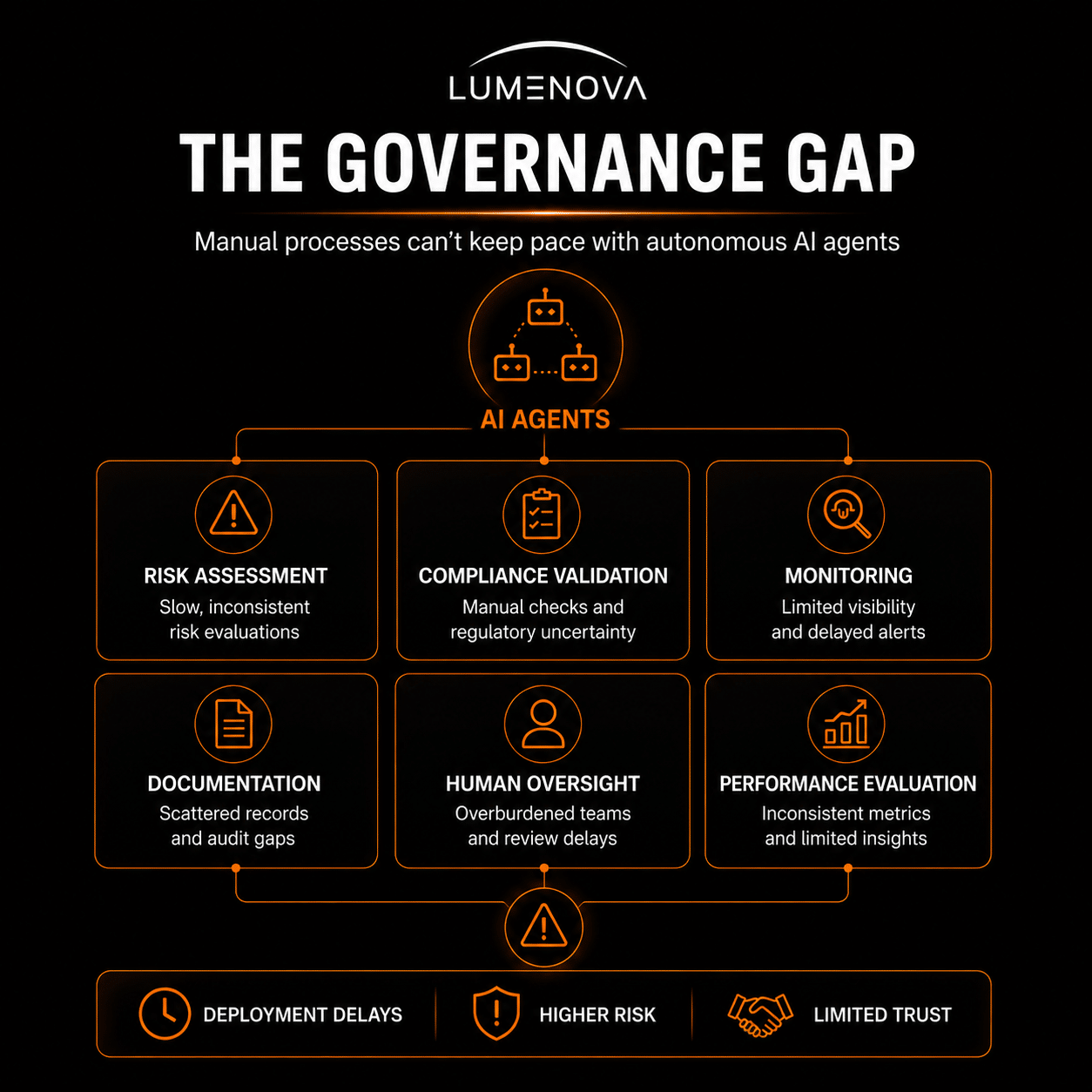
Every AI agent introduced into an enterprise increases the complexity of governance by requiring:
- Risk assessments to identify potential operational, legal, and ethical risks.
- Compliance validation against evolving regulations and internal AI policies.
- Continuous monitoring to detect model drift, unexpected behavior, and emerging vulnerabilities.
- Comprehensive documentation for auditability, transparency, and regulatory reporting.
- Human oversight for high-impact or high-risk decisions where accountability must remain with people.
- Performance evaluation to ensure AI agents consistently deliver accurate, reliable, and measurable business outcomes.
Unfortunately, these governance activities remain highly manual in many organizations. Human review boards, disconnected documentation, siloed compliance processes, and spreadsheet-based tracking simply cannot keep pace with hundreds (or eventually thousands) of AI agents operating continuously across multiple business functions.
The consequences are already becoming apparent. A recent enterprise survey found that while 86% of organizations have moved beyond AI pilots into production, only 34% say they trust the actions of their AI agents, highlighting that governance, data quality, and operational controls are now the primary barriers to enterprise-scale deployment.
As Gartner and other industry analysts continue to emphasize throughout the latest enterprise AI adoption news, the organizations that succeed with Agentic AI will not necessarily be those deploying the most agents, but those that can govern them effectively.
What Is the Future of Enterprise Software With AI?
Enterprise software is undergoing its most significant transformation since the rise of cloud computing. Rather than simply embedding AI into existing applications, organizations are rethinking how work gets done, from fragmented, application-centric workflows to intelligent, agent-driven systems that can coordinate complex business processes autonomously.
1. The Rise of “Headless” Software and AI Agents
According to Gartner, enterprises are shifting from assistive AI toward outcome-focused workflows, where employees spend less time navigating applications and more time directing AI agents through natural language. In this model, traditional enterprise systems remain the trusted systems of record, while AI-powered systems of reasoning orchestrate tasks across multiple applications to achieve business outcomes.
In this emerging architecture:
- Systems of Record such as ERP, CRM, and HR platforms continue to securely manage enterprise data, transactions, and compliance.
- Systems of Reasoning powered by AI agents sit on top of these applications, interpreting goals, coordinating workflows, and executing multi-step tasks across the organization.
At the same time, enterprises are moving beyond general-purpose large language models by deploying domain-specific Small Language Models (SLMs) that deliver greater accuracy, lower latency, reduced costs, and fewer hallucinations for specialized business use cases.
2. The Shift from SaaS to “Services-as-Software”
The traditional per-seat SaaS licensing model is beginning to evolve as AI agents take on work previously performed by employees.
Instead of measuring software value by the number of user licenses, organizations are increasingly evaluating platforms based on business outcomes and operational efficiency.
Key trends include:
- Outcome-based pricing tied to measurable business value rather than software access.
- Consumption-based models that align costs with AI usage and delivered results.
- Agentic value creation, where software is judged by its ability to autonomously execute complex workflows, reduce manual effort, and accelerate decision-making.
This marks a shift from purchasing software tools to investing in intelligent services that continuously generate business value.
SEE ALSO: Controlling AI Agent Infrastructure Costs: What Every Team Lead Needs to Know Before Scaling Agents
3. Structural Transformation, Not Feature Addition
One of the biggest themes emerging from enterprise AI adoption news is that simply bolting AI features onto legacy applications rarely delivers meaningful business value. Instead, leading organizations are fundamentally redesigning end-to-end operations around AI, embedding intelligence into core business processes rather than treating it as an add-on.
This transformation includes:
- Deliberate business process reinvention by redesigning workflows around AI instead of automating isolated tasks.
- AI-native operating models that integrate autonomous agents into day-to-day operations, enabling cross-functional collaboration and intelligent decision-making.
- Governance by design, embedding risk management, AI compliance, security, and policy enforcement directly into AI development and deployment pipelines rather than treating governance as a final approval step.
- Continuous monitoring and observability to track model performance, detect drift, identify emerging risks, and maintain regulatory compliance throughout the AI lifecycle.
- Human oversight for high-impact decisions, ensuring AI agents remain accountable, transparent, and aligned with organizational objectives through scalable human-in-the-loop controls.
As autonomous AI agents take on increasingly complex business functions, governance becomes foundational rather than optional. The future of enterprise software will not be defined by standalone AI features, but by intelligent, governed ecosystems where AI agents orchestrate work across enterprise systems while humans provide strategic direction and oversight.
This shift represents the next major milestone in enterprise AI adoption, moving organizations from disconnected AI experiments to scalable, enterprise-wide transformation.
Turning Governance Into a Competitive Advantage
Organizations that successfully scale AI are increasingly investing in governance platforms that automate repetitive compliance activities while providing continuous visibility into AI systems.
| Traditional AI Governance | Modern AI Governance |
| Manual approvals and fragmented reviews | Automated governance workflows |
| Spreadsheets and disconnected documentation | Centralized AI inventory and documentation |
| Point-in-time compliance checks | Continuous AI observability and monitoring |
| Inconsistent policy enforcement | Standardized governance across the AI lifecycle |
| Reactive audit preparation | Continuous audit readiness and evidence collection |
| Slower AI deployment | Faster, more confident enterprise AI adoption |
Lumenova AI addresses this challenge through a combination of continuous AI observability, automated governance workflows, and a dedicated Forward Deploy Team that works directly with enterprise customers to accelerate implementation. By helping organizations standardize governance across the AI lifecycle, our platform enables enterprises to move from experimentation to production with greater confidence.
Final Thoughts
The latest enterprise AI adoption news makes one trend unmistakably clear: the next wave of competitive advantage will not come from simply building more AI models. It will come from deploying them safely, consistently, and at enterprise scale.
The enterprise AI market is entering a period of sustained growth driven by increasing investment, expanding use cases, and the emergence of Agentic AI. For many organizations, the biggest obstacle is no longer access to AI technology. It is replacing fragmented, manual oversight with automated governance that supports innovation without sacrificing compliance or trust.
As enterprise software evolves toward intelligent, autonomous systems, organizations that establish scalable AI governance today will be best positioned to capture tomorrow’s opportunities.
For enterprises looking to accelerate AI adoption without increasing regulatory or operational risk, Lumenova AI stands out as a trusted governance partner.
Book a discovery call with the Lumenova AI team, or take the Agentic AI Risk and Governance Assessment to uncover governance gaps, strengthen oversight, and ensure your AI initiatives are prepared for enterprise-scale deployment before risks become costly.
Frequently Asked Questions
AI-ready organizations have strong data foundations, executive support, scalable infrastructure, skilled teams, and governance processes that enable AI to scale responsibly.
Building trust requires transparency, continuous monitoring, human oversight, and clear accountability. Organizations that regularly evaluate AI performance and manage risks proactively are more likely to achieve successful long-term adoption.
Enterprises should establish governance frameworks that support documentation, risk assessments, audit readiness, and ongoing compliance. Taking a proactive approach makes it easier to adapt as new AI regulations emerge.
Organizations should invest in governance, data quality, continuous monitoring, and scalable AI infrastructure to support the next generation of intelligent, autonomous systems.